
Already, Things are Off to a Rocky Start, Epiphany, Matthew 2:1-12

I was recently reminded that the church calendar is not always as fluid as we would like it to be.  The church liturgical year began on December 3 with the season of Advent. Advent is a time of preparation. It’s a time of patient waiting for the birth of the Christ-child. Sometimes the actual dates make it a challenge to plan for as Bryan and I were recently reminded. You see this planning conundrum showed itself on December 24th which happened to be both the fourth Sunday of Advent but also Christmas Eve. It forces us to ask ourselves, “Do we axe the fourth Sunday of Advent that morning and go straight into Christmas Eve and into the birthing mode or do we dally in Advent just a bit longer highlighting the need for patient waiting for Jesus’ birth?”

This year we tarried a bit longer.  For the morning of December 24th, we followed the recommended texts and hymns for the morning of the fourth Sunday of Advent and those are not what you would call Christmassy texts and carols. Advent Four is still about waiting patiently for the birth. As every parent knows, you can’t rush a birth. When a woman enters into labor, she quickly learns the baby has a mind of its own and will be born when it is ready. That’s the power of Advent.  We have to wait for when the Christ is ready to come. So, for the person who sent us a cordial email over the weekend expressing your gross disappointment about the lack of Christmas carols and birth texts on the morning of December 24th, I feel your pain. Mary and baby Jesus weren’t ready yet.

This morning poses a similar dilemma for those of us who order worship. The Christian liturgical calendar has two celebrations over two consecutive days. Yesterday, after the twelve days of Christmas, the Church celebrated Epiphany, and the Sunday after Epiphany, the Church celebrates Jesus’ baptism. So, we are forced to wrestle with – do we commemorate Epiphany, or do we celebrate Jesus’ baptism? This year, I chose Epiphany. So, for those of you who were looking forward to remembering Jesus’ baptism this morning and singing all those wonderfully well-known baptism hymns, I apologize!  We are looking at the arrival of the Magi this morning because oftentimes this particular Sunday is “Three Kings Sunday.  Listen to the Word of the Lord from Matthew 1:1-12.

Matthew 2:1-12

2.1 In the time of King Herod, after Jesus was born in Bethlehem of Judea, wise men from the East came to Jerusalem, 2asking, “Where is the child who has been born king of the Jews? For we observed his star at its rising and have come to pay him homage.” 3When King Herod heard this, he was frightened, and all Jerusalem with him; 4and calling together all the chief priests and scribes of the people, he inquired of them where the Messiah was to be born. 5They told him, “In Bethlehem of Judea; for so it has been written by the prophet: 6‘And you, Bethlehem, in the land of Judah, are by no means least among the rulers of Judah; for from you shall come a ruler who is to shepherd my people Israel.’” 7Then Herod secretly called for the wise men and learned from them the exact time when the star had appeared. 8Then he sent them to Bethlehem, saying, “Go and search diligently for the child; and when you have found him, bring me word so that I may also go and pay him homage.”

9When they had heard the king, they set out; and there, ahead of them, went the star that they had seen at its rising, until it stopped over the place where the child was. 10When they saw that the star had stopped, they were overwhelmed with joy. 11On entering the house, they saw the child with Mary his mother; and they knelt down and paid him homage. Then, opening their treasure chests, they offered him gifts of gold, frankincense, and myrrh. 12And having been warned in a dream not to return to Herod, they left for their own country by another road.

Already in Jesus’ Story, we see how things get off to a rocky start. It’s a rocky start in our cultural misreading of this Story but it’s also a rocky start for Jesus amid Story time; you see, unbeknownst to Jesus at that time, even as a little boy, he is causing political problems. Culturally, we have misread this text and it’s a wonderful reminder to us that we need to carefully read Scripture as opposed to thinking we already know the Story whereby we don’t really pay attention to the details because “We get the gist of it already.” Just as Herod didn’t know his Jewish scriptures, too many of us are light on our own knowledge of our Christian texts.

To begin with, how many Kings are there in the Story? Three? No, there are only two mentioned – Herod and the newborn King of the Jews. The Persians following the star were not kings but were magi, readers of the stars and nature. They were astrologers.

Next, our Nativity scenes have Jesus in the manger, the cows are lowing and the sheep “baa’ing” and there are the shepherds gathered around the Holy Family and the manger like Tin Man, the Scarecrow, and Lion were around Dorothy’s bed in the Wizard of Oz. Matthew makes it clear that Jesus and his parents were in a house by the time the Magi arrived, not in the manger. The Holy Family was moving on up!

Finally, the time it takes for people walking from today’s country of Iran to Bethlehem would take several months to complete. We have in our imagination that Jesus was still wrapped in swaddling clothes by the time the Magi arrived. In all likelihood, he would have been wearing Huggies by the time they got there.  

An epiphany is a fancy word for a special revelation of something. It’s that moment we have an a-ha experience when we see something we have seen all along but see it in a totally different way. The first epiphany was seen by the Magi as early as when they were still in Persia. Their epiphany was a star that revealed to them there was a birth of a new King in the west.

The second epiphany in our Story is when King Herod realized in his oh-fudge moment there was a political rival afoot. Jesus, just a toddler, was already causing ripples of uneasiness in the established system and empire. He was just a child and he was already making people uncomfortable. Not only was King Herod frightened at the news of this new king, but we read in verse 3 that all Jerusalem was frightened along with him! The everyday Jewish man and woman knew that news of a new Jewish King would bring fierce retribution from Caesar and all of Rome. Jesus, oblivious of it all in his little house in Bethlehem, was already making his people uneasy and causing a fuss. In verse 16 of this same chapter, we read how Herod out of his fear and insecurity sends troops with orders to kill every child two years of age or younger in and around the area of Bethlehem to mitigate the rise of this so-called newborn king.

The Magi’s appearance in Matthew’s gospel does two things. One, it is a celebration that non-Jewish Gentiles from other countries recognized God’s special arrival in the child Jesus. Two, the Magi’s appearance flips over all the finely set carefully planned Christmas tables and causes a mess. You see, when the people hear about and see Jesus, it demands a response from them. From us.  

Yesterday during prayer, I was reflecting upon January 6th and what happened three years ago at our nation’s capital. One politician over the weekend called those who have been convicted for their crimes at the Capital “political hostages” as opposed to criminals who tried to disrupt the peaceful transfer of power in our nation. And then it hit me: January 6th fell and continues to fall on Epiphany, the day of the revealing of our God among us in Jesus. Three years ago, it revealed the tearing fabric of our democracy and the spiritual shallowness our nation has achieved. I am scared to think about what Epiphany will reveal next year about our country and how we understand what it means to be neighbors to one another.

This morning is the invitation to come to the Lord’s Table and receive the precious meal which is an epiphanal moment for us. Through this meal, Jesus reveals to us that we are to love one another as much as God does – and that means giving one’s life and fidelity to what matters most: first to God but then to neighbor. But this meal is also an invitation for you, like the Magi, to look for signs of what epiphany is going to look like in 2025. As they took out on an arduous adventure to seek the newborn king, we are invited to be fed and then released on an adventure in guaranteeing we are spreading as much of God’s graciousness to as many others as we possibly can; we do this so that by this time next year, we will have shown the world what a “Christian nation” really looks like because what we have now is not revealing that at all. Come to the Table and be fed.

In the Name of the One who is, was, and is to come. Amen.

New Revised Standard Version Bible, copyright © 1989 National Council of the Churches of Christ in the United States of America. Used by permission. All rights reserved worldwide. http://nrsvbibles.org

© 2024 Patrick H. Wrisley. Sermon manuscripts are available for the edification of members and friends of First Presbyterian Church of Glens Falls, 8 West Notre Dame Street, Glens Falls, NY 12801, and may not be reproduced or repurposed without permission from the author. All rights reserved.
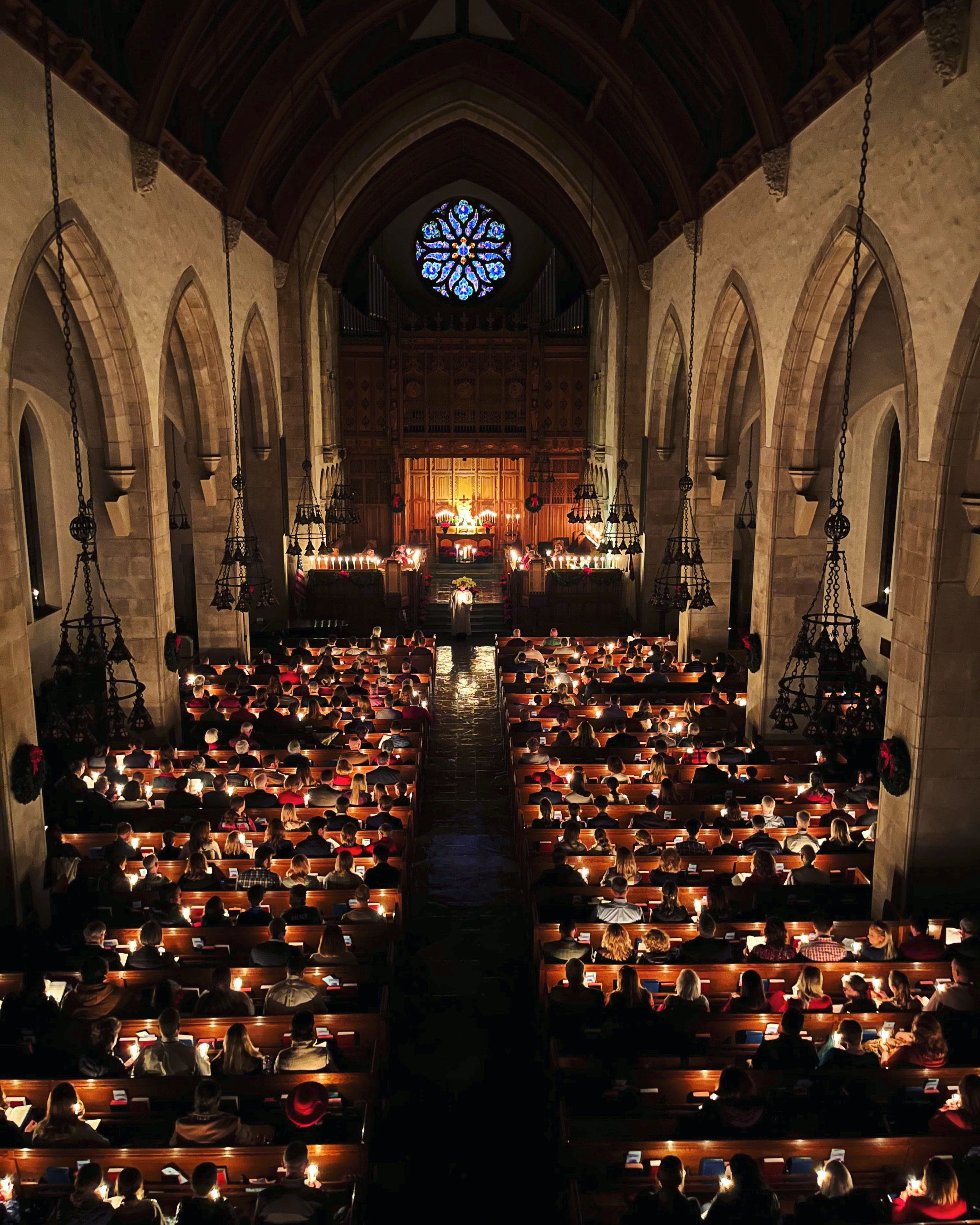
Posted in Sermon | Tagged , , , , , , , , | Leave a comment

New Identity, New Responsibilities; Galatians 4:4-7

       A sermon delivered on December 31, 2023, Year B by Rev. Patrick H. Wrisley, D.Min.

Our text today is a birth narrative written before any of the other birth narratives of Matthew, Mark, or Luke were written. Matthew, Mark, and Luke were storytellers who painstakingly went to lengths to write the Story of Jesus in ways their respective audiences would relate with and remember. Paul, on the other hand, was a Jewish theologian who wrote directly and to the point. His birth narrative is short, and tight, and delivers the gospel promise to all who could hear what he had to say. There is no baby wrapped in swaddling clothes wriggling in a feed trough, there are no Magi who come bearing gifts, or angel appearances declaring great news and tidings of joy. No, Paul cuts straight through to what the Good News of God actually is.

I suppose Paul’s birth narrative is so tight and compact because the stakes were high with the group of Gentile Christians he was writing to in Galatia. Things had started off well enough for them but then what we might call Old School Jews came into the fellowship and started clouding up the message. They began to sow seeds of doubt among their Gentile church members about the legitimacy of their faith. They insisted that if Gentile members were really devout Christians, then they would have to start following the old Jewish Law and Torah which included the necessity of adult male circumcision.

Paul is totally over this corruption of the Gospel message which required certain acts to be followed before they could be loved by God. The previous chapter of our letter begins with Paul exclaiming quite literally, “You stupid Galatians! Who has bewitched you!?” Consequently, Paul goes straight to the point of the Gospel narrative. Turn in your Bible to Galatians 4:4-7. Listen to the Word of the Lord!

4But when the fullness of time had come, God sent his Son, born of a woman, born under the law, 5in order to redeem those who were under the law, so that we might receive adoption as children. 6And because you are children, God has sent the Spirit of his Son into our hearts, crying, “Abba! Father!” 7 So you are no longer a slave but a child, and if a child then also an heir, through God..[1]

Over 25 years ago, there was a young man who was a member of the church I led in Florida and who also began to hang out at my home a good bit. You see, I have two beautiful daughters. Under the auspices of doing “youth group” stuff together, Tyson hung out a lot. During this time, he got pretty familiar with me and called me, “Patrick.” Granted, that is my given name but when you as an adult hear some pimply 15-year-old call you by your first name, well, it just doesn’t feel right. I grew up with the strict instructions everyone older than you was always addressed as “sir” or “ma’am.” Calling an adult by their first name was seen as verboten. Eventually, the true reason for hanging out became evident and he started dating my youngest daughter, Kate. Once their relationship changed, so did mine with Tyson.

I am a firm believer that a daddy of two beautiful daughters has to set boundaries with these boys calling on them at my home. So, if a young man came and had dinner with us, I would smile, ask everyone at the table to hold hands, and then say, “Bobby, it’s a tradition at our house that our guests are given the privilege of saying grace. Please, go ahead.” That was always a fun thing to do watching them be reminded who was in charge. But the other boundary I set was a boundary of respect and that a child addressed an adult as such and not with their first name. So, one day after he’s started going out with my daughter, Kate, he called me ‘Patrick’; I looked at him over my glasses, smiled, and said, “It’s Dr. Wrisley, for you.” I mean, c’mon! I was the dad of the daughter he was dating. I was the pastor of the church he was attending. Boundary set. Boundary noted.

Over time, they continued to date through college and one day he approached me and asked, “Dr. Wrisley, I would like to marry your daughter.” I was thrilled! Of course! By this time, I had known Tyson for years as well as his folks! He was a great young man any father would be thrilled to have as a son-in-law! I enthusiastically told him, “Yes!” and went on to tell him, “And please, call me Dad.”[2]

What changed? Our mutual identities changed. No longer was I his pastor or his girlfriend’s dad; no longer was there a need for a firm boundary of ‘you’re out there and I’m in here.’ No longer was he “that boy” but now he was my son. His identity changed because he was now part of my family and with the change of identity, there was now a new depth of intimacy that wasn’t there before.

Beloved, whereas Matthew’s birth story declares Jesus’ identity as savior when Joesph is told by the angel, “You shall name him Jesus because he will save his people from their sins” and whereas in Luke’s birth account Mary is told that Jesus’ identity will be tied to sitting on the throne of King David,[3] Paul’s birth narrative deals not only with Jesus’ identity but our identity, too. Paul is trying to convince the Galatian Christians that THEY have had an identity change. No longer are they outsiders. No longer were they to be treated as unclean, unworthy participants in the faith community or in the world. No longer were they required to fulfill every edict, every jot and tittle of the Jewish Law. No, in Paul’s understanding, the Galatians were now bona fide, full members of the family of God. Their identity changed: Because Jesus came to rescue all those who were under weight of the Law’s impossible demands, we are now called heirs, sisters and brothers who are a part of the family of God. Jesus is now our brother. We now have inheritance rights we never had before!

This reality hit home for me in a big way while serving in a former church. Kristopher and Robert were the guardians of a little boy of a family member who was not capable of caring for him adequately. Kristopher and Robert took charge of this little boy at an early age and raised him as their own. I will never forget the excitement on their faces as they sent me a picture of the three of them flying to Kentucky to formally adopt this 8-year-old boy as their own son. The next day, they sent another picture with the three of them along with the judge as the boy held a sign, “I have my forever home!”

Everything changed for that little boy that day. He had two parents who made him their very own. He had a new last name. He had his own room, his own Christmas stocking, and new parents to sit with the teacher at the parent-teacher conferences. His forever family would see to his emotional, physical, and spiritual needs. They would guarantee he would be raised in a Christian home. Why? Because this little boy’s identity changed. He was no longer on the outside hoping to be a part of a family; he was now an heir and had a full seat at the dinner table.

Paul’s birth narrative is pretty basic and to the point. It’s about our getting a new identity. At the fullness of time, God sent his son, Jesus, born of a woman, born under the strictures of the Jewish Law, in order to redeem those under the same Law that could not be kept, in order that we might receive adoption as God’s bona fide children. The proof of our adoption is that within each of us, in the inner depths of our heart and soul, there is God’s Spirit calling out, not to the Great Creator, Redeemer, and Sustainer, but crying out for Abba, Daddy, our very own Father! We are family members now. Paul’s birth narrative highlights God was born that we might have a new identity and receive adoption papers. It’s an identity we live into right this moment, in the now, not way off into the future when we die and are in heaven.

Friends, has your heart ever cried out, “Father! Abba! Help me!”? If so, then you have been given the sweet gift of adoption papers into the household of your forever family of God. It means your very identity has been changed and is different. On this New Year’s Eve, the question I pose for all of us is this: Am I living into my identity as a son or daughter of God? What do others see? What is my identity to them?

In the Name of the One who is, was, and ever more shall be, Amen.

© 2023 Patrick H. Wrisley. Sermon manuscripts are available for the edification of members and friends of First Presbyterian Church of Glens Falls, 8 West Notre Dame Street, Glens Falls, NY 12801 and may not be reproduced or repurposed without permission from the author. All rights reserved.


[1] New Revised Standard Version Bible, copyright © 1989 National Council of the Churches of Christ in the United States of America. Used by permission. All rights reserved worldwide. http://nrsvbibles.org.

[2] Tyson had the last word, though. He continued to call me, “Dr. Wrisley” after their wedding just to bug me.

[3] See Matthew 1:21-24 and Luke 1.31-35.

Posted in Sermon | Tagged , , , , , , , , , , , , | Leave a comment

A Christmas Eve Meditation, 2023

Delivered at First Presbyterian Church of Glens Falls

Luke 2:1–20 (NRSV)

2.1 In those days a decree went out from Emperor Augustus that all the world should be registered. This was the first registration and was taken while Quirinius was governor of Syria.All went to their own towns to be registered.Joseph also went from the town of Nazareth in Galilee to Judea, to the city of David called Bethlehem, because he was descended from the house and family of David. 5 He went to be registered with Mary, to whom he was engaged and who was expecting a child. 6 While they were there, the time came for her to deliver her child.And she gave birth to her firstborn son and wrapped him in bands of cloth, and laid him in a manger because there was no place for them in the inn.

8 In that region there were shepherds living in the fields, keeping watch over their flock by night. Then an angel of the Lord stood before them, and the glory of the Lord shone around them, and they were terrified. 10 But the angel said to them, “Do not be afraid; for see—I am bringing you good news of great joy for all the people: 11 to you is born this day in the city of David a Savior, who is the Messiah, the Lord. 12 This will be a sign for you: you will find a child wrapped in bands of cloth and lying in a manger.”   13 And suddenly there was with the angel a multitude of the heavenly host, praising God and saying,

14 “Glory to God in the highest heaven, and on earth peace among those whom he favors!”

15 When the angels had left them and gone into heaven, the shepherds said to one another, “Let us go now to Bethlehem and see this thing that has taken place, which the Lord has made known to us.” 16 So they went with haste and found Mary and Joseph, and the child lying in the manger. 17 When they saw this, they made known what had been told them about this child; 18 and all who heard it were amazed at what the shepherds told them. 19 But Mary treasured all these words and pondered them in her heart. 20 The shepherds returned, glorifying and praising God for all they had heard and seen, as it had been told them.

            During my morning prayers yesterday, I began to contemplate why the Nativity and the Incarnation are so important to me. It’s a pertinent question to ask because the season has been co-opted by a culture whose cathedrals are the malls and the real point of Christmas is often silenced by the news of the latest sale. It forced me to dig in and really think about the Nativity and the Incarnation. It demanded that I hit the pause button and really reflect upon the child born in the manger; why does all this Christmas stuff matter anyhow?

            My mind went immediately to an old voicemail I listened to on Friday left by my late wife, Kelly. I was reactivating my Google Voice account and discovered messages that went as far back as 2015! I clicked on one from Kelly from 2016 and heard her voice utter words I have heard thousands of times, “Hey Wris!”

            Hey, Wris.

            Oh, that voice. Tears flowed over me as I listened to her and that sweet voice. Oh, how I miss her, so.

            The Nativity and Incarnation mean so much to me as I am reminded of the Great I Am in the baby Jesus has experienced the depth of pathos I was feeling at that moment. He felt the depth of the pain of incredible loss I was feeling for my wife. He is feeling the depth of pain Rachel has weeping for all the innocent Palestinians who have died and are enduring the two months of urban warfare with 2,000-pound bombs leveling the little swath of home called Gaza. Jesus feels the depth of despair those immigrants amassed on our southern border as they escape political persecution just as Mary and Joseph did when Herod ordered the massacre of the infants two years old or younger in surrounding the area near Bethlehem after the three Magi told him they came to honor a newborn king in Bethlehem.   

            This year, I have been feeling the weight of leading both earnest and diffident followers of this child for thirty-five years now. The cost to my personal family has been great but the toll on me physically, emotionally, and spiritually has caused my spirit to become increasingly arthritic. In other words, the joints that effortlessly buoyed me along in my pastoral duties and responsibilities are now worn, bone-to-bone, and though they still work, they ache, hurt, and get catchy. Sometimes they buckle for no apparent reason.

            Within those moments of buckling up, breaking down, and collapsing for no obvious reason is why the Nativity and the Incarnation are so powerful for me. When my physical, emotional, or spiritual weight forces me to collapse, I know that I know that I know that little child in the manger grown into a man who transcends all time, space, and matter gently catches me, holds me up, walks with me, helping me come to a place of rest. It’s because of this simple fact that I can do what I do for one more year and that one day, I’ll be able to spend Christmas with my Kelly once again.

            Beloved, this is why the Nativity and the Incarnation are so important to me. It’s why knowing the stories, even by rote, still has power and deep meaning for me. My Christmas gift to you is the invitation to ponder that question for yourself: What does the birth of Jesus, the celebration of God lives with and among us, mean to you? I really want you to slow down, hit the pause button, and think about it. Let the Christ candle’s light illumine the depths of your heart to reveal the Christmas gift.

            In the Name of the One who is, was, and is yet to come, Immanuel, so be it. Merry Christmas, sweet friends. Let us pray.

© December 24, 2023, by Patrick H. Wrisley. Sermon manuscripts are available for the edification of members and friends of First Presbyterian Church of Glens Falls, 8 West Notre Dame Street, Glens Falls, NY 12801, and may not be reproduced or repurposed without permission from the author. All rights reserved.

Posted in Sermon | Tagged , , , , , , , , , , , | 2 Comments

The Winsome News!, Mark 1:1-8

Sixty-three years before Jesus was born, the powers of Rome came and took control of what we know as Israel and Palestine. As we learn in the various Gospel stories, the Romans were an oppressive regime exercising their will at leisure. For roughly 100 hundred years the Jews put up with their rule. Some Jewish religious and civic leaders went along with the Romans and their rule so no boats would be rocked; others were not as tolerant. They worked underground and engaged in guerrilla warfare against their occupiers. This group was known as the Zealots.

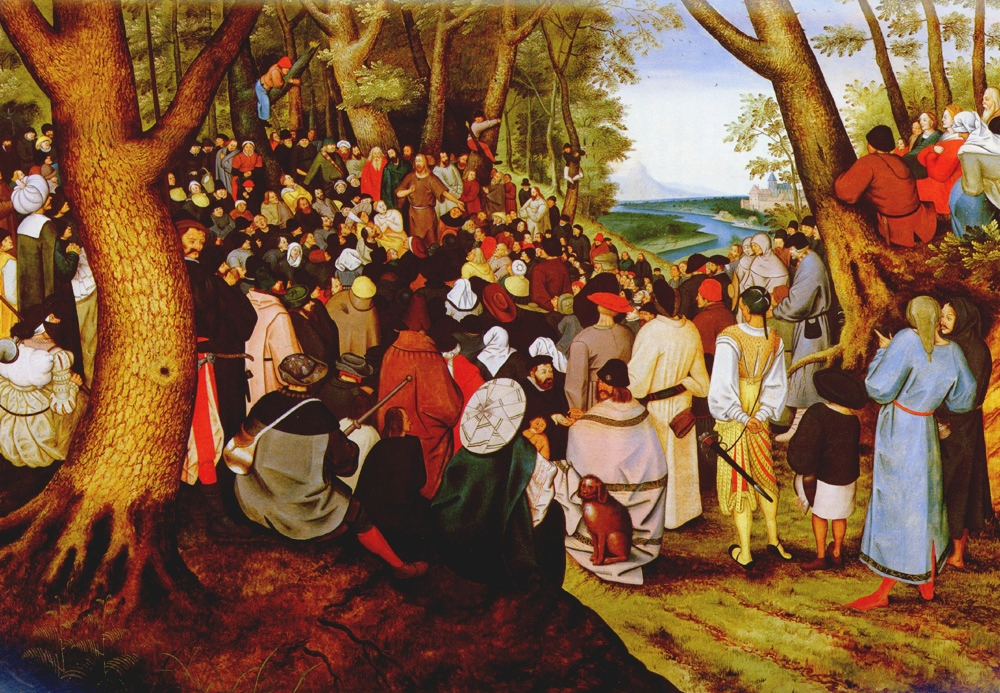
Landscape with St. John the Baptist preaching by Pieter Brueghel the Younger at Rheinisches Landesmuseum, Bonn, Germany (Wikimedia Commons/Art Renewal Center)

Somewhere about 63 AD, i.e. about 30 years after Jesus’ death and resurrection, the wheels came off the bus. The Roman proconsul in Jerusalem, Florus, decided to help himself to vast loads of silver from the Jewish Temple which enraged the Jews. An insurrection broke out and the Jews were successful in routing the Roman occupiers inside the city. The Zealots’ numbers began to swell as people felt that they indeed could overcome the entire Roman occupation. Rome responded by sending 60,000 soldiers and reports that some 100,000 Jews were killed or taken into slavery in Galilee. Those who escaped Galilee fled to the citadel of Jerusalem for safety. That didn’t go well either because the Zealots who were fighting against Rome came face to face with the Jewish leaders in Jerusalem who sold out to the Romans and catered to them. These two groups began to fight amongst each other as well! So even inside Jerusalem, there was killing and intrigue between these two Jewish factions. [i]

Why share this brief history lesson with you? Because it helps us better understand the Gospel Stories. Over the next several months, we are going to be spending a lot of time in Mark’s gospel account and it’s helpful to remember he wrote this with the backdrop of the history I just shared. It makes the very first sentence of Mark’s gospel pop out with meaning. Turn in your Bible to Mark 1 and we will begin with verse one. Listen to the Word of the Lord.

 The beginning of the good news of Jesus Christ, the Son of God.

As it is written in the prophet Isaiah, 

“See, I am sending my messenger ahead of you,
who will prepare your way;
the voice of one crying out in the wilderness:
‘Prepare the way of the Lord,
make his paths straight,’”

John the baptizer appeared in the wilderness, proclaiming a baptism of repentance for the forgiveness of sins. And people from the whole Judean countryside and all the people of Jerusalem were going out to him, and were baptized by him in the river Jordan, confessing their sins. Now John was clothed with camel’s hair, with a leather belt around his waist, and he ate locusts and wild honey. He proclaimed, “The one who is more powerful than I is coming after me; I am not worthy to stoop down and untie the thong of his sandals. I have baptized you with water; but he will baptize you with the Holy Spirit.”2

“The beginning of the Good News of Jesus Christ, the Son of God.”  This is the first note that is struck in Mark’s Story written during the period of the Great Revolt.  The news is positive, it is redemptive, and we can also say, it’s subversive. Scholar Christopher Hutson reminds us that only the emperors and rulers of the day had divi filius, son of god, stamped on their currency.[3]  So, during the years of the Great Revolt in Palestine, there came a declaration, “The beginning of the good news of Jesus Christ, Son of God.” If you lived in a country amid war, how would you hear these words?

You see, John the Baptist is quoting two Hebrew texts:  one is from Isaiah 40:3-4 and the other is Malachi 3:1. Isaiah and Malachi were two prophets used by God writing to Jews in exile reminding them that though times are bleak, even though the people have forsaken God, though the people have forsaken each other, God is coming to set things right. For the exiled Jew, this would be fantastic news to hear!  For the exiled Jew, these words are the assurance that God does not forget the people he has chosen and loves, no matter how bad the straights are in which they find themselves. This is exciting news indeed!

So, how do we get ready for the arrival of the Messiah? Well, Mark uses John the Baptist who calls the people to repentance for the forgiveness of sins. We think of John the Baptist and we quickly think of bad news. John is the fiery preacher who demands people to repent and we equate his words to, “You better turn, or you’re going to burn!” We so misunderstand the Baptist. John’s was an open invitation to come and get ready to meet the King! His words are good news and according to Mark’s Story, people heard it that way because scores of people from all over the Judean countryside were going to be baptized for repentance by him. They heard it as a welcome wake-up call.

Advent, beloved, is the time we wake up and get ready for God’s arrival.  And how does the Baptist tell us to get ready?  Is it with Christmas decorations and hanging the stockings with care?  Is it fighting malls, crowds, and discovering you know the King’s English when you’re driving up and down the Thruway? Is it spending money you don’t really have to spend? No. John tells us the way we prepare is through the Good News of a baptism of repentance.  But what does it mean to repent? Repenting sounds so heavy and lugubrious. Let me briefly give you the ingredients for meaningful preparation and repentance as we slowly make our way to the Savior’s birth.

The first ingredient is Recognition. What are we to recognize? Well, first, we are to recognize and act as though God is indeed coming. God is breaking into our lives and is setting up a home in us. The second thing John calls us to recognize is the condition of our spiritual houses.  What shape will God find our spiritual houses in?  Is there trash to be taken out?  Is there cleaning that needs to be done? Are there items of furniture that really don’t fit anymore and need to be thrown out to make room at the table for Jesus?  Recognizing God’s oncoming arrival and the concomitant need for us to get our spiritual houses to make them fit for God’s indwelling is the first ingredient for repentance.

The second ingredient is Relinquishment.  One cannot answer the door and shake someone’s hand unless he or she puts something down first.  It’s one thing to recognize God’s arrival and our need to get ready but it’s entirely something else to relinquish our old ways and habits. This is one reason why John and Jesus’ ministry was couched as Good News, liberating news because now, one could live their lives with God differently than before. Before, you lived your life before God obeying every jot and tittle of the law. It was a spiritual life built on guilt and shame and there was no way anyone could fulfill it. But now, one lived his or her life in response to God’s grace and love. This is the reason John and Jesus’ words and actions were seen as threatening to the religious status quo of the time.  

In order to make room for God in our lives we have to relinquish and give up certain attitudes, behaviors, and assumptions about what it means to live as a follower and child of God. It means to relinquish the pride that we know it all; it means to relinquish our material finances and possessions and acknowledge that there is a growing disparity in our nation between the haves and have not’s; we are to question whether we are part of the solution or are a part of the problem. It means to relinquish those behaviors that destroy the image of God in other people through demeaning comments, demeaning their position in our society, or demeaning them to get what we want for our benefit.

A drunk cannot get sober unless he or she relinquishes the bottle.  A broken marriage cannot be mended unless both parties relinquish past hurts and then rejoin their hands in mutual solidarity.  John is reminding us that before we can receive the gift, we have to let go of what we currently cling to tightly.

The final ingredient in John’s recipe for repentance is Reorientation.  At its core, repentance means to turn in the other direction. It means to strike out on a different course and to take a different path. It means to reorient one’s spirit and soul to the magnetic north of God’s loving call as opposed to our culture’s, our life’s neon-colored signs of instant gratification.  It’s about replacing hubris with humility, with replacing hoarding with showering grace in all its forms onto others, and with replacing petty hatred with a pillowy heart of love.  It means to reorienting, realigning our actions with what we say we believe.

Beloved, Advent is a season that serves as reset button for our spiritual lives. Sometimes our computer locks up and we have to do a hard reset and turn the machine off and then back on to recalibrate the software; we have to reboot it. This is what Advent provides and it’s our invitation to enter into what Mark calls the Good News. I like to call it Winsome News. To be winsome is to be pleasing as we reflect a warm, childlike trust and enthusiasm. Isn’t this how Mark wants us to respond to this Advent? The beginning of the Winsome News of Jesus Christ, the Son of God. So, let’s take time to recognize this Winsome News and then let’s relinquish our lives and reorient ourselves to it.

In the Name of the One who is, who was, and is yet to some. Amen.

© 2023 Patrick H. Wrisley, Pastor, First Presbyterian Church of Glens Falls.  Sermon manuscripts are available for the edification of members and friends of First Presbyterian Church of Glens Falls and may not be altered, re-purposed, published or preached without permission. All rights reserved.


[i] See Ancient Jewish History: The Great Revolt at the Jewish Virtual Library at https://www.jewishvirtuallibrary.org/the-great-revolt-66-70-ce.  Accessed 12/10/2023.

[2] The New Revised Standard Version, copyright 1989, 1995 by the Division of Christian Education of the National Council of the Churches of Christ in the United States of America. Used by permission. All rights reserved.

[3] Feasting on the Word: Year B, Volume 1: Advent through Transfiguration (Feasting on the Word: Year B volume) (p. 116). Presbyterian Publishing Corporation. Kindle Edition.

Posted in Sermon | Tagged , , , , , , , , , , , , , , | Leave a comment

Apocalypse, Now!, 1 Corinthians 1:3-9

A sermon preached on December 3, 2023, by the Rev. Patrick H Wrisley, D.Min.

            Are you an owl or are you a rooster? Are you a “clucker” or are you one to sit back and observe all that is unfolding in front of you?  Richard Landes, former Director of the Center for Millennial Studies, wrote an article over twenty years ago as the year 2,000 was approaching, that essentially there are owls and there are roosters. Owls are stoic and quietly observe what is happening in front of them whereas roosters are easily excitable and crow, making noise every chance they can.[1] As Georgia rock band REM sang years ago, it’s the end of the world as we know it and roosters make a lot of noise that Jesus is coming and he’s bringing with him quite an attitude!

            Reflect back 24 years ago when everyone was wondering what was going to happen when the year 2,000 rolled around. People thought computers would freeze up and the world would come to a standstill. Religious zealots thought the world was going to come to an end and Christ would return to summon all the deserving faithful home. Owls are people who would say, “Now just relax, everything is going to be fine. Roosters are the zealots who are telling everyone, “The end is near!”

            Today is the very first day of the new Christian liturgical year. On this very first day of the Christian year, we begin our commemoration of Advent, which literally means ‘coming’ or ‘arrival.’ It is the slow march towards Christmas Day when we celebrate the arrival and birth of the baby Jesus. Advent is the season of preparation and so today, as we prepare for Christ’s birth, we are reminded that we are a people who wait with and in hope. The first day of Advent is also the day the larger church remembers the coming of Christ at the culmination of time when all heaven and earth will be laid bare before the gracious judgment seat of Christ. The first Advent is the birth of Jesus in the manger; the second Advent is when Jesus comes in judgment at the fullness of time. The Christian calendar always begins reflecting hopefully on the second Advent of when Jesus is coming again and will be revealed in glory.

            The first Sunday in Advent is the day the Church hopefully waits for the apocalypse. Roosters in our world have crowed that the Apocalypse is a bad and terrible event when Jesus comes back, flips tables, and takes names. We have let the fiction of Tim LaHaye and Jerry Jenkins in their books, Left Behind, shape our thinking about when Jesus comes again more than we have scripture. The word apocalypse literally means, “the revealing.” Advent is the Church’s way of forcing us to slow down and reflect on what the great reveal means to both of us personally and as a church while we wait for Jesus to appear. Advent is a season of waiting, not only for Christmas Day, but is a time of waiting and preparation which forces the Church to ask, “How are we preparing for the revelation of Jesus when he comes again?” In our text this morning, Paul refers to that time as the Day of the Lord. Advent is a time we wait for Jesus to be revealed in an attitude of hope, not one of dread.

            Our scripture this morning is from one of the many letters Paul wrote to his most difficult church, the one in Corinth. What we have in our Bible as First and Second Corinthians is thought to be a series of letters Paul and others wrote to the church some sixty miles southwest of Athens, Greece. Corinth was a sea town that was a crossroads of trade and commerce and its reputation for being shady was well known in antiquity. It was the original “sin city.”  Non-biblical author of the second or third century, Alciphron, noted in letters how the people in Corinth were not very friendly or graceful and that the rich acted haughty, coarse, and disgusting while the poor groveled for scraps of bread. The more we read Paul’s letters to the Corinthian church, we begin to see that not a lot has changed since Paul’s time and a couple of hundred years later.[2]

            Our text is from the prologue of his letter to them and sets the scene for what he will unpack later in his writings, namely how they are using their spiritual gifts and how they are treating one another in the Christian fellowship. Hear the Word of the Lord!

1 Corinthians 1:3-9

3Grace to you and peace from God our Father and the Lord Jesus Christ. 4I give thanks to my God always for you because of the grace of God that has been given you in Christ Jesus, 5for in every way you have been enriched in him, in speech and knowledge of every kind— 6just as the testimony of Christ has been strengthened among you— 7so that you are not lacking in any spiritual gift as you wait for the revealing of our Lord Jesus Christ. 8He will also strengthen you to the end, so that you may be blameless on the day of our Lord Jesus Christ. 9God is faithful; by him you were called into the fellowship of his Son, Jesus Christ our Lord.[3]

            What does this text have to say to us during our time of waiting and preparation? To answer this, we must remember who Paul is writing to in the first place. As sophisticated twenty-first-century folks, we think Paul is writing to us, i.e. to you or me. We love to personalize everything! We need to remind ourselves that Paul is speaking to the collective church in Corinth. The letter is not written to Patrick, Bob, Bryan, Sandy, or Carol; it’s written to the collective community of Christians there. The ‘you’ Paul uses is not singular; it’s best translated, as “all y’all”! This is how we need to hear our text this morning:

Grace to all y’all members of First Presbyterian Church of Glens Falls and peace from God our Father and the Lord Jesus Christ. I give thanks to my God always for First Presbyterian Church Glens Falls because of the grace of God that has been given all y’all in Christ Jesus, for in every way you as a church have been enriched in him, in speech and knowledge of every kind — just as the testimony of Christ has been strengthened among the membership of First Presbyterian Church— so that as a community of faith, all y’all were not lacking in any spiritual gift as together y’all wait for the revealing of our Lord Jesus Christ. He will also strengthen First Pres to the end so that as a church, y’all will be blameless on the day of our Lord Jesus Christ. God is faithful; by him, First Pres was called into the fellowship of his Son, Jesus Christ our Lord. 

So, Church, how does this literal reading of Paul’s words instruct us on how we wait? Personally, I believe it causes us to ask some penetrating questions of ourselves as a church who at times has struggled to understand each other.  Paul’s words are a wonderful corrective lens we gaze through and are presented with some questions to ponder as a community as we wait with each other, as we as a community of fellowship prepare for the coming of the Lord.

            First, we are reminded that what we have is a gift from God. Look around this room, and think of the ministries we have conducted in the past or are a part of doing now – all we see and all we have done and are doing are a result of God’s gifts and grace to us first. As we wait together for the coming of the Lord, I want us to spend time this Advent reflecting on how God has blessed this congregation over the years and how we are to extend those blessings into the future.

            Second, this season of waiting, of Advent, is a time for us to remember and celebrate the spiritual gifts this body has been endowed with for the good of the gospel ministry of Jesus. As a congregation, you have shaped generations of children through our preschool and Sunday school ministries. You have been a vocal witness to the glory of Christ in Albany Presbytery but also with the community of Warren County and beyond. You have been a leader in demonstrating the justice, mercy, and loving ethic of God to those in our community. Those are gifts you have shared; what are the gifts you, Church, want to share now and into the future while we wait?

            Finally, Church, as we wait, as we prepare for the Lord’s coming, we are to ponder on how God will strengthen and support us in our waiting. We are reminded of God’s faithfulness for our provision and sustenance, for God’s abiding care and love for us as a family of God. As we wait for Jesus’ coming day, we wait hopefully, patiently, knowing God is faithful even when the world and its news try to tell us otherwise.  Paul’s words to the church are a wonderful reminder for us, the Church, that God’s faithfulness and grace are best expressed through what we as a fellowship do for and with each other.  Let us come to the Table and be nourished by the hand of the Lord as we hope and wait.

            In the Name of the One who is, was, and ever more shall be. So be it.

© 2023 Patrick H. Wrisley. Sermon manuscripts are available for the edification of members and friends of First Presbyterian Church of Glens Falls, 8 West Notre Dame Street, Glens Falls, NY 12801, and may not be reproduced or repurposed without permission from the author. All rights reserved.


[1] Richard Landes, On Owls, Roosters, and Apocalyptic Time: A Historical Method for Reading a Refractory Documentation, From Union Seminary Quarterly Review 49 (1996): 165-85.

[2] J. Paul Sampley, New Interpreters Bible, Acts, Vol. X (Nashville: Abingdon Press, 2002), p. 772.

[3] New Revised Standard Version Bible, copyright © 1989 National Council of the Churches of Christ in the United States of America. Used by permission. All rights reserved worldwide. See http://nrsvbibles.org.

Posted in Sermon | Tagged , , , , , , , , , , , | Leave a comment