

Matthew’s Second Set of “Blessed Ares,” Matthew 25:31-46

Today, we’re reading what has been called the Sermon on the Judgment, or as the preacher that married Kelly and me 40 years ago calls it, “The Sermon on the Last Audit.”[1] It’s about how all of us will appear before Christ at the end of time and provide an accounting on how we shared our God-given blessings with the everyday people we encounter. If you remember, you will recall that Matthew’s gospel and Jesus’ teachings begin with a list of blessings promised to us by God in the Sermon on the Mount beginning in chapter 5. At the beginning of his Story, Jesus’ first public teaching is when he goes over a list of “blessed ares” like the meek, those who endure suffering, the poor, the peacemakers, and the like.  Today’s reading, indeed, the final teaching of Jesus’ ministry, also contain a list of “blessed ares.” As you listen the text, listen closely for the “blessed ares” in his final teaching as they are very subtle. Hear the Word of the Lord!

Matthew 25:31- 46

31 “When the Son of Man comes in his glory, and all the angels with him, then he will sit on the throne of his glory. 32 All the nations will be gathered before him, and he will separate people one from another as a shepherd separates the sheep from the goats, 33 and he will put the sheep at his right hand and the goats at the left. 34 Then the king will say to those at his right hand, ‘Come, you that are blessed by my Father, inherit the kingdom prepared for you from the foundation of the world; 35 for I was hungry and you gave me food, I was thirsty and you gave me something to drink, I was a stranger and you welcomed me, 36 I was naked and you gave me clothing, I was sick and you took care of me, I was in prison and you visited me.’ 37 Then the righteous will answer him, ‘Lord, when was it that we saw you hungry and gave you food, or thirsty and gave you something to drink? 38 And when was it that we saw you a stranger and welcomed you, or naked and gave you clothing? 39 And when was it that we saw you sick or in prison and visited you?’ 40 And the king will answer them, ‘Truly I tell you, just as you did it to one of the least of these who are members of my family,[a] you did it to me.’ 41 Then he will say to those at his left hand, ‘You that are accursed, depart from me into the eternal fire prepared for the devil and his angels; 42 for I was hungry and you gave me no food, I was thirsty and you gave me nothing to drink, 43 I was a stranger and you did not welcome me, naked and you did not give me clothing, sick and in prison and you did not visit me.’ 44 Then they also will answer, ‘Lord, when was it that we saw you hungry or thirsty or a stranger or naked or sick or in prison, and did not take care of you?’ 45 Then he will answer them, ‘Truly I tell you, just as you did not do it to one of the least of these, you did not do it to me.’ 46 And these will go away into eternal punishment, but the righteous into eternal life.”[2]

Today is the final Sunday for the Christian liturgical year.  In many ways, it is the Church’s New Year’s Eve and builds up to today’s celebration of Christ the King of all Creation. Matthew’s Gospel begins in darkness with a baby born in a manger at night and now it ends with that baby-now-Christ-of-God sitting as King at the fulfillment of time to usher the faithful home. Interestingly enough, there will be those who are grossly disappointed when they learn they don’t make the cut to move into the sheep line.  Assuming all their lives that they were sheep people, they quickly realize they were basing their assumptions on old, outdated information. They really didn’t listen too well to what Jesus said or pay attention to what he did in relation to others.

Our nation’s churches are full of Christians who think that they’re sheep but are really self-righteous goats pushing other sheep and those who want to be a sheep right outside of the church. Today’s text is a good reminder not to make assumptions about who we think is “in” or “out” of God’s favor. It also calls us to look for those threads that unite us together in an undivided demonstration of what it means to be Christ-followers in America today.

Today’s startling last lesson from Jesus contains the bookend “blessed ares” for his Matthean ministry. The “blessed ares” revealed today show each of us how we can begin living and experiencing eternal life this very moment; yet, this second set of “blessed ares” also determine the eternal consequences for our life after this life. In other words, this second set of “blessed ares” dictate which line we are herded towards – the sheep line or the goat line. 

The first radical thing for us to note about this judgement scene in Matthew is what determines which line we fall into. Whether we are a sheep, or a goat is not based on a list of “Thou shalt nots…” This is what Jesus has been trying to get across to people throughout Matthew’s gospel, particularly in these last several chapters. Jesus has been instructing spiritual, legal, and social leaders that faith is not about loving God with a well-lived life; on the contrary, what brings God joy is a life lived well in its expression of love for others. Jesus has been demonstrating and teaching that one’s eternal life is based first and foremost on God’s initiative, on God’s thoroughly soaking grace lavished on us. Jesus’ entire ministry is all about teaching and showing what that love looks like.  Consequently, one’s eternal life is calculated on how well we continue the flywheel effect of grace and share those graces with others.

The second radical observation about our future judgement in Matthew’s text is that is doesn’t say it’s determined by our belief in Jesus. Our eternal life is not based on our mental assent that he is Lord and Savior; frankly, anyone can say that! What’s really amazing is that one’s salvation is not just measured in mental acknowledgement and recognition of who Jesus is; on the contrary, Jesus is saying one’s faith and eternal life is based on whether we believed who he is enough to intentionally live like Jesus lived! As one scholar remarks, “Students of the New Testament know that the only description of the last judgment is in Matthew 25. There is nothing in it about ecclesiastical connections or religious practices. There is not a word in this passage about theology, creeds, orthodoxies. There is only one criterion here, and that it is whether or not you saw Jesus Christ in the face of the needy and whether or not you gave yourself away in love in his name.”[3]

Folks, you need to know that I am not saying that believing in Jesus is not important; it is! What I am saying, and what Jesus’ teaching tells us, is that our salvation is determined by what we do with our belief in Jesus. Do we put skin on our faith and live it out or does our belief just sit on a shelf of mental acknowledgement? I love what Dr. Lindsay Armstrong says, “Matthew lifts up the importance of what we do with our lives. Why? Because how we spend our time and whom we actively love and do not love provides a diagnostic image of our overall (spiritual) health.”[4] 

So, friends, if Jesus were to slap you and me into a heavenly MRI machine, what would it reveal about our spiritual health? What are the rubrics used to measure it? I suggest the measurement of our spiritual health, our church’s spiritual health, is best measured with the last set of “blessed ares” in our Story today. Did you hear them?

  • Blessed are you when you see a stranger and give them food to eat.
  • Blessed are you when you see someone thirsty and give them water to drink.
  • Blessed are you when you look at the face of a broken human being and you welcome them because when you do, you are showing hospitality to me.
  • Blessed are you when you see someone naked and without basic needs and clothe them and see to their basic needs as a human being.
  • Blessed are you when you cared for me while I was sick, and I could give nothing in return for what you did for me.
  • Blessed are you when you intentionally sought me out and visited me where I was in the dark, remote places, like a hospital ICU, a food kitchen, or in jail.

Friends, Jesus is telling us that our faith is not rocket science and is pretty simple to grasp.  When we see Jesus in the life, the face, of the person next to us, we are called to love that person as if it were Jesus himself! Dale Bruner exclaims, “These ministries are within the reach of every single person; everyone has access to Jesus through a needy person.”[5]  He is reminding us that big, humongous miracles aren’t happening here; little, seemingly inconsequential ministries are. “It is precisely in these little ministries that the miracle of the Big Mystery – eternal salvation – comes.”[6] 

Church, each of us are united and woven together by the little things, those little ministries we share that hold the indeterminable weight of the key to our eternal life and salvation. Matthew reminds us that salvation is not about our correct beliefs or doctrines; he reminds us salvation is not about obeying rules and regulations; no, Matthew has Jesus reminding you and me that our eternal salvation is based upon how well we live like Jesus lived, loving those around us in the most simple and basic ways. Jesus begins his gospel with “blessed ares” and Jesus ends his teaching ministry with “blessed ares.” These two sets of “blessed ares” are two bookends supporting what a gospel life looks like in order to live like Jesus. I do believe he is trying to get us to remember something, don’t you?

In the Name of the One Who is, who was and ever shall be. Amen.

© 2023 Patrick H. Wrisley. Sermon manuscripts are available for the edification of members and friends of First Presbyterian Church, 8 West Notre Dame Street, Glens Falls, NY 12801 and may not be altered, re-purposed, published or preached without permission.  All rights reserved.


[1]From a sermon from the Rev. Dr. B. Wiley Stephens, Dunwoody United Methodist Church in Dunwoody, Georgia, Heaven’s Audit of One’s Soul, November 23, 2008. Accessed on 2/17/09 at http://day1.org/1120-heavens_audit_of_ones_soul.

[2] The New Revised Standard Version, copyright 1989, 1995 by the Division of Christian Education of the National Council of the Churches of Christ in the United States of America. Used by permission. All rights reserved.

[3] Feasting on the Word: Year A, Volume 4: Season after Pentecost 2 (Propers 17-Reign of Christ) (Feasting on the Word: Year A volume) by David L. Bartlett, Barbara Brown Taylor https://a.co/j1pRcxf.

[4] Feasting on the Word: Year A, Volume 4: Season after Pentecost 2 (Propers 17-Reign of Christ) (Feasting on the Word: Year A volume) by David L. Bartlett, Barbara Brown Taylor https://a.co/6B28YdH. Words in parentheses were added by me for rhetorical clarity.

[5] Frederick Dale Bruner, Matthew: A Commentary. Volume 2: The Churchbook, Matthew 13-28 (Grand Rapids: William B. Eerdmans Publishing Company, 1990), 570.

[6] Ibid., 567.
Posted in Sermon | Tagged , , , , , , , , | Leave a comment

Each According to Their Ability, Matthew 25:14-30

A sermon delivered November 19, 2023 by the Rev. Patrick H. Wrisley, D.Min.

The scene is being set for Jesus’ final days alive. Previously, we have seen Jesus in the Temple having rounds with the religious leaders, scholars, and politicians as they continued to pepper him with questions in order to trap him in his own words.  Well, now the scene has changed. After silencing those officials, Jesus has left the Temple and has descended down a hill outside the eastern walls of Jerusalem and then hiked up a road through an ancient Jewish cemetery to the Mount of Olives which sits directly across from the Temple Mount. It is most likely the same road he came down a week later riding a donkey on his entry back into Jerusalem on Palm Sunday which in Matthew’s story-time is only a week away.

Jesus gathers his disciples and ends his teaching ministry by telling stories of what they can expect in the future.  They are unsettling stories because they are stories of God’s judgement and are a call for the people to be ready to meet their God. Last week, we heard the story of the ten bridesmaids and how some were left out of the festivities because they were not prepared. Jesus follows up that story with ours today from Matthew 25:14-30.  Listen to the Word of the Lord.

Matthew 25:14-30

“For it is as if a man, going on a journey, summoned his slaves and entrusted his property to them; to one he gave five talents, to another two, to another one, to each according to his ability. Then he went away. The one who had received the five talents went off at once and traded with them and made five more talents. In the same way, the one who had the two talents made two more talents. But the one who had received the one talent went off and dug a hole in the ground and hid his master’s money. After a long time, the master of those slaves came and settled accounts with them. Then the one who had received the five talents came forward, bringing five more talents, saying, ‘Master, you handed over to me five talents; see, I have made five more talents.’ His master said to him, ‘Well done, good and trustworthy slave; you have been trustworthy in a few things, I will put you in charge of many things; enter into the joy of your master.’ And the one with the two talents also came forward, saying, ‘Master, you handed over to me two talents; see, I have made two more talents.’ His master said to him, ‘Well done, good and trustworthy slave; you have been trustworthy in a few things, I will put you in charge of many things; enter into the joy of your master.’ Then the one who had received the one talent also came forward, saying, ‘Master, I knew that you were a harsh man, reaping where you did not sow, and gathering where you did not scatter seed; so, I was afraid, and I went and hid your talent in the ground. Here you have what is yours.’ But his master replied, ‘You wicked and lazy slave! You knew, did you, that I reap where I did not sow, and gather where I did not scatter? Then you ought to have invested my money with the bankers, and on my return I would have received what was my own with interest. So take the talent from him, and give it to the one with the ten talents. For to all those who have, more will be given, and they will have an abundance; but from those who have nothing, even what they have will be taken away. As for this worthless slave, throw him into the outer darkness, where there will be weeping and gnashing of teeth.’[1]

I have to be honest; this has never been one of my favorite stories. Every time I hear it, I cringe a bit as the tone of the parable sounds so un-Jesus like.  He sounds harsh and dare I say, a little mean, in today’s text. Casting that poor guy out into the darkness where’s the weeping and pain. Calling him wicked and lazy? Ouch! I always thought that it was a bit of an overreaction for the slave owner to do that to a servant who guarded his master’s money and didn’t lose any of it. What is Jesus trying to say to you and me?

A venture capitalist gathers her three-vice presidents into the board room. “I’m going away for a while, and I want you to handle my money and investments while I’m gone. I’m going to split my portfolio into thirds according to the ability each of you have demonstrated and I want you to personally oversee the portion you have.” One invests her money and doubles it. The second vice-president invests her money and doubles it, too!  The third vice-president thought he was being shrewd. “The boss gave me 15 year’s-worth of her wages and I’m going to make sure it’s secure.  I’ve got an old fireproof gun safe in my basement and I’ll put the money there.”

That seems like a good conservative fiscal strategy, doesn’t it? After all, the Fed can’t make up its mind on interest rates, the market is a little all over the place, there are two major wars that can impact food distribution and oil. We can kind of feel for the guy who says, “I will just place the cash inside my vault and not lose any of it.”

The boss returns and the one vice-president says, “Look, I invested the billion dollars you gave me and made a billion more!” If you were the boss, how would you feel? You’d be thrilled and say, “Awesome! Giddy-up!” The second vice-president said, “I took the half-billion and invested it and made a half-billion more!”  If you were the boss, how would you feel? You’d be thrilled and say, “Awesome! Giddy-up!” The third vice-president tells the boss, “I took the quarter billion dollars you gave me and locked it up in a safe! I wanted you to see that you could trust me with your money!”  Now, if you’re the boss, how would you feel?  She looks at the vice-president who locked her money up in a fireproof vault in his basement and says, “You’re fired. Security will escort you out the building! Giddy-up-on-out-of-here!”

Why would Jesus share this Story? Why is the poor guy who buried the money cast outside? Why was that vice-president fired even though he did not lose any money? Why?

Because of squandered ability and opportunity. Verse 15 says each was given according to their ability, their power. The word Matthew uses for ability is the same word we derive our modern word for dynamite.  We each have been given responsibility for that which is not ours because God’s expectation is we will use the dynamite we’ve been given, the power and ability that we individually have, to do something productive with it! Three people were given charge of a gift they did not own; two invested their gift and doubled their return. One buried the gift; it simply sat there.

Matthean scholar Dale Bruner invites us to zoom out from this text and look at it from a 40,000-foot level.[2] Perhaps as we talk about the talents, about our using the aptitude that God gives each of us, we need to first remember what the Master, i.e., God has given us. Jesus has just come from having debates with old school thinking scholars and religious leaders. He reprimanded them because they were totally missing the point about what a life with God was really all about. Jesus has been railing on them in the Temple for focusing on the nit-noids of the Law to the exclusion of fulfilling the Law of God which is what?[3] To love the Lord our God with all our heart, soul, and mind. And what else? To love our neighbor as ourselves. Some years ago, a group of confirmands was examined by the Session and were asked, “Why do we love others?” They correctly responded, “Because God first loved us.”

Because God first loved us.

Hear the Story again one more time. The Lord gave each to his three servants according to their ability. To one, the Lord gave grace.  The Lord went away and while he was away the servant invested the grace and doubled it. The Lord responds by lavishing the servant with even more grace. To another, the Lord gave grace and when the Lord left for a time, the servant invested the grace and doubled it as well. The Lord is a thrilled and pours out even more grace upon the servant to the servant’s joy. To a third, the Lord gave grace and while he was away, the servant took that grace, kept it to himself, and put it in a secret hiding place only he knew about. When the Lord returned, the servant said, “Lord, I kept the grace to myself and did not attempt to invest it in any way.”

Can we now better understand and make the connection why Jesus shares this parable? Jesus is trying to hit home the point that as Christ-Followers, we have been given grace in order to invest it in others so God’s grace can be multiplied. We are given grace in the hopes we will blow it up and let it freely rain upon those who don’t deserve it. We are not given and extended grace to keep that grace for ourselves and make it solely for “me.” Through this parable, Jesus is telling us that if we want to remain at the proverbial party then we must invest God’s grace freely given to us and cultivate that same grace in those around us.

Beloved, Christ-followers are called to be united and undivided in our call to be grace sowers, growers, and harvesters. The parable asks us, “Are we?”

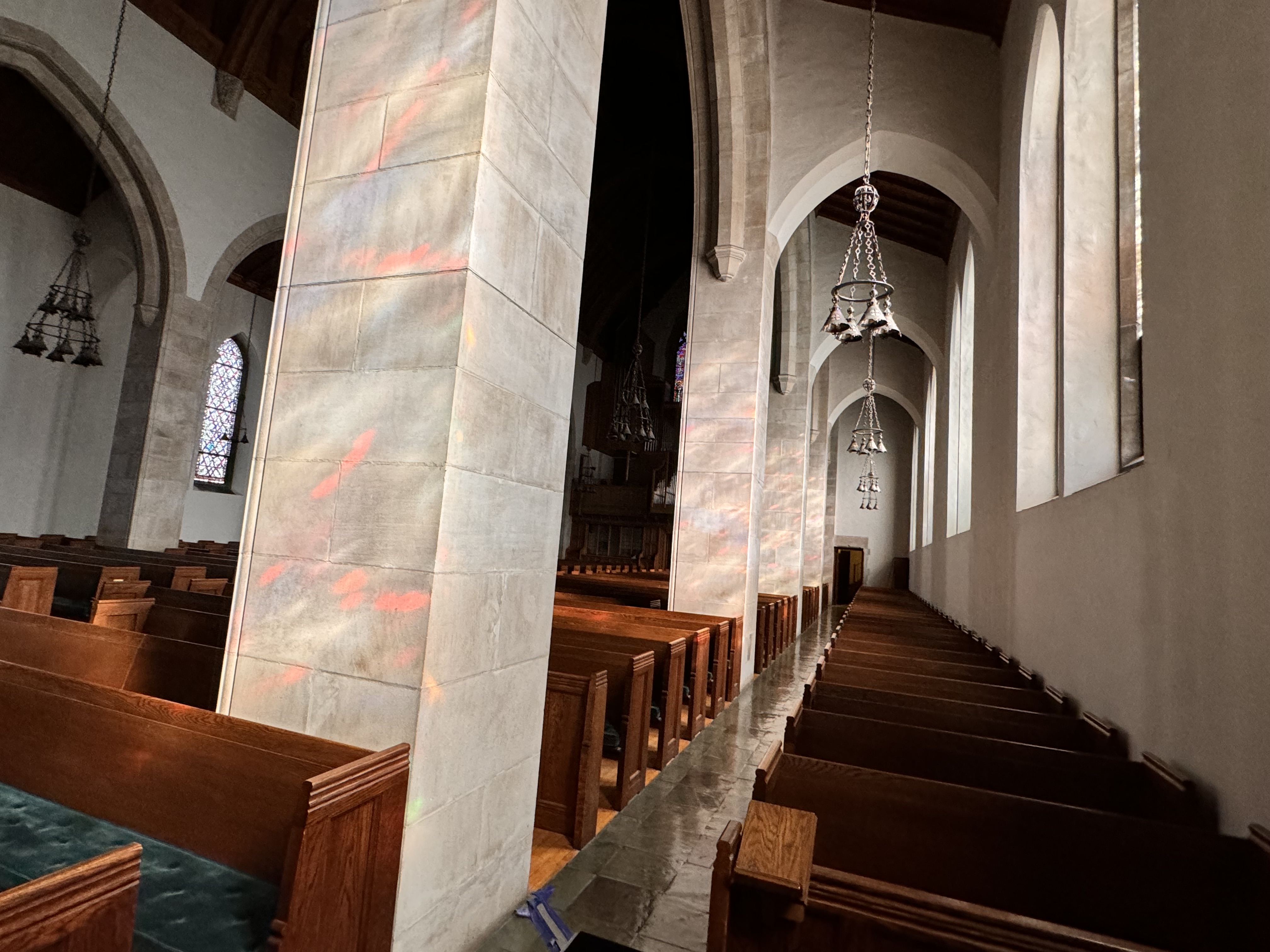
I want you to take a moment and look at the front of the stone pillars on my right side. Can you see it? Do you see it?  Look at all the speckled colors thrown onto the pillars from the morning sun coming through our windows. It’s gorgeous! Beloved, that’s a perfect example of how each of us to is invest God’s grace shown to us. We are to be sowing grace, investing God’s love and blessings just as the light is thrown over those stone pillars! We are not to keep the talent of grace to ourselves well-hidden and out of sight; we are called to liberally throw it around and about like the symphony of color showering our sanctuary this morning.

The Good News is that we worship and follow a God who lavishes us with grace and who only asks us to do one thing: Invest that grace, invest those gifts we’ve been entrusted with, in and through others in Christ’s Name. Amen.

© 2023 Patrick H. Wrisley. Sermon manuscripts are available for the edification of members and friends of First Presbyterian Church of Glens Falls, New York and may not be altered, re-purposed, published or preached without permission.   All rights reserved.


[1] The New Revised Standard Version, copyright 1989, 1995 by the Division of Christian Education of the National Council of the Churches of Christ in the United States of America. Used by permission. All rights reserved.

[2] Dale Frederick Bruner, Matthew: A Commentary. Vol. 2: The Churchbook, Matthew 13-28 (Grand Rapids: William B. Eerdmans Publishing Company, 1990), 551 – 562.

[3] See Matthew 23 & 24 for these first-century theological debates.  

Posted in Sermon | Tagged , , , , , , , , , | Leave a comment

Laissez-Faire Faith, Matthew 25:1-13

A sermon delivered by Patrick H Wrisley on November 19, 2023.

We preachers all have at least one really good wedding story we have had taken place. Mine was when I was an associate pastor for evangelism at Peachtree Presbyterian in Atlanta many years ago. It was a sweet couple in their late thirties, and both were high-ranking executives in their jobs. He was handsome and she was just beautiful – they appeared to be the perfect couple.

She had confided in our counseling together she was nervous about standing in front of a lot of people and was concerned she might faint in the middle of the service. I tried to assure her that it would all be fine and unbeknownst to her I made sure I had a pack of smelling salts in my pocket just in case.  The big day came, and the couple looked spectacular and there were several hundred in attendance that afternoon. I checked in with the bride and she was fine – cool as a cucumber! We got the service going right on time and everything was going as planned.

Now there is one ability that preachers develop over the years and that is to have conscious out-of-body experiences. In other words, we can be leading worship or preaching while at the same time standing outside ourselves watching what’s going on in the congregation. We spy the squirmy kid in the pew, or the sleeping parishioner seated towards the back. We see it all. So, at this wedding, we finished with the processional, climbed the steps of the chancel, and took our places. We were about to do the vows and so I told them to, “Turn and face one another, holding each other’s hands, and repeat after me.”

Now, standing In front of me are the best man, the groom, the bride, and the maid of honor. I am looking at the bride and tell her, “Please repeat after me…I Christine, take you Robert…” and it was at this precise moment I had my out-of-body experience. As I was telling her the lines to say, the maid of honor and I locked eyes and stared at each other. Unbeknownst to anyone else we saw this large, black spider slowly making its way up the back of the bride’s veil. We’re not talking about a little spider; this thing was the size of a small Volkswagen Beetle! Huge. Watching the spider while feeding the bride the next line to repeat, I noted how anxious the maid of honor was getting. She kept shifting her feet from side to side like she needed to use the restroom or something. As the spider was inching its way to the top of her head, the maid of honor snapped. Holding her bouquet as well as the bride’s flowers, she raised them over her head and brought them smack down across the bride’s head to knock the spider off of her! Again, again, and again she whacked the back of the bride’s head until we finally saw the spider fly off in front of the couple. The bride screamed and quickly lifted her foot and stomped on it. She had deadly precision with that stiletto heel and when she finally stopped stomping, I bent over and pronounced, “You got him!”

Our Story in Matthew is a wedding story. It’s about the bridal party waiting for the groom to arrive so they can accompany him to the bride’s house, pick up his fiancé, and then head to his parent’s house for the wedding and celebration. It’s a Story Jesus is using to describe what the kingdom of heaven is like. Listen to the Word of the Lord!

Matthew 25:1-13

25 “Then the kingdom of heaven will be like this. Ten bridesmaids took their lamps and went to meet the bridegroom. Five of them were foolish, and five were wise. When the foolish took their lamps, they took no oil with them; but the wise took flasks of oil with their lamps. As the bridegroom was delayed, all of them became drowsy and slept. But at midnight there was a shout, ‘Look! Here is the bridegroom! Come out to meet him.’ Then all those bridesmaids got up and trimmed their lamps. The foolish said to the wise, ‘Give us some of your oil, for our lamps are going out.’ But the wise replied, ‘No! there will not be enough for you and for us; you had better go to the dealers and buy some for yourselves.’ 10 And while they went to buy it, the bridegroom came, and those who were ready went with him into the wedding banquet; and the door was shut. 11 Later the other bridesmaids came also, saying, ‘Lord, lord, open to us.’ 12 But he replied, ‘Truly I tell you, I do not know you.’ 13 Keep awake therefore, for you know neither the day nor the hour.

We are picking up in Matthew’s Story with Jesus and the twelve disciples sitting somewhere on the Mount of Olives adjacent to Jerusalem sometime during what we call Holy Week. Looking west, they could see the gleaming Temple, and this is the backdrop of his telling them about things to come in the future. He’s telling them several stories about how the in-breaking of the Kingdom of Heaven may seem to be delayed but its arrival will surely come one day at a time when people least expect it. As readers of Matthew’s biblical account, we realize we are in a second long section of Jesus preaching and teaching his companions. Do you remember the first? It’s all the way back in Matthew chapters five all the way through seven. We call that section of teaching, The Sermon on the Mount, and it describes the ethics of how people in the Christian community, the church, are to live with each other. Matthew spends chapters 24 and 25 describing stories that tell the church, i.e., members like you and me, not to lag in our zeal as we wait for Jesus’ return. Remember, whenever a writer stretches out scenes in their story, they are wanting us to sit up and pay attention. So, what are we supposed to see?

Well, we have a large bridal party of ten young, single women waiting for the groom to show up. They had one job: Escort the groom as he went to meet his finance’ at her house and parade them to the wedding and feast. We know nothing about this group except half of them were wise and the other half not so much. They’re called foolish which is a polite way to say, they’re not the brightest bulbs in the box; the original language uses the word that means they’re stupid, heedless of any consequences.

The punchline of our scripture today is verse 25: Keep awake, therefore, for no one knows the day or the hour. A more precise reading is Jesus telling them, “Stay prepared.” The problem in our Story is not that the bridal party falls asleep waiting for the groom to show up; the problem was half of them weren’t prepared for his delay as they didn’t bring extra oil to burn.

Matthew shares this Story with his church that believed in Jesus but was wondering when Jesus was coming back again as conquering Messiah. He was writing to a church that had grown a bit slack in its waiting for Christ’s return. The bridal party represents the people of the church. The groom in our Story is Jesus and his coming back. The point is whether each of us is prepared or not. Pretty simple.

So how do we know if we are prepared or not? The key is linking this long sermon in Matthew to his earlier one, the Sermon on the Mount. One’s preparation is revealed in the quality of our being able to express all those wonderful Beatitudes in Matthew five. I love what Dale Bruner from Whitworth University says. He describes lamp oil as experiential and expressed Christianity. “Without the reserve oil of discipled Christianity – that is to say, an experience of Jesus without obedience to his teachings — betrays unbelief and will not find entrance into the end-time kingdom.”[1]

Funny thing about this bridal party. They all are the same except some were prepared and some were not. Just by looking at them when they first gathered would not have revealed who the wise or foolish ones were. It’s just a bridal party of excited girls waiting. It’s only when a crisis occurs that their wisdom or foolishness is revealed. The crisis of the tardy groom revealed who was prepared and who was not. The ones who were not prepared immediately wanted to leech off the ones who were. Their lack of preparedness is their personal problem and dilemma; they can’t blame anyone but themselves. When they finally do get their act together and arrive late, Matthew has the groom quote the words of Jesus back in Matthew 7, “Not everyone who says to me, ‘Lord, Lord,’ will enter the kingdom of heaven, but only the one who does the will of my Father in heaven.”[2] Go away. Though you call me “Lord, Lord,” I can’t recognize who you are because you’re not prepared. Ouch.

Jesuit scholar Thomas Stegman, writes, “They have not taken to heart Jesus’ warning that it is not enough to call out “Lord, Lord” in order to enter the kingdom. The wedding banquet is reserved for those who do God’s will, for those who have the oil of works of love and mercy. The negative example of the foolish maidens makes poignantly clear that being a Christian in name only is insufficient. The parable proper ends on a chilling note of rejection.”[3]

So, I suppose what each of us has to do when we leave this morning is reflect on whether or not we are truly prepared. What will Jesus say if we knock on the door to the banquet?

In the Name of the One who is, who was, and who is yet to come. Amen.

© 2023 Patrick H. Wrisley, Pastor, First Presbyterian Church of Glens Falls, 8 West Notre Dame Street, Glens Falls, NY 12801.  Sermon manuscripts are available for the edification of members and friends of First Presbyterian Church, Glens Falls, NY and may not be altered, re-purposed, published or preached without permission. All rights reserved.


[1] Bruner, Matthew. A Commentary. Volume 2: The Churchbook. Matthew 13-28, revised and expanded (Grand Rapids: William B. Eerdmans Publishing Company, 1990), 546.

[2] See Matthew 7:21.

[3] Feasting on the Word: Year A, Volume 4: Season after Pentecost 2 (Propers 17-Reign of Christ) (Feasting on the Word: Year A volume) by David L. Bartlett, Barbara Brown Taylor. See https://a.co/cc6zLWj

Posted in Sermon | Tagged , , , , , , , , , | 1 Comment

The Same But Different – All Saints Sunday, 1 John 3:1-3

He was doing what all pastors do on Sunday morning; he was at this church leading worship that spring morning directing the people in prayer, sharing the news of the church family, and preaching his sermon. While all this was going on, a group of people from the church broke into his house, the manse across the street, and were ransacking the place because they were upset with the pastor and the session for going along with the presbytery’s direction to ordain women as ministers, among other things. They sprayed obscene graffiti down the hallway leading to his children’s bedrooms. They broke windows, smashed pictures, and emptied the contents of the refrigerator into their piano. Drawers were emptied onto the floor and the beds had their mattresses sliced from top to bottom. They wanted to send a message that there was trouble in the church.

This is a church that went through a schism, a rending into two distinct parts and factions. One side used hate and vitriol to get their message of how things at the church should be, “All in the glorious name of Christ.” The other side was caught flat-footed and found itself on the defensive. The case went all the way up to the Georgia State Supreme Court which sided with the members who wanted to stay with the presbytery and continue their over 100-year-old ministry there. I arrived two years later as a fresh new pastor out of seminary to a faithful remnant of 60 people. I wish I could say I made this story up but I’m not.

Needless to say, the church I inherited was the same church that was established back in the 1800s but it was definitely different as a result of the schism that took place. Literal families were ripped apart taking opposite sides on what Christian orthodoxy really was. The remnant there were tired from the fighting. The budget had been whittled away through the lengthy court battles. Now they were fighting to survive and rediscover their sense of purpose in the community. Yes, it was the same church but it was really different.

This is what is going on in our scripture Story this morning. John, the Beloved disciple and one of the first four who responded to Jesus’ call to follow, is writing to a church somewhere in today’s western Turkey. It too was a church that underwent schism over orthodoxy and right beliefs. There were some who said Jesus was a good person but was not really Emmanuel, i.e., God with us. They also taught that in order to find salvation, you had to learn special knowledge about how God worked. They were called Gnostic Christians. The letter of John was written to the remnant who held to Christ as the living Son of God. John is reminding them to maintain pure beliefs about Jesus, to live obedient lives, and to be intentional with their devotion and worship. He was writing to a church that was the same but because of the rift among the people. The church was different now. He was reminding them even though it may feel different, they were to maintain the basics of the faith.

Our brief text this morning is in the midst of a section where John is giving the church some encouragement. Listen to 1 John 3:1-3, the Word of God.

1 John 3:1-3

3.1 See what love the Father has given us, that we should be called children of God, and that is what we are. The reason the world does not know us is that it did not know him. 2 Beloved, we are God’s children now; what we will be has not yet been revealed. What we do know is this: when he is revealed, we will be like him, for we will see him as he is.3 And all who have this hope in him purify themselves, just as he is pure.[1]

The same but different. John reminds the Church that because of Jesus, the Father’s love has been shared with us thereby making Jesus followers adopted children of God. What a powerful promise and fact! No longer are we outsiders looking in through the living room window, but we are now members of the family sitting inside and having our seat at the table! We are the same, but we are so totally different from who we were before. As children, we now have a stake in the family. As children, we now have inheritance rights. As children, we now bask in the love of the gracious Father. And how do we know we are adopted children of the Father? Because we know Jesus.

In 1 John 2 immediately preceding our text this morning, John reminds the Church that those who deny the Son deny the Father but those who confess the Son has the Father as well (1 John 2:23). He assures members of the Church their current family status will reap future rewards later. You see, Jesus’ Easter has given you and me a glimpse of what we will be like when we die and rest with the Father. We will be the same but different. “What we will be has not been revealed but when Jesus reveals himself to us, we will be like him.”

Our Christian faith believes that we will be raised with a spiritual body – same but different. We will be united with God and reunited with those we have lost in this life. Our relationships with them will be the same but different as well. All dysfunctions between us will be erased from the relationships. All ill will, suspicion, and doubt of other people’s motives will be gone. Any sense of impatience with those we knew in this life will melt away as we bask in each other’s presence as we are mutually seated at Christ’s table. There will no longer be any need for fear and the very concept of hatred is an impossibility in the presence of the Loving Father. The Church, life as we know it, our very being will be the same but oh so different when Jesus is revealed to us in eternal life.

Today we pause and remember those saints who have experienced their transition from this life to their life in the glorious presence of God the Father, Son, and Spirit. Our memories with tears remind us of who they were to us but All Saint’s Day is our reminder that they are now so much more of who they were meant to be. They are healed and made whole from any disease or moral deficiencies they had as they have put on God’s heavenly cloak of pure love. They are the same as we knew them, but they are so different now as well. They, along with the angels, cheer us on, encourage us, and tell us we can do it. That’s why communion is so important. It’s our reminder we are not alone and that for this brief moment, we can sit with Jesus and the saints at the Table of Heaven.

In the Name of the One who is, who was, and is yet to come. Amen.

© 2023 Patrick H. Wrisley, Pastor, First Presbyterian Church of Glens Falls.  Sermon manuscripts are available for the edification of members and friends of the First Presbyterian Church of Glens Falls and may not be altered, re-purposed, published, or preached without permission. All rights reserved.


[1] New Revised Standard Version (NRSV). New Revised Standard Version Bible, copyright © 1989 the Division of Christian Education of the National Council of the Churches of Christ in the United States of America. Used by permission. All rights reserved.

Posted in Sermon | Tagged , , | Leave a comment

You Should Try Doing This Sometimes!, 1 Thessalonians 2:1-8

A sermon delivered by the Rev. Patrick H. Wrisley, D.Min. on October 29, 2023.

The late Frank Harrington, the former pastor of the nation’s largest Presbyterian Church in Atlanta, Georgia, tells the story of how he received an angry phone call from one of his parishioners late on a Sunday afternoon. The man was the father of a graduating college senior and just learned that his daughter, who was finishing up at a prestigious university was, “Throwing it all away!” Frank was confused and asked the father to tell him the background of why he was so upset.

“Well, we were sitting around the table having a nice Sunday dinner when my daughter from out of nowhere begins to say she’s been thinking about the direction of her life. Today she concluded what she wants to do with it: She is going to become a missionary! I about died! I immediately told her that was a crazy idea and asked her why she would want to do something like that!”

His daughter said, “It was the sermon Dr. Harrington preached this morning about challenging us to use our gifts and go out into God’s mission field.” At this point, the father gives his priceless response; he looks across the table and says to her, “But come on honey, Frank was only preaching!”

Frank was only preaching. In other words, the father was suggesting Frank was just waxing eloquently in the pulpit and really didn’t mean what he was saying; he was only doing his job and doing what he was supposed to do.”

We preachers are the butt of many a joke or comment. We are told our sermons go too long, are too short, are too boring, are too complicated, are too controversial, or my favorite, “You’re just not feeding me.” There are those times when we preachers just want to tell the congregation, “You should try doing this sometimes and see what it’s like week after week!”

Our Story this morning is about a preacher and his congregation. The congregation has had a tough go because people have begun persecuting members of the church because they believe in Jesus. On top of that, the preacher’s reputation precedes him to the pulpit. People have heard about him and his companions before they even arrived. This is the Story of the Apostle Paul and the church he established in Thessalonica. Turn in the pew Bible or the Bible you brought with you to what is believed to be the earliest of all of Paul’s letters, 1 Thessalonians 2:1-8. Listen to the Word of the Lord!

1 Thessalonians 2:1-8

1You yourselves know, brothers and sisters, that our coming to you was not in vain, 2but though we had already suffered and been shamefully mistreated at Philippi, as you know, we had courage in our God to declare to you the gospel of God in spite of great opposition. 3For our appeal does not spring from deceit or impure motives or trickery, 4but just as we have been approved by God to be entrusted with the message of the gospel, even so we speak, not to please mortals, but to please God who tests our hearts. 5As you know and as God is our witness, we never came with words of flattery or with a pretext for greed; 6nor did we seek praise from mortals, whether from you or from others, 7though we might have made demands as apostles of Christ. But we were gentle among you, like a nurse tenderly caring for her own children. 8So deeply do we care for you that we are determined to share with you not only the gospel of God but also our own selves, because you have become very dear to us.[1]

Paul lived during a time when there were professional speakers who would travel around and make public speeches and have debates in order to build a following of students and disciples who would pay the speaker a fee for teaching. These were the Joel Olsteen’s of the first century. These folks were trained in Greek rhetoric and philosophy and could really grab your attention. Paul is comparing himself to these speakers in verse 5 and following as he reminds them that he is not speaking to impress them, to flatter them, to get money from them, or to achieve fame and glory from them. No, Paul reminds them he is preaching because he believes God, “Has entrusted us with the message of the gospel, even so we speak, not to please mortals, but to please God who tests our hearts.”

Yes, there are times when we preachers simply want to say, “You should try doing this sometimes!” We preach because we cannot help it. We are compelled to do it because this is what God is telling us to do. Like Jeremiah, there are times we would rather remain silent but as he exclaimed, “If I say I will not mention (the Lord) or speak any more in his name,” there is in my heart as it were a burning fire shut up in my bones, and “I am weary with holding it in, and I cannot.”[2]

Preaching is a risky business. It nearly killed Jeremiah because he was so unpopular. It got Jesus crucified. Stephen and Paul were stoned because of it. German abbess Hildegarde von Bingen was declared a heretic by the Pope because of it. Martin Luther King was killed because of it. Yes, I say, you should try doing this sometimes!

Preaching the gospel is messy, friends. I would venture to say that those preachers who make their people feel good all the time are not preaching the gospel. Gospel is good news, absolutely, but gospel is revolutionary in its goodness. How is the gospel revolutionary?

It’s revolutionary because it’s a message of reconciliation and reconciling with someone who has hurt you, dishonored you, or mistreated you is not an easy behavior to do.   

It’s revolutionary because it’s a message to live your life in a totally new way. When we live our lives differently, it means we have to put away old values and live into new ones. It means those people we openly disliked now have to be treated with grace. It means we learn to see the world and people in it through the eyes of Jesus instead of 21st-century media outlets and politicians. It means we learn to communicate with others in a life-giving way versus sniping behind their backs at every turn.

It’s revolutionary because it’s a message of humility and service on behalf of the other and in a selfie-obsessed Tic-Tok culture that is difficult. Our American ethos is one that says if people want to get ahead, they simply must try harder. The Christian ethos is I must try harder to help others get ahead. The gospel message is revolutionary and messy. A good preacher will make you squirm more than assuage what you already hold important.

Years ago, I had an elder at one of my churches leave one Sunday morning and tell me, “Preacher, I give that sermon a B-minus.” Now, I have to believe he meant it as a compliment, but I was nonetheless stunned and speechless. The first thing that went through my mind was, “Paul, you should try doing this sometimes!” What came out of my mouth was more intentional. I replied, “Thanks. You do realize the grade you give me says more about where you are in your faith development than in my ability to preach?” He never graded me again.

We preacher-types are expected to follow some unspoken rules while preaching. One of them is that preachers are told not to be political in the pulpit and that is frankly quite silly. Jesus preached politically because he lifted up the power structures of the day and held them to accountability. I would rather say that preachers should not be partisan. There are value judgments to be leveled against Republicans and Democrats alike as we have witnessed the circus in the House of Representatives the last three weeks. I think the moment of my biggest regret in my years of preaching was when I failed to preach the gospel during the 2020 election cycle. I failed to call out the moral and ethical behaviors of a Christian candidate who had and was not acting like a Christian man. I regret that to this day, and I am ashamed of myself because I did not want to alienate wealthy givers and offend people. I stand before you today and repent of that. Today I realize that quite frankly, sometimes the gospel of Jesus Christ is just plain offensive to others, and I have to get over that fact; indeed, I already have.

Yes, I really wish you could do this sometime and see what it’s like. Like Paul, preachers aren’t doing it for the money but are preaching because we are compelled to preach the gospel. It means we will not always say what you want to hear or what you will agree with. It means my words may make you unsettled or uncomfortable sometimes. It means I will risk not being liked by some of you because preaching the gospel is messy. But you need to know, beloved, I do it because, one, God compels me. Second, I do it because like Paul says in our scripture today, I love you as a mother loves her children; I am ready to not only share the good news of Christ with you, but I am willing to share my very soul with you because you are very dear to me. Please remember this as we grow together.

In the Name of the One who is, was, and is yet to be. Amen.

© 2023 Patrick H. Wrisley. Sermon manuscripts are available for the edification of members and friends of First Presbyterian Church of Glens Falls, 8 West Notre Dame Street, Glens Falls, NY 12801, and may not be reproduced or repurposed without permission from the author. All rights reserved.


[1] New Revised Standard Version Bible, copyright © 1989 National Council of the Churches of Christ in the United States of America. Used by permission. All rights reserved worldwide. http://nrsvbibles.org

[2] See Jeremiah 20:7-9.

Posted in Sermon | Tagged , , , , , , , | 1 Comment