
The Winsome News!, Mark 1:1-8

Sixty-three years before Jesus was born, the powers of Rome came and took control of what we know as Israel and Palestine. As we learn in the various Gospel stories, the Romans were an oppressive regime exercising their will at leisure. For roughly 100 hundred years the Jews put up with their rule. Some Jewish religious and civic leaders went along with the Romans and their rule so no boats would be rocked; others were not as tolerant. They worked underground and engaged in guerrilla warfare against their occupiers. This group was known as the Zealots.
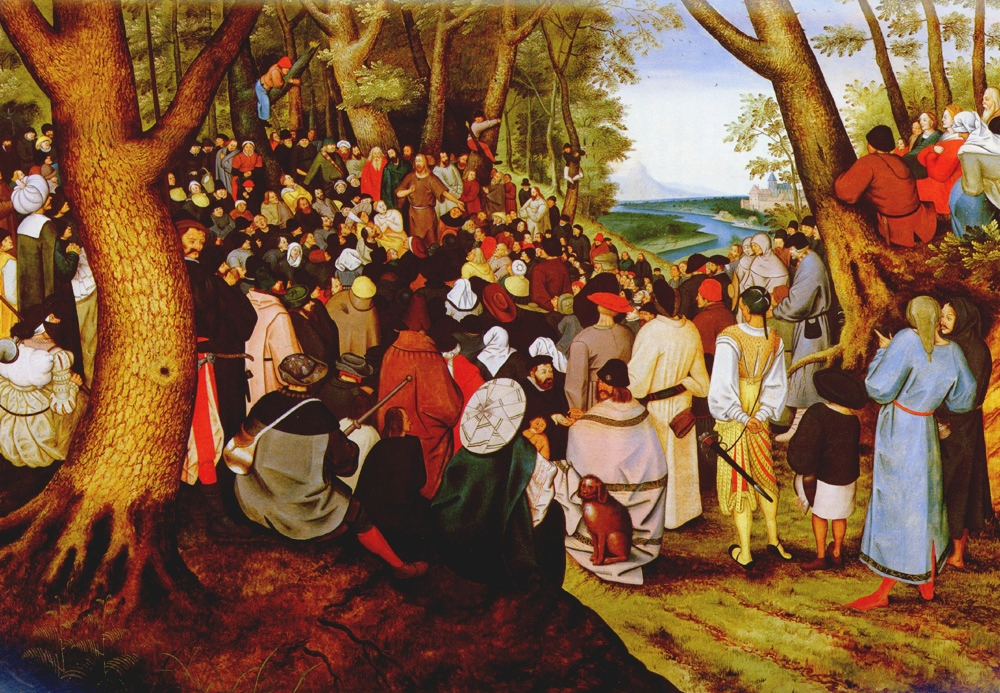
Landscape with St. John the Baptist preaching by Pieter Brueghel the Younger at Rheinisches Landesmuseum, Bonn, Germany (Wikimedia Commons/Art Renewal Center)

Somewhere about 63 AD, i.e. about 30 years after Jesus’ death and resurrection, the wheels came off the bus. The Roman proconsul in Jerusalem, Florus, decided to help himself to vast loads of silver from the Jewish Temple which enraged the Jews. An insurrection broke out and the Jews were successful in routing the Roman occupiers inside the city. The Zealots’ numbers began to swell as people felt that they indeed could overcome the entire Roman occupation. Rome responded by sending 60,000 soldiers and reports that some 100,000 Jews were killed or taken into slavery in Galilee. Those who escaped Galilee fled to the citadel of Jerusalem for safety. That didn’t go well either because the Zealots who were fighting against Rome came face to face with the Jewish leaders in Jerusalem who sold out to the Romans and catered to them. These two groups began to fight amongst each other as well! So even inside Jerusalem, there was killing and intrigue between these two Jewish factions. [i]

Why share this brief history lesson with you? Because it helps us better understand the Gospel Stories. Over the next several months, we are going to be spending a lot of time in Mark’s gospel account and it’s helpful to remember he wrote this with the backdrop of the history I just shared. It makes the very first sentence of Mark’s gospel pop out with meaning. Turn in your Bible to Mark 1 and we will begin with verse one. Listen to the Word of the Lord.

 The beginning of the good news of Jesus Christ, the Son of God.

As it is written in the prophet Isaiah, 

“See, I am sending my messenger ahead of you,
who will prepare your way;
the voice of one crying out in the wilderness:
‘Prepare the way of the Lord,
make his paths straight,’”

John the baptizer appeared in the wilderness, proclaiming a baptism of repentance for the forgiveness of sins. And people from the whole Judean countryside and all the people of Jerusalem were going out to him, and were baptized by him in the river Jordan, confessing their sins. Now John was clothed with camel’s hair, with a leather belt around his waist, and he ate locusts and wild honey. He proclaimed, “The one who is more powerful than I is coming after me; I am not worthy to stoop down and untie the thong of his sandals. I have baptized you with water; but he will baptize you with the Holy Spirit.”2

“The beginning of the Good News of Jesus Christ, the Son of God.”  This is the first note that is struck in Mark’s Story written during the period of the Great Revolt.  The news is positive, it is redemptive, and we can also say, it’s subversive. Scholar Christopher Hutson reminds us that only the emperors and rulers of the day had divi filius, son of god, stamped on their currency.[3]  So, during the years of the Great Revolt in Palestine, there came a declaration, “The beginning of the good news of Jesus Christ, Son of God.” If you lived in a country amid war, how would you hear these words?

You see, John the Baptist is quoting two Hebrew texts:  one is from Isaiah 40:3-4 and the other is Malachi 3:1. Isaiah and Malachi were two prophets used by God writing to Jews in exile reminding them that though times are bleak, even though the people have forsaken God, though the people have forsaken each other, God is coming to set things right. For the exiled Jew, this would be fantastic news to hear!  For the exiled Jew, these words are the assurance that God does not forget the people he has chosen and loves, no matter how bad the straights are in which they find themselves. This is exciting news indeed!

So, how do we get ready for the arrival of the Messiah? Well, Mark uses John the Baptist who calls the people to repentance for the forgiveness of sins. We think of John the Baptist and we quickly think of bad news. John is the fiery preacher who demands people to repent and we equate his words to, “You better turn, or you’re going to burn!” We so misunderstand the Baptist. John’s was an open invitation to come and get ready to meet the King! His words are good news and according to Mark’s Story, people heard it that way because scores of people from all over the Judean countryside were going to be baptized for repentance by him. They heard it as a welcome wake-up call.

Advent, beloved, is the time we wake up and get ready for God’s arrival.  And how does the Baptist tell us to get ready?  Is it with Christmas decorations and hanging the stockings with care?  Is it fighting malls, crowds, and discovering you know the King’s English when you’re driving up and down the Thruway? Is it spending money you don’t really have to spend? No. John tells us the way we prepare is through the Good News of a baptism of repentance.  But what does it mean to repent? Repenting sounds so heavy and lugubrious. Let me briefly give you the ingredients for meaningful preparation and repentance as we slowly make our way to the Savior’s birth.

The first ingredient is Recognition. What are we to recognize? Well, first, we are to recognize and act as though God is indeed coming. God is breaking into our lives and is setting up a home in us. The second thing John calls us to recognize is the condition of our spiritual houses.  What shape will God find our spiritual houses in?  Is there trash to be taken out?  Is there cleaning that needs to be done? Are there items of furniture that really don’t fit anymore and need to be thrown out to make room at the table for Jesus?  Recognizing God’s oncoming arrival and the concomitant need for us to get our spiritual houses to make them fit for God’s indwelling is the first ingredient for repentance.

The second ingredient is Relinquishment.  One cannot answer the door and shake someone’s hand unless he or she puts something down first.  It’s one thing to recognize God’s arrival and our need to get ready but it’s entirely something else to relinquish our old ways and habits. This is one reason why John and Jesus’ ministry was couched as Good News, liberating news because now, one could live their lives with God differently than before. Before, you lived your life before God obeying every jot and tittle of the law. It was a spiritual life built on guilt and shame and there was no way anyone could fulfill it. But now, one lived his or her life in response to God’s grace and love. This is the reason John and Jesus’ words and actions were seen as threatening to the religious status quo of the time.  

In order to make room for God in our lives we have to relinquish and give up certain attitudes, behaviors, and assumptions about what it means to live as a follower and child of God. It means to relinquish the pride that we know it all; it means to relinquish our material finances and possessions and acknowledge that there is a growing disparity in our nation between the haves and have not’s; we are to question whether we are part of the solution or are a part of the problem. It means to relinquish those behaviors that destroy the image of God in other people through demeaning comments, demeaning their position in our society, or demeaning them to get what we want for our benefit.

A drunk cannot get sober unless he or she relinquishes the bottle.  A broken marriage cannot be mended unless both parties relinquish past hurts and then rejoin their hands in mutual solidarity.  John is reminding us that before we can receive the gift, we have to let go of what we currently cling to tightly.

The final ingredient in John’s recipe for repentance is Reorientation.  At its core, repentance means to turn in the other direction. It means to strike out on a different course and to take a different path. It means to reorient one’s spirit and soul to the magnetic north of God’s loving call as opposed to our culture’s, our life’s neon-colored signs of instant gratification.  It’s about replacing hubris with humility, with replacing hoarding with showering grace in all its forms onto others, and with replacing petty hatred with a pillowy heart of love.  It means to reorienting, realigning our actions with what we say we believe.

Beloved, Advent is a season that serves as reset button for our spiritual lives. Sometimes our computer locks up and we have to do a hard reset and turn the machine off and then back on to recalibrate the software; we have to reboot it. This is what Advent provides and it’s our invitation to enter into what Mark calls the Good News. I like to call it Winsome News. To be winsome is to be pleasing as we reflect a warm, childlike trust and enthusiasm. Isn’t this how Mark wants us to respond to this Advent? The beginning of the Winsome News of Jesus Christ, the Son of God. So, let’s take time to recognize this Winsome News and then let’s relinquish our lives and reorient ourselves to it.

In the Name of the One who is, who was, and is yet to some. Amen.

© 2023 Patrick H. Wrisley, Pastor, First Presbyterian Church of Glens Falls.  Sermon manuscripts are available for the edification of members and friends of First Presbyterian Church of Glens Falls and may not be altered, re-purposed, published or preached without permission. All rights reserved.


[i] See Ancient Jewish History: The Great Revolt at the Jewish Virtual Library at https://www.jewishvirtuallibrary.org/the-great-revolt-66-70-ce.  Accessed 12/10/2023.

[2] The New Revised Standard Version, copyright 1989, 1995 by the Division of Christian Education of the National Council of the Churches of Christ in the United States of America. Used by permission. All rights reserved.

[3] Feasting on the Word: Year B, Volume 1: Advent through Transfiguration (Feasting on the Word: Year B volume) (p. 116). Presbyterian Publishing Corporation. Kindle Edition.

Posted in Sermon | Tagged , , , , , , , , , , , , , , | Leave a comment

Apocalypse, Now!, 1 Corinthians 1:3-9

A sermon preached on December 3, 2023, by the Rev. Patrick H Wrisley, D.Min.

            Are you an owl or are you a rooster? Are you a “clucker” or are you one to sit back and observe all that is unfolding in front of you?  Richard Landes, former Director of the Center for Millennial Studies, wrote an article over twenty years ago as the year 2,000 was approaching, that essentially there are owls and there are roosters. Owls are stoic and quietly observe what is happening in front of them whereas roosters are easily excitable and crow, making noise every chance they can.[1] As Georgia rock band REM sang years ago, it’s the end of the world as we know it and roosters make a lot of noise that Jesus is coming and he’s bringing with him quite an attitude!

            Reflect back 24 years ago when everyone was wondering what was going to happen when the year 2,000 rolled around. People thought computers would freeze up and the world would come to a standstill. Religious zealots thought the world was going to come to an end and Christ would return to summon all the deserving faithful home. Owls are people who would say, “Now just relax, everything is going to be fine. Roosters are the zealots who are telling everyone, “The end is near!”

            Today is the very first day of the new Christian liturgical year. On this very first day of the Christian year, we begin our commemoration of Advent, which literally means ‘coming’ or ‘arrival.’ It is the slow march towards Christmas Day when we celebrate the arrival and birth of the baby Jesus. Advent is the season of preparation and so today, as we prepare for Christ’s birth, we are reminded that we are a people who wait with and in hope. The first day of Advent is also the day the larger church remembers the coming of Christ at the culmination of time when all heaven and earth will be laid bare before the gracious judgment seat of Christ. The first Advent is the birth of Jesus in the manger; the second Advent is when Jesus comes in judgment at the fullness of time. The Christian calendar always begins reflecting hopefully on the second Advent of when Jesus is coming again and will be revealed in glory.

            The first Sunday in Advent is the day the Church hopefully waits for the apocalypse. Roosters in our world have crowed that the Apocalypse is a bad and terrible event when Jesus comes back, flips tables, and takes names. We have let the fiction of Tim LaHaye and Jerry Jenkins in their books, Left Behind, shape our thinking about when Jesus comes again more than we have scripture. The word apocalypse literally means, “the revealing.” Advent is the Church’s way of forcing us to slow down and reflect on what the great reveal means to both of us personally and as a church while we wait for Jesus to appear. Advent is a season of waiting, not only for Christmas Day, but is a time of waiting and preparation which forces the Church to ask, “How are we preparing for the revelation of Jesus when he comes again?” In our text this morning, Paul refers to that time as the Day of the Lord. Advent is a time we wait for Jesus to be revealed in an attitude of hope, not one of dread.

            Our scripture this morning is from one of the many letters Paul wrote to his most difficult church, the one in Corinth. What we have in our Bible as First and Second Corinthians is thought to be a series of letters Paul and others wrote to the church some sixty miles southwest of Athens, Greece. Corinth was a sea town that was a crossroads of trade and commerce and its reputation for being shady was well known in antiquity. It was the original “sin city.”  Non-biblical author of the second or third century, Alciphron, noted in letters how the people in Corinth were not very friendly or graceful and that the rich acted haughty, coarse, and disgusting while the poor groveled for scraps of bread. The more we read Paul’s letters to the Corinthian church, we begin to see that not a lot has changed since Paul’s time and a couple of hundred years later.[2]

            Our text is from the prologue of his letter to them and sets the scene for what he will unpack later in his writings, namely how they are using their spiritual gifts and how they are treating one another in the Christian fellowship. Hear the Word of the Lord!

1 Corinthians 1:3-9

3Grace to you and peace from God our Father and the Lord Jesus Christ. 4I give thanks to my God always for you because of the grace of God that has been given you in Christ Jesus, 5for in every way you have been enriched in him, in speech and knowledge of every kind— 6just as the testimony of Christ has been strengthened among you— 7so that you are not lacking in any spiritual gift as you wait for the revealing of our Lord Jesus Christ. 8He will also strengthen you to the end, so that you may be blameless on the day of our Lord Jesus Christ. 9God is faithful; by him you were called into the fellowship of his Son, Jesus Christ our Lord.[3]

            What does this text have to say to us during our time of waiting and preparation? To answer this, we must remember who Paul is writing to in the first place. As sophisticated twenty-first-century folks, we think Paul is writing to us, i.e. to you or me. We love to personalize everything! We need to remind ourselves that Paul is speaking to the collective church in Corinth. The letter is not written to Patrick, Bob, Bryan, Sandy, or Carol; it’s written to the collective community of Christians there. The ‘you’ Paul uses is not singular; it’s best translated, as “all y’all”! This is how we need to hear our text this morning:

Grace to all y’all members of First Presbyterian Church of Glens Falls and peace from God our Father and the Lord Jesus Christ. I give thanks to my God always for First Presbyterian Church Glens Falls because of the grace of God that has been given all y’all in Christ Jesus, for in every way you as a church have been enriched in him, in speech and knowledge of every kind — just as the testimony of Christ has been strengthened among the membership of First Presbyterian Church— so that as a community of faith, all y’all were not lacking in any spiritual gift as together y’all wait for the revealing of our Lord Jesus Christ. He will also strengthen First Pres to the end so that as a church, y’all will be blameless on the day of our Lord Jesus Christ. God is faithful; by him, First Pres was called into the fellowship of his Son, Jesus Christ our Lord. 

So, Church, how does this literal reading of Paul’s words instruct us on how we wait? Personally, I believe it causes us to ask some penetrating questions of ourselves as a church who at times has struggled to understand each other.  Paul’s words are a wonderful corrective lens we gaze through and are presented with some questions to ponder as a community as we wait with each other, as we as a community of fellowship prepare for the coming of the Lord.

            First, we are reminded that what we have is a gift from God. Look around this room, and think of the ministries we have conducted in the past or are a part of doing now – all we see and all we have done and are doing are a result of God’s gifts and grace to us first. As we wait together for the coming of the Lord, I want us to spend time this Advent reflecting on how God has blessed this congregation over the years and how we are to extend those blessings into the future.

            Second, this season of waiting, of Advent, is a time for us to remember and celebrate the spiritual gifts this body has been endowed with for the good of the gospel ministry of Jesus. As a congregation, you have shaped generations of children through our preschool and Sunday school ministries. You have been a vocal witness to the glory of Christ in Albany Presbytery but also with the community of Warren County and beyond. You have been a leader in demonstrating the justice, mercy, and loving ethic of God to those in our community. Those are gifts you have shared; what are the gifts you, Church, want to share now and into the future while we wait?

            Finally, Church, as we wait, as we prepare for the Lord’s coming, we are to ponder on how God will strengthen and support us in our waiting. We are reminded of God’s faithfulness for our provision and sustenance, for God’s abiding care and love for us as a family of God. As we wait for Jesus’ coming day, we wait hopefully, patiently, knowing God is faithful even when the world and its news try to tell us otherwise.  Paul’s words to the church are a wonderful reminder for us, the Church, that God’s faithfulness and grace are best expressed through what we as a fellowship do for and with each other.  Let us come to the Table and be nourished by the hand of the Lord as we hope and wait.

            In the Name of the One who is, was, and ever more shall be. So be it.

© 2023 Patrick H. Wrisley. Sermon manuscripts are available for the edification of members and friends of First Presbyterian Church of Glens Falls, 8 West Notre Dame Street, Glens Falls, NY 12801, and may not be reproduced or repurposed without permission from the author. All rights reserved.


[1] Richard Landes, On Owls, Roosters, and Apocalyptic Time: A Historical Method for Reading a Refractory Documentation, From Union Seminary Quarterly Review 49 (1996): 165-85.

[2] J. Paul Sampley, New Interpreters Bible, Acts, Vol. X (Nashville: Abingdon Press, 2002), p. 772.

[3] New Revised Standard Version Bible, copyright © 1989 National Council of the Churches of Christ in the United States of America. Used by permission. All rights reserved worldwide. See http://nrsvbibles.org.

Posted in Sermon | Tagged , , , , , , , , , , , | Leave a comment

Matthew’s Second Set of “Blessed Ares,” Matthew 25:31-46

Today, we’re reading what has been called the Sermon on the Judgment, or as the preacher that married Kelly and me 40 years ago calls it, “The Sermon on the Last Audit.”[1] It’s about how all of us will appear before Christ at the end of time and provide an accounting on how we shared our God-given blessings with the everyday people we encounter. If you remember, you will recall that Matthew’s gospel and Jesus’ teachings begin with a list of blessings promised to us by God in the Sermon on the Mount beginning in chapter 5. At the beginning of his Story, Jesus’ first public teaching is when he goes over a list of “blessed ares” like the meek, those who endure suffering, the poor, the peacemakers, and the like.  Today’s reading, indeed, the final teaching of Jesus’ ministry, also contain a list of “blessed ares.” As you listen the text, listen closely for the “blessed ares” in his final teaching as they are very subtle. Hear the Word of the Lord!

Matthew 25:31- 46

31 “When the Son of Man comes in his glory, and all the angels with him, then he will sit on the throne of his glory. 32 All the nations will be gathered before him, and he will separate people one from another as a shepherd separates the sheep from the goats, 33 and he will put the sheep at his right hand and the goats at the left. 34 Then the king will say to those at his right hand, ‘Come, you that are blessed by my Father, inherit the kingdom prepared for you from the foundation of the world; 35 for I was hungry and you gave me food, I was thirsty and you gave me something to drink, I was a stranger and you welcomed me, 36 I was naked and you gave me clothing, I was sick and you took care of me, I was in prison and you visited me.’ 37 Then the righteous will answer him, ‘Lord, when was it that we saw you hungry and gave you food, or thirsty and gave you something to drink? 38 And when was it that we saw you a stranger and welcomed you, or naked and gave you clothing? 39 And when was it that we saw you sick or in prison and visited you?’ 40 And the king will answer them, ‘Truly I tell you, just as you did it to one of the least of these who are members of my family,[a] you did it to me.’ 41 Then he will say to those at his left hand, ‘You that are accursed, depart from me into the eternal fire prepared for the devil and his angels; 42 for I was hungry and you gave me no food, I was thirsty and you gave me nothing to drink, 43 I was a stranger and you did not welcome me, naked and you did not give me clothing, sick and in prison and you did not visit me.’ 44 Then they also will answer, ‘Lord, when was it that we saw you hungry or thirsty or a stranger or naked or sick or in prison, and did not take care of you?’ 45 Then he will answer them, ‘Truly I tell you, just as you did not do it to one of the least of these, you did not do it to me.’ 46 And these will go away into eternal punishment, but the righteous into eternal life.”[2]

Today is the final Sunday for the Christian liturgical year.  In many ways, it is the Church’s New Year’s Eve and builds up to today’s celebration of Christ the King of all Creation. Matthew’s Gospel begins in darkness with a baby born in a manger at night and now it ends with that baby-now-Christ-of-God sitting as King at the fulfillment of time to usher the faithful home. Interestingly enough, there will be those who are grossly disappointed when they learn they don’t make the cut to move into the sheep line.  Assuming all their lives that they were sheep people, they quickly realize they were basing their assumptions on old, outdated information. They really didn’t listen too well to what Jesus said or pay attention to what he did in relation to others.

Our nation’s churches are full of Christians who think that they’re sheep but are really self-righteous goats pushing other sheep and those who want to be a sheep right outside of the church. Today’s text is a good reminder not to make assumptions about who we think is “in” or “out” of God’s favor. It also calls us to look for those threads that unite us together in an undivided demonstration of what it means to be Christ-followers in America today.

Today’s startling last lesson from Jesus contains the bookend “blessed ares” for his Matthean ministry. The “blessed ares” revealed today show each of us how we can begin living and experiencing eternal life this very moment; yet, this second set of “blessed ares” also determine the eternal consequences for our life after this life. In other words, this second set of “blessed ares” dictate which line we are herded towards – the sheep line or the goat line. 

The first radical thing for us to note about this judgement scene in Matthew is what determines which line we fall into. Whether we are a sheep, or a goat is not based on a list of “Thou shalt nots…” This is what Jesus has been trying to get across to people throughout Matthew’s gospel, particularly in these last several chapters. Jesus has been instructing spiritual, legal, and social leaders that faith is not about loving God with a well-lived life; on the contrary, what brings God joy is a life lived well in its expression of love for others. Jesus has been demonstrating and teaching that one’s eternal life is based first and foremost on God’s initiative, on God’s thoroughly soaking grace lavished on us. Jesus’ entire ministry is all about teaching and showing what that love looks like.  Consequently, one’s eternal life is calculated on how well we continue the flywheel effect of grace and share those graces with others.

The second radical observation about our future judgement in Matthew’s text is that is doesn’t say it’s determined by our belief in Jesus. Our eternal life is not based on our mental assent that he is Lord and Savior; frankly, anyone can say that! What’s really amazing is that one’s salvation is not just measured in mental acknowledgement and recognition of who Jesus is; on the contrary, Jesus is saying one’s faith and eternal life is based on whether we believed who he is enough to intentionally live like Jesus lived! As one scholar remarks, “Students of the New Testament know that the only description of the last judgment is in Matthew 25. There is nothing in it about ecclesiastical connections or religious practices. There is not a word in this passage about theology, creeds, orthodoxies. There is only one criterion here, and that it is whether or not you saw Jesus Christ in the face of the needy and whether or not you gave yourself away in love in his name.”[3]

Folks, you need to know that I am not saying that believing in Jesus is not important; it is! What I am saying, and what Jesus’ teaching tells us, is that our salvation is determined by what we do with our belief in Jesus. Do we put skin on our faith and live it out or does our belief just sit on a shelf of mental acknowledgement? I love what Dr. Lindsay Armstrong says, “Matthew lifts up the importance of what we do with our lives. Why? Because how we spend our time and whom we actively love and do not love provides a diagnostic image of our overall (spiritual) health.”[4] 

So, friends, if Jesus were to slap you and me into a heavenly MRI machine, what would it reveal about our spiritual health? What are the rubrics used to measure it? I suggest the measurement of our spiritual health, our church’s spiritual health, is best measured with the last set of “blessed ares” in our Story today. Did you hear them?

  • Blessed are you when you see a stranger and give them food to eat.
  • Blessed are you when you see someone thirsty and give them water to drink.
  • Blessed are you when you look at the face of a broken human being and you welcome them because when you do, you are showing hospitality to me.
  • Blessed are you when you see someone naked and without basic needs and clothe them and see to their basic needs as a human being.
  • Blessed are you when you cared for me while I was sick, and I could give nothing in return for what you did for me.
  • Blessed are you when you intentionally sought me out and visited me where I was in the dark, remote places, like a hospital ICU, a food kitchen, or in jail.

Friends, Jesus is telling us that our faith is not rocket science and is pretty simple to grasp.  When we see Jesus in the life, the face, of the person next to us, we are called to love that person as if it were Jesus himself! Dale Bruner exclaims, “These ministries are within the reach of every single person; everyone has access to Jesus through a needy person.”[5]  He is reminding us that big, humongous miracles aren’t happening here; little, seemingly inconsequential ministries are. “It is precisely in these little ministries that the miracle of the Big Mystery – eternal salvation – comes.”[6] 

Church, each of us are united and woven together by the little things, those little ministries we share that hold the indeterminable weight of the key to our eternal life and salvation. Matthew reminds us that salvation is not about our correct beliefs or doctrines; he reminds us salvation is not about obeying rules and regulations; no, Matthew has Jesus reminding you and me that our eternal salvation is based upon how well we live like Jesus lived, loving those around us in the most simple and basic ways. Jesus begins his gospel with “blessed ares” and Jesus ends his teaching ministry with “blessed ares.” These two sets of “blessed ares” are two bookends supporting what a gospel life looks like in order to live like Jesus. I do believe he is trying to get us to remember something, don’t you?

In the Name of the One Who is, who was and ever shall be. Amen.

© 2023 Patrick H. Wrisley. Sermon manuscripts are available for the edification of members and friends of First Presbyterian Church, 8 West Notre Dame Street, Glens Falls, NY 12801 and may not be altered, re-purposed, published or preached without permission.  All rights reserved.


[1]From a sermon from the Rev. Dr. B. Wiley Stephens, Dunwoody United Methodist Church in Dunwoody, Georgia, Heaven’s Audit of One’s Soul, November 23, 2008. Accessed on 2/17/09 at http://day1.org/1120-heavens_audit_of_ones_soul.

[2] The New Revised Standard Version, copyright 1989, 1995 by the Division of Christian Education of the National Council of the Churches of Christ in the United States of America. Used by permission. All rights reserved.

[3] Feasting on the Word: Year A, Volume 4: Season after Pentecost 2 (Propers 17-Reign of Christ) (Feasting on the Word: Year A volume) by David L. Bartlett, Barbara Brown Taylor https://a.co/j1pRcxf.

[4] Feasting on the Word: Year A, Volume 4: Season after Pentecost 2 (Propers 17-Reign of Christ) (Feasting on the Word: Year A volume) by David L. Bartlett, Barbara Brown Taylor https://a.co/6B28YdH. Words in parentheses were added by me for rhetorical clarity.

[5] Frederick Dale Bruner, Matthew: A Commentary. Volume 2: The Churchbook, Matthew 13-28 (Grand Rapids: William B. Eerdmans Publishing Company, 1990), 570.

[6] Ibid., 567.

Posted in Sermon | Tagged , , , , , , , , | Leave a comment

Each According to Their Ability, Matthew 25:14-30

A sermon delivered November 19, 2023 by the Rev. Patrick H. Wrisley, D.Min.

The scene is being set for Jesus’ final days alive. Previously, we have seen Jesus in the Temple having rounds with the religious leaders, scholars, and politicians as they continued to pepper him with questions in order to trap him in his own words.  Well, now the scene has changed. After silencing those officials, Jesus has left the Temple and has descended down a hill outside the eastern walls of Jerusalem and then hiked up a road through an ancient Jewish cemetery to the Mount of Olives which sits directly across from the Temple Mount. It is most likely the same road he came down a week later riding a donkey on his entry back into Jerusalem on Palm Sunday which in Matthew’s story-time is only a week away.

Jesus gathers his disciples and ends his teaching ministry by telling stories of what they can expect in the future.  They are unsettling stories because they are stories of God’s judgement and are a call for the people to be ready to meet their God. Last week, we heard the story of the ten bridesmaids and how some were left out of the festivities because they were not prepared. Jesus follows up that story with ours today from Matthew 25:14-30.  Listen to the Word of the Lord.

Matthew 25:14-30

“For it is as if a man, going on a journey, summoned his slaves and entrusted his property to them; to one he gave five talents, to another two, to another one, to each according to his ability. Then he went away. The one who had received the five talents went off at once and traded with them and made five more talents. In the same way, the one who had the two talents made two more talents. But the one who had received the one talent went off and dug a hole in the ground and hid his master’s money. After a long time, the master of those slaves came and settled accounts with them. Then the one who had received the five talents came forward, bringing five more talents, saying, ‘Master, you handed over to me five talents; see, I have made five more talents.’ His master said to him, ‘Well done, good and trustworthy slave; you have been trustworthy in a few things, I will put you in charge of many things; enter into the joy of your master.’ And the one with the two talents also came forward, saying, ‘Master, you handed over to me two talents; see, I have made two more talents.’ His master said to him, ‘Well done, good and trustworthy slave; you have been trustworthy in a few things, I will put you in charge of many things; enter into the joy of your master.’ Then the one who had received the one talent also came forward, saying, ‘Master, I knew that you were a harsh man, reaping where you did not sow, and gathering where you did not scatter seed; so, I was afraid, and I went and hid your talent in the ground. Here you have what is yours.’ But his master replied, ‘You wicked and lazy slave! You knew, did you, that I reap where I did not sow, and gather where I did not scatter? Then you ought to have invested my money with the bankers, and on my return I would have received what was my own with interest. So take the talent from him, and give it to the one with the ten talents. For to all those who have, more will be given, and they will have an abundance; but from those who have nothing, even what they have will be taken away. As for this worthless slave, throw him into the outer darkness, where there will be weeping and gnashing of teeth.’[1]

I have to be honest; this has never been one of my favorite stories. Every time I hear it, I cringe a bit as the tone of the parable sounds so un-Jesus like.  He sounds harsh and dare I say, a little mean, in today’s text. Casting that poor guy out into the darkness where’s the weeping and pain. Calling him wicked and lazy? Ouch! I always thought that it was a bit of an overreaction for the slave owner to do that to a servant who guarded his master’s money and didn’t lose any of it. What is Jesus trying to say to you and me?

A venture capitalist gathers her three-vice presidents into the board room. “I’m going away for a while, and I want you to handle my money and investments while I’m gone. I’m going to split my portfolio into thirds according to the ability each of you have demonstrated and I want you to personally oversee the portion you have.” One invests her money and doubles it. The second vice-president invests her money and doubles it, too!  The third vice-president thought he was being shrewd. “The boss gave me 15 year’s-worth of her wages and I’m going to make sure it’s secure.  I’ve got an old fireproof gun safe in my basement and I’ll put the money there.”

That seems like a good conservative fiscal strategy, doesn’t it? After all, the Fed can’t make up its mind on interest rates, the market is a little all over the place, there are two major wars that can impact food distribution and oil. We can kind of feel for the guy who says, “I will just place the cash inside my vault and not lose any of it.”

The boss returns and the one vice-president says, “Look, I invested the billion dollars you gave me and made a billion more!” If you were the boss, how would you feel? You’d be thrilled and say, “Awesome! Giddy-up!” The second vice-president said, “I took the half-billion and invested it and made a half-billion more!”  If you were the boss, how would you feel? You’d be thrilled and say, “Awesome! Giddy-up!” The third vice-president tells the boss, “I took the quarter billion dollars you gave me and locked it up in a safe! I wanted you to see that you could trust me with your money!”  Now, if you’re the boss, how would you feel?  She looks at the vice-president who locked her money up in a fireproof vault in his basement and says, “You’re fired. Security will escort you out the building! Giddy-up-on-out-of-here!”

Why would Jesus share this Story? Why is the poor guy who buried the money cast outside? Why was that vice-president fired even though he did not lose any money? Why?

Because of squandered ability and opportunity. Verse 15 says each was given according to their ability, their power. The word Matthew uses for ability is the same word we derive our modern word for dynamite.  We each have been given responsibility for that which is not ours because God’s expectation is we will use the dynamite we’ve been given, the power and ability that we individually have, to do something productive with it! Three people were given charge of a gift they did not own; two invested their gift and doubled their return. One buried the gift; it simply sat there.

Matthean scholar Dale Bruner invites us to zoom out from this text and look at it from a 40,000-foot level.[2] Perhaps as we talk about the talents, about our using the aptitude that God gives each of us, we need to first remember what the Master, i.e., God has given us. Jesus has just come from having debates with old school thinking scholars and religious leaders. He reprimanded them because they were totally missing the point about what a life with God was really all about. Jesus has been railing on them in the Temple for focusing on the nit-noids of the Law to the exclusion of fulfilling the Law of God which is what?[3] To love the Lord our God with all our heart, soul, and mind. And what else? To love our neighbor as ourselves. Some years ago, a group of confirmands was examined by the Session and were asked, “Why do we love others?” They correctly responded, “Because God first loved us.”

Because God first loved us.

Hear the Story again one more time. The Lord gave each to his three servants according to their ability. To one, the Lord gave grace.  The Lord went away and while he was away the servant invested the grace and doubled it. The Lord responds by lavishing the servant with even more grace. To another, the Lord gave grace and when the Lord left for a time, the servant invested the grace and doubled it as well. The Lord is a thrilled and pours out even more grace upon the servant to the servant’s joy. To a third, the Lord gave grace and while he was away, the servant took that grace, kept it to himself, and put it in a secret hiding place only he knew about. When the Lord returned, the servant said, “Lord, I kept the grace to myself and did not attempt to invest it in any way.”

Can we now better understand and make the connection why Jesus shares this parable? Jesus is trying to hit home the point that as Christ-Followers, we have been given grace in order to invest it in others so God’s grace can be multiplied. We are given grace in the hopes we will blow it up and let it freely rain upon those who don’t deserve it. We are not given and extended grace to keep that grace for ourselves and make it solely for “me.” Through this parable, Jesus is telling us that if we want to remain at the proverbial party then we must invest God’s grace freely given to us and cultivate that same grace in those around us.

Beloved, Christ-followers are called to be united and undivided in our call to be grace sowers, growers, and harvesters. The parable asks us, “Are we?”

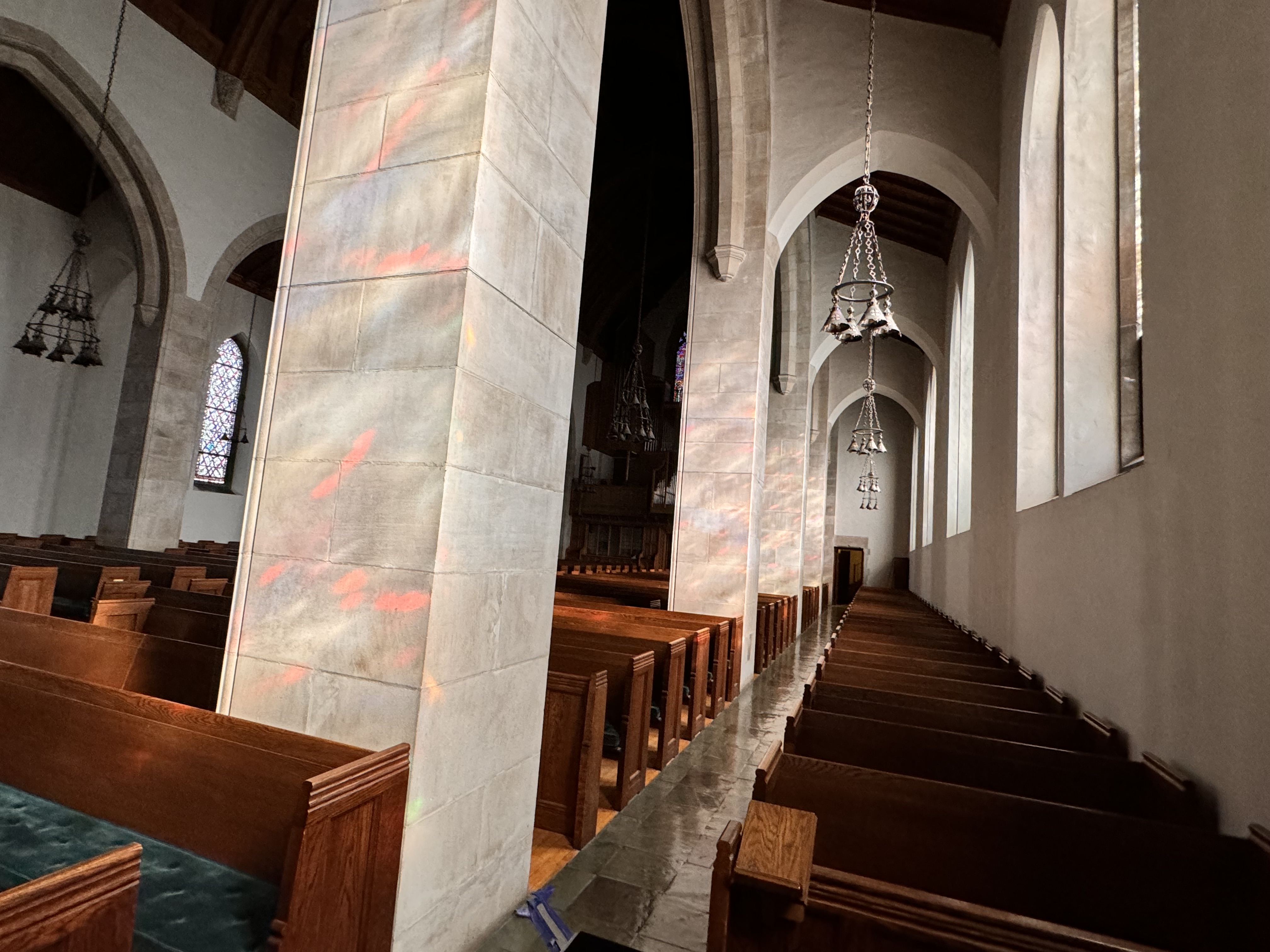
I want you to take a moment and look at the front of the stone pillars on my right side. Can you see it? Do you see it?  Look at all the speckled colors thrown onto the pillars from the morning sun coming through our windows. It’s gorgeous! Beloved, that’s a perfect example of how each of us to is invest God’s grace shown to us. We are to be sowing grace, investing God’s love and blessings just as the light is thrown over those stone pillars! We are not to keep the talent of grace to ourselves well-hidden and out of sight; we are called to liberally throw it around and about like the symphony of color showering our sanctuary this morning.

The Good News is that we worship and follow a God who lavishes us with grace and who only asks us to do one thing: Invest that grace, invest those gifts we’ve been entrusted with, in and through others in Christ’s Name. Amen.

© 2023 Patrick H. Wrisley. Sermon manuscripts are available for the edification of members and friends of First Presbyterian Church of Glens Falls, New York and may not be altered, re-purposed, published or preached without permission.   All rights reserved.


[1] The New Revised Standard Version, copyright 1989, 1995 by the Division of Christian Education of the National Council of the Churches of Christ in the United States of America. Used by permission. All rights reserved.

[2] Dale Frederick Bruner, Matthew: A Commentary. Vol. 2: The Churchbook, Matthew 13-28 (Grand Rapids: William B. Eerdmans Publishing Company, 1990), 551 – 562.

[3] See Matthew 23 & 24 for these first-century theological debates.  

Posted in Sermon | Tagged , , , , , , , , , | Leave a comment

Laissez-Faire Faith, Matthew 25:1-13

A sermon delivered by Patrick H Wrisley on November 19, 2023.

We preachers all have at least one really good wedding story we have had taken place. Mine was when I was an associate pastor for evangelism at Peachtree Presbyterian in Atlanta many years ago. It was a sweet couple in their late thirties, and both were high-ranking executives in their jobs. He was handsome and she was just beautiful – they appeared to be the perfect couple.

She had confided in our counseling together she was nervous about standing in front of a lot of people and was concerned she might faint in the middle of the service. I tried to assure her that it would all be fine and unbeknownst to her I made sure I had a pack of smelling salts in my pocket just in case.  The big day came, and the couple looked spectacular and there were several hundred in attendance that afternoon. I checked in with the bride and she was fine – cool as a cucumber! We got the service going right on time and everything was going as planned.

Now there is one ability that preachers develop over the years and that is to have conscious out-of-body experiences. In other words, we can be leading worship or preaching while at the same time standing outside ourselves watching what’s going on in the congregation. We spy the squirmy kid in the pew, or the sleeping parishioner seated towards the back. We see it all. So, at this wedding, we finished with the processional, climbed the steps of the chancel, and took our places. We were about to do the vows and so I told them to, “Turn and face one another, holding each other’s hands, and repeat after me.”

Now, standing In front of me are the best man, the groom, the bride, and the maid of honor. I am looking at the bride and tell her, “Please repeat after me…I Christine, take you Robert…” and it was at this precise moment I had my out-of-body experience. As I was telling her the lines to say, the maid of honor and I locked eyes and stared at each other. Unbeknownst to anyone else we saw this large, black spider slowly making its way up the back of the bride’s veil. We’re not talking about a little spider; this thing was the size of a small Volkswagen Beetle! Huge. Watching the spider while feeding the bride the next line to repeat, I noted how anxious the maid of honor was getting. She kept shifting her feet from side to side like she needed to use the restroom or something. As the spider was inching its way to the top of her head, the maid of honor snapped. Holding her bouquet as well as the bride’s flowers, she raised them over her head and brought them smack down across the bride’s head to knock the spider off of her! Again, again, and again she whacked the back of the bride’s head until we finally saw the spider fly off in front of the couple. The bride screamed and quickly lifted her foot and stomped on it. She had deadly precision with that stiletto heel and when she finally stopped stomping, I bent over and pronounced, “You got him!”

Our Story in Matthew is a wedding story. It’s about the bridal party waiting for the groom to arrive so they can accompany him to the bride’s house, pick up his fiancé, and then head to his parent’s house for the wedding and celebration. It’s a Story Jesus is using to describe what the kingdom of heaven is like. Listen to the Word of the Lord!

Matthew 25:1-13

25 “Then the kingdom of heaven will be like this. Ten bridesmaids took their lamps and went to meet the bridegroom. Five of them were foolish, and five were wise. When the foolish took their lamps, they took no oil with them; but the wise took flasks of oil with their lamps. As the bridegroom was delayed, all of them became drowsy and slept. But at midnight there was a shout, ‘Look! Here is the bridegroom! Come out to meet him.’ Then all those bridesmaids got up and trimmed their lamps. The foolish said to the wise, ‘Give us some of your oil, for our lamps are going out.’ But the wise replied, ‘No! there will not be enough for you and for us; you had better go to the dealers and buy some for yourselves.’ 10 And while they went to buy it, the bridegroom came, and those who were ready went with him into the wedding banquet; and the door was shut. 11 Later the other bridesmaids came also, saying, ‘Lord, lord, open to us.’ 12 But he replied, ‘Truly I tell you, I do not know you.’ 13 Keep awake therefore, for you know neither the day nor the hour.

We are picking up in Matthew’s Story with Jesus and the twelve disciples sitting somewhere on the Mount of Olives adjacent to Jerusalem sometime during what we call Holy Week. Looking west, they could see the gleaming Temple, and this is the backdrop of his telling them about things to come in the future. He’s telling them several stories about how the in-breaking of the Kingdom of Heaven may seem to be delayed but its arrival will surely come one day at a time when people least expect it. As readers of Matthew’s biblical account, we realize we are in a second long section of Jesus preaching and teaching his companions. Do you remember the first? It’s all the way back in Matthew chapters five all the way through seven. We call that section of teaching, The Sermon on the Mount, and it describes the ethics of how people in the Christian community, the church, are to live with each other. Matthew spends chapters 24 and 25 describing stories that tell the church, i.e., members like you and me, not to lag in our zeal as we wait for Jesus’ return. Remember, whenever a writer stretches out scenes in their story, they are wanting us to sit up and pay attention. So, what are we supposed to see?

Well, we have a large bridal party of ten young, single women waiting for the groom to show up. They had one job: Escort the groom as he went to meet his finance’ at her house and parade them to the wedding and feast. We know nothing about this group except half of them were wise and the other half not so much. They’re called foolish which is a polite way to say, they’re not the brightest bulbs in the box; the original language uses the word that means they’re stupid, heedless of any consequences.

The punchline of our scripture today is verse 25: Keep awake, therefore, for no one knows the day or the hour. A more precise reading is Jesus telling them, “Stay prepared.” The problem in our Story is not that the bridal party falls asleep waiting for the groom to show up; the problem was half of them weren’t prepared for his delay as they didn’t bring extra oil to burn.

Matthew shares this Story with his church that believed in Jesus but was wondering when Jesus was coming back again as conquering Messiah. He was writing to a church that had grown a bit slack in its waiting for Christ’s return. The bridal party represents the people of the church. The groom in our Story is Jesus and his coming back. The point is whether each of us is prepared or not. Pretty simple.

So how do we know if we are prepared or not? The key is linking this long sermon in Matthew to his earlier one, the Sermon on the Mount. One’s preparation is revealed in the quality of our being able to express all those wonderful Beatitudes in Matthew five. I love what Dale Bruner from Whitworth University says. He describes lamp oil as experiential and expressed Christianity. “Without the reserve oil of discipled Christianity – that is to say, an experience of Jesus without obedience to his teachings — betrays unbelief and will not find entrance into the end-time kingdom.”[1]

Funny thing about this bridal party. They all are the same except some were prepared and some were not. Just by looking at them when they first gathered would not have revealed who the wise or foolish ones were. It’s just a bridal party of excited girls waiting. It’s only when a crisis occurs that their wisdom or foolishness is revealed. The crisis of the tardy groom revealed who was prepared and who was not. The ones who were not prepared immediately wanted to leech off the ones who were. Their lack of preparedness is their personal problem and dilemma; they can’t blame anyone but themselves. When they finally do get their act together and arrive late, Matthew has the groom quote the words of Jesus back in Matthew 7, “Not everyone who says to me, ‘Lord, Lord,’ will enter the kingdom of heaven, but only the one who does the will of my Father in heaven.”[2] Go away. Though you call me “Lord, Lord,” I can’t recognize who you are because you’re not prepared. Ouch.

Jesuit scholar Thomas Stegman, writes, “They have not taken to heart Jesus’ warning that it is not enough to call out “Lord, Lord” in order to enter the kingdom. The wedding banquet is reserved for those who do God’s will, for those who have the oil of works of love and mercy. The negative example of the foolish maidens makes poignantly clear that being a Christian in name only is insufficient. The parable proper ends on a chilling note of rejection.”[3]

So, I suppose what each of us has to do when we leave this morning is reflect on whether or not we are truly prepared. What will Jesus say if we knock on the door to the banquet?

In the Name of the One who is, who was, and who is yet to come. Amen.

© 2023 Patrick H. Wrisley, Pastor, First Presbyterian Church of Glens Falls, 8 West Notre Dame Street, Glens Falls, NY 12801.  Sermon manuscripts are available for the edification of members and friends of First Presbyterian Church, Glens Falls, NY and may not be altered, re-purposed, published or preached without permission. All rights reserved.


[1] Bruner, Matthew. A Commentary. Volume 2: The Churchbook. Matthew 13-28, revised and expanded (Grand Rapids: William B. Eerdmans Publishing Company, 1990), 546.

[2] See Matthew 7:21.

[3] Feasting on the Word: Year A, Volume 4: Season after Pentecost 2 (Propers 17-Reign of Christ) (Feasting on the Word: Year A volume) by David L. Bartlett, Barbara Brown Taylor. See https://a.co/cc6zLWj

Posted in Sermon | Tagged , , , , , , , , , | 1 Comment