
A Sermon delivered by Rev. Dr. Patrick H. Wrisley on November 17, 2024
Turn in your Bible to Mark 13 as we will be reading the first eight verses. As a writer, Mark has us come literally full circle from where we began in chapter 1. Chapter 1 introduces us to Jesus who has come to proclaim the good news of God declaring the Kingdom of God has come near. We are then introduced to the very first disciples Jesus called, his inner circle. Simon Peter, Andrew, James and his brother John. As a stylistic choice, Mark has Jesus pull these four aside again. He gives them some inside information. These four appeared at the very beginning of his Story. Now, Mark assembles the Fab 4 again just before the Story’s climax. This literary technique does two things. On one hand, it signals a major shift in the Story. Mark is inviting you and me into the inner circle. He wants us to hear something very important.
Hear the Word of the Lord from Mark 13:1-8.
Mark 13:1-8
13.1 As he came out of the temple, one of his disciples said to him, “Look, Teacher, what large stones and what large buildings!” 2Then Jesus asked him, “Do you see these great buildings? Not one stone will be left here upon another; all will be thrown down.”
3When he was sitting on the Mount of Olives opposite the temple, Peter, James, John, and Andrew asked him privately, 4“Tell us, when will this be, and what will be the sign that all these things are about to be accomplished?” 5Then Jesus began to say to them, “Beware that no one leads you astray. 6Many will come in my name and say, ‘I am he!’ and they will lead many astray. 7When you hear of wars and rumors of wars, do not be alarmed; this must take place, but the end is still to come. 8For nation will rise against nation, and kingdom against kingdom; there will be earthquakes in various places; there will be famines. This is but the beginning of the birth pangs.[1]
Do you remember the first time you went to New York City? I remember going as a young boy of seven or so with my cousin John and was simply overwhelmed with the size of everything. The buildings were huge, people were everywhere. The very air had electricity in it – you feel the city. Then there was the original Yankee Stadium, the very house that Ruth built. What a day for a boy.
Today we find the disciples in Jerusalem a few days before the Jewish celebration of Passover. The city is thronging with pilgrims and vendors have set up shops everywhere to take advantage of the influx of consumers. Rich, poor, young and old, singles, families, sheep, goats, birds – it was a carnival atmosphere. Jesus’ twelve disciples, we must remember, were simple country boys from sticks of northern Galilee. They are overwhelmed with the onslaught of the sights and sounds they encountered.
Jesus has been spending time in the Temple grounds teaching and verbally sparring with the entrenched religious establishment who have made the decision they have had enough of Jesus and his teachings. Already, the plot has been hatched on how to arrest and kill him once the festival of Passover was through (Mk 14:1-2).
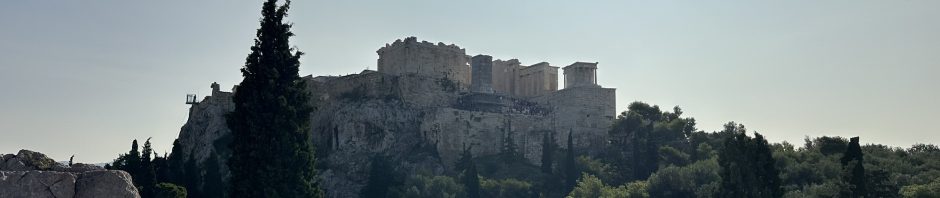
Walking eastward out of the Temple, the disciples marvel at all they see. Look at the stones! Look at these huge buildings! The great Herodian Temple contained some of the largest stones in the ancient world. The average size ran from 2 to 5 feet tall and 10 to 15 feet long. The master corner stone measures some 11 feet high. It stretches over 44 feet long. Experts estimate it weighs between 400 to 570 tons.[2]
Jesus and the disciples would have left the temple heading down into a valley just below the Temple grounds called the Kidron Valley. They immediately start climbing through an ancient Jewish cemetery as they hiked up the the Mount of Olives. We don’t know if they stopped in the Garden of Gethsemane or continued all the way up the hill. But when they sat down, they looked west. The entire Jerusalem skyline came into view. The sun would have been lowering in the western sky and all the white limestone would have simply glowed.
We can see them sweating from their climb as the sun hit their faces while they were having this moment. It’s here Peter, Andrew, James, and John want to pick back up the conversation they were having when they left the Temple.
“Jesus, you said the Temple would be destroyed. Tell us when all this is going to happen. What sign should we look for when it will take place?” This marks the beginning of what people call Mark’s little apocalypse. It’s the last teaching Jesus shares with his leadership team before he gets arrested. Mark spends the entirety of chapter 13 on it so he obviously wants us to sit up and take note.
But of what?
Jesus was taking this intimate moment with his closest friends to remind them all things are transient and change is inevitable. This change starts imperceptibly. It grows with time. Leaders will emerge who claim to have all the right answers. The disciples will be tempted to follow them. He tells them as the changes occur, there will be civil unrest, natural disasters, and war. Then he tells them something crucial. It almost gets lost in the narrative because of all this apocalyptic talk about the end of time. Jesus tells them, “Don’t be afraid or alarmed.”
Do not be frightened. In its original language, the word means wailing or crying out loud. Jesus is telling his friends, “Keep your eyes on me – don’t look right, left, up or down. Keep focused on me. I’ve got this. Don’t fall for substitutes or artificial quick fixes to problems; keep your focus on me.”
Jesus’ words to Peter, Andrew, James and John are important for us to hear today. We live in a swirly time that for many feels very apocalyptic and out of control. The US is on the verge of being entangled in world destabilizing wars with Russia and the Middle East. There is grief over the direction of our nation and the future of our democracy. Our politicians have yet learned how to play nice in the sandbox together in Albany and in Washington. Pronounced ecological disasters are occurring the world over from rising sea levels, severity of storms, or drought. As Bob Dylan rightly sung years ago, “The times, they are a changin’!”
And what are we asked to remember? Do not be frightened. Jesus reminds us, “I got this.”
Friends, it is so easy to get wrapped up in the bad news and what ifs of our world. It’s easy to be buoyed along by naysayers and doomsayers. It’s easy to become complacent. We can mistakenly believe that what I personally do or do not do makes no difference. But we must remember, life’s not always easy!
Just as we are marching through the season of autumn heading to the season of winter, so too our world is moving into a season of lower case ‘a’ apocalypse. We have come to think of the apocalypse in terms of the end of the world. I want us to reframe what it means for us as a season of change and reorienting. An apocalypse forces people to look at life in new ways. It also changes how they relate with each other. These are situations they never thought they would face before. It’s up to us how we navigate these changes.
Some will take up arms and vitriol.
Some will pretend nothing is going on and keep to themselves.
Some will lean and live into their faith in God and will keep their eyes straight ahead, full of hope and grit, knowing that God’s got all of this. The problem with apocalypses is that they are disorienting. We can lose our mark and way. They have this ability to fill us with fear about all the what-ifs and might-can-happens. When that occurs, we get stuck and miss living the full life of abundance that Jesus promises that is available to us now. We live our lives responding to problems instead of living into the the new possibilities opening in front of us. We cling to old ways while failing to imagine new potentials.
There was a news blip I saw yesterday about New Smyrna Beach, Florida north of Cape Canaveral. All along the Volusia County coastline, the beaches are open to drive on during the day. Interestingly, the Daytona 500 race originally took place on the beach of Daytona Beach Shores! Locals know if you’re going to be driving on the beach, you had better be aware of the tide charts. Well, apparently Bubba in his 4×4 quad cab Dodge Ram didn’t think he needed to do that. The picture said it all: It was growing dark and the waves were lapping over his floorboards. What a waste of a good truck.
Jesus reminds us to take time to watch the tides. Don’t be frightened by the changes coming but let us keep our wits and stay focused. Change is inevitable but he wants us along with James, John, Andrew and Peter to know, “Hey, I’ve got this.”
© November 17, 2024, by Patrick H. Wrisley. Sermon manuscripts are available for the edification of members and friends of First Presbyterian Church of Glens Falls, NY. These manuscripts shall not be altered, re-purposed, published, or preached without permission. All rights reserved.
[1] The New Revised Standard Version.
[2] Accessed on Chat GPT, 11/15/2024.