
Nothing Works if We Don’t Get the Basics Right; Psalm 133

Sermon:        Nothing Works if We Don’t’ Get the Basics Right
Scripture:     Psalm 133; Philippians 3:17- 4:3
Preacher:      Patrick H. Wrisley, D.Min.
Location:      First Presbyterian Church, Fort Lauderdale, FL
Date:             August 16, 2020

Today’s Psalm, coupled with the Philippians text, shape the thoughts we are going to explore this morning as we look at the fact that nothing works if we don’t get the basics right. For the Apostle Paul, it’s the basic reminder that Christ-Followers are members of the citizenry of heaven. Let’s read what it is from the Psalm’s perspective.

Psalm 133 is a from a group of Psalms that are called “Songs of Ascent.”  The Songs of Ascent were the various Psalms the Jewish people sang as they made their way up to Jerusalem for the major religious festivals. Members from all the different tribes would join in a singular voice singing praises to God for all God had done, is doing, and will do, not just in their personal lives but as a nation. Listen to this brief psalm and listen for God’s reminder to us; hear the Word of the Lord.

Psalm 133

1How very good and pleasant it is when kindred live together in  unity!

2It is like the precious oil on the head, running down upon the beard, on the beard of Aaron, running down over the collar of his robes.

3It is like the dew of Hermon, which falls on the mountains of Zion. For there the Lord ordained his blessing, life forevermore.[1]

This is a song the people would sing as they made their way to the Temple.  They sang it as a reminder that through their history together, God wove them from a scattered group of people called Hebrews and made them a unified nation of Jews. I may be from the tribe of Judah but I sing with one voice with my brothers and sisters from the tribe of Asher, Dan, Benjamin, and Naphtali.  We may live in different areas in Palestine but we are all united together as members of one nation. Our Psalm describes what it looks like when the people live together in unity by using two similes of abundance.

When sisters and brothers dwell and get along, it is like the extravagant oil that is used to ordain and set Aaron apart for his work. There is so much oil it rolls down his face, through his beard, and soaks into his clothes.

When brothers and sisters live in unity, their very community sounds like a well-practiced symphony of grace that starts in the mountain snows and flows down into the dusty valleys below bringing life where life may appear tenuous and doubtful. One scholar writes, “When unity settles in a community—be it family, church, or even a nation—it brings blessing and great joy to everyone”[2] but especially to God.

The Psalmist reminds us that yes, we may be different but there is beauty when that diverse uniqueness comes together and finds its oneness, its connectedness that is centered on worshipping the Lord God. The Apostle Paul reminds us that even though Euodia and Syntyche may disagree, they will come together and conform as mutual citizens of heaven and show the world there is another, a better way.

Last Monday morning I followed my daily routine. Every morning upon waking, I will make the coffee and then scan the headlines to see what has happened overnight. If I have time before the coffee pot finishes brewing, I will quickly scan Facebook or Instagram to see what’s up with those I know. When the coffee is finally made, I grab two mug-fulls and head upstairs into my study for scripture reading and prayer.

This past Monday morning, I followed my routine and made it to my chair for prayer but I was heartbroken and all I could do is sit there and stew. I even had a moment of professional despair as I pondered, “What good has my three decades of ministry produced if my people, my sheep, my flock are saying these things about each other?”

I closed my eyes and saw your faces sitting across and next to one another in worship. I saw the faces of congregants of the many churches I served over the many years in a similar way. Faces of people who loved each other. People who sacrificed their time and money for the cause of Christ in the community with each other.  People who took time praying for one another and with each other while studying the Holy Scriptures learning about the engine of God’s heart which is love.  With eyes closed, I saw you stand up and point a finger at the person you take communion with and declare, “You’re a left-wing, pinko-communist!” while the other stands up and shouts, “You’re a right-wing fascist!” One side declares to the other how unchristian, how “Satan-filled”, how ungodly, how stupid their brother or sister is because they don’t see the world like us. In my meditation that morning, this scene of bickering turned arguing with one another just broke my heart.

Jesus was nowhere to be found in the words you used against one another in my meditation. It’s what caused me to have a crisis of call and wonder, “Why do I even bother to try?”

What led me down that path during my Monday morning prayers this week is Facebook. Social media.  I was reading vitriol being espoused in rants, commentaries, and reposted newspaper articles from members of my churches over the years towards others that lacked any godly substance or edification at all.  With my mouth agape, I thought to myself, “These aren’t the people I see on Sunday morning in worship, at a prayer meeting, Bible study, or while serving others!” And yet, your voice, your words, were on full display on social media. The words I read and the posts I watched did not match the people whose faces receive communion from my hands in worship together. There is a disconnect. I tried to imagine what it would be like if you could stand up, look at another church member in the eye across from where you sit, and tell them how radically un-Chrisitan, Fascist, Communistic, left, or ring-wing extremist militants they are face to face. “That would never happen in real life in church!” I reminded myself. It was then the Holy Spirit whispered in my ear, “Preacher, it already is happening on Facebook.”  I wondered to myself how sensible, reasonable people I know from the church can lose all their sensibility and emotional filters when they go online and don’t have to look at someone in the eye?

Serendipitously, or better, Providentially, our General Presbyter, Daris Bultena, raised these issues for a group of clergy and laypeople the very next day at a regularly scheduled meeting. The way he put it was that when it comes to social media, your personal “brand” comes first and is more important than the “content” of what you post. In other words, we need to ask ourselves if how we portray ourselves online with what we are posting is consistent with the men and women we say we are as Christians and followers of Jesus. You see, this is what got me so upset in my prayer time Monday.  There was a gross inconsistency between the people I know my members to really be and with who they appear to be based upon what they’re posting online. There’s a gap.

Beloved, we are living in one hell of a year that has been beset with all sorts of physical, emotional, communal, financial, and spiritual pain and it is only August! We are at the door of a Fall season that is dripping wet with political bitterness, fear of the pandemic mixed with the flu, and with the fact that as a group, many white people like me have yet to face up to the fact that as a culture, we have not treated people of color very well and have caused them harm and angst.  Friends, we have a long way to go before we sing “Auld Lang Syne!” so let’s use today as a pause button to recalibrate our life so our “inner” spiritual, ethical world matches what we show others in our “outside” public world.  In other words, does the brand of being a Christian match the content of being a Christian by what we see say, by what we post, by how we love? Is the Christian example we display online marked by the threads of sacrificial love, justice, and reconciliation, or, displayed by the knots that reflect bitterness derived from hubris, moral superiority, and my sense of self-entitlement at the expense of others?

Friends, we are all brothers and sisters together. Some are Republican and some are Democrat. Some are straight and some are gay. Some are happy and some are filled with depression. Some are white Caucasians while others are black, or brown. But in this Church and in the world, we are all followers of Jesus Christ and the world, our very country, needs us to act like it and show others what it means.  Can I get an “Amen”?

Patrick H. Wrisley, D.Min.
Senior Pastor & Teaching Elder
First Presbyterian Church
401 SE 15th Avenue
Fort Lauderdale, FL 33301

© 2020 Patrick H. Wrisley. Sermon manuscripts are available for the edification of members and friends of First Presbyterian Church, Fort Lauderdale, Florida, and may not be altered, re-purposed, published, or preached without permission.   All rights reserved.

[1] New Revised Standard Version (NRSV). New Revised Standard Version Bible, copyright © 1989 the Division of Christian Education of the National Council of the Churches of Christ in the United States of America. Used by permission. All rights reserved.

[2] Connections: A Lectionary Commentary for Preaching and Worship: Year A, Volume 3, Season After Pentecost by Joel B. Green, Thomas G. Long, et al.
https://a.co/6FPL83w
Posted in Sermon | Tagged , , , , , , , , , , , , , , , , | Leave a comment

The Place of Remembered Blessing, Genesis 28:10-19a

Sermon:        The Place of Remembered Blessing
Scripture:     Genesis 28:10-19a
Preacher:      Patrick H. Wrisley, D.Min.
Location:      First Presbyterian Church Fort Lauderdale
Date:             July 19, 2020

Have you ever known a family that puts the ‘fun’ in ‘dysfunctional’?  You know the families I am talking about, don’t you?  There’s sibling rivalry between brothers who are so totally different in every possible way you wonder how they came from the same parents!  The younger brother does everything he can to supplant and cheat his older brother.  The younger brother manipulates his parents against one another.  He steals from the older brother what’s rightfully his.  He lies and twists the truth.  It finally gets so bad that he has to run away from home because of the turmoil he’s caused; his dad is dying, his mother is beside herself, and his older brother is out to run him down and kill him for all the strife the youngest sibling has caused.

Friends, I have just set up the scripture for this morning.  The dysfunctional family I am talking about is Isaac, Rebekah, Esau, and the conniving younger brother, Jacob himself.

In our story, we find Jacob on the run as we know from verses 27:41-45 when Jacob steals his brother’s birthright and is now on the lamb.  This is where we pick up.

Genesis 28:10-19a

10Jacob left Beer-sheba and went toward Haran. 11He came to a certain place and stayed there for the night, because the sun had set. Taking one of the stones of the place, he put it under his head and lay down in that place.12And he dreamed that there was a ladder set up on the earth, the top of it reaching to heaven; and the angels of God were ascending and descending on it. 13And the Lord stood beside him and said, “I am the Lord, the God of Abraham your father and the God of Isaac; the land on which you lie I will give to you and to your offspring; 14and your offspring shall be like the dust of the earth, and you shall spread abroad to the west and to the east and to the north and to the south; and all the families of the earth shall be blessed in you and in your offspring. 15Know that I am with you and will keep you wherever you go, and will bring you back to this land; for I will not leave you until I have done what I have promised you.”

16Then Jacob woke from his sleep and said, “Surely the Lord is in this place—and I did not know it!” 17And he was afraid, and said, “How awesome is this place! This is none other than the house of God, and this is the gate of heaven.” 18So Jacob rose early in the morning, and he took the stone that he had put under his head and set it up for a pillar and poured oil on the top of it. 19He called that place Bethel.[1]

One of my favorite authors, fellow Georgian Barbara Brown Taylor, writes in her book, Altar in the World, about a trip she took to Hawaii. Walking along the beach, she came to a secluded place where there was a little pool.  She writes,

Walking around the pool, I came to three stones set upright near the edge where the water was deepest.  All three were shaped like fat baguettes, with the tallest one in the middle.  The other two were set snug up against it, the same grey color as humpbacked whales.  Altogether, they announced that something significant had happened in that place…whoever had come before me had set up an altar, and though I might never know what that person encountered there, I knew the name of the place: Bethel, House of God.”[2]

Years ago a dear friend preached a sermon entitled, “A Place of Remembered Blessing.”  Though I cannot remember the specifics of his sermon, I do remember the title and have held onto it for over 30 years.[3]  A place of remembered blessing.  A place where you are surprised by God’s Presence and are taken aback and you know that you have been surprised by the Almighty, or as C.S. Lewis noted, Surprised by Joy.  This is what Jacob discovered.  It was all Jacob could do but erect a rock pile, anoint it, and call it, Bethel – the House of God.

This is a Story laced with four incredible strands of grace; it’s woven together with four threads of Good News.  First, there’s the Good News that even though Jacob was a scoundrel and a jerk, he is still useable and needed by God. It’s a Story that reminds you and me that God can use anyone, even scoundrels like you and me, to accomplish the task God has set before us.  Our text reminds us that there is not a single person our Lord cannot show or reveal himself to if it’s God’s choice to do so. A former professor of mine, Walter Brueggemann, says the remarkable thing is not God’s appearance but that God would show up and appear to such a conniving exiled one![4]

Second, even though Jacob didn’t know God, God knew Jacob. We often think that a person has to be looking for God before God can be revealed.   This is simply not the case. There are many families where one member of the family believes in Jesus and another doesn’t. We are given hope that either in our own or in one of our family member’s recalcitrance God still loves them and will show up when they are able and capable to hear the Divine Word; believe me, friends, I doubt there are many family members or friends of ours whose ways were any worse than Jacob’s!

Third, though Jacob was smack dab in the middle of nowhere – it’s akin to being on some side road off Alligator Alley in the Everglades – God was right there in a place that Jacob would not expect to find anyone.  This Good news reminds us that wherever our loved-ones flee to, or, wherever we go and escape the issues or nasty people in our life, God is already waiting there for us.

Fourth, there is the Good News that God shows up and appears to Jacob in a way that matches Jacob’s personality, i.e. in a dream. Remember, Jacob was a master manipulator.  Even when he was born he was grasping at his twin Esau’s heal as Esau was moving through Rebekah’s birth canal! Jacob wanted to be first![5]  He wanted to be in control! He lived his entire life that way and God knew that fact.  So what does God do?  God shows up at a time when Jacob is totally unaware and defenseless.  God shows up in a dream.  God shows up at a time when Jacob’s guard was down, and as such, it provides Jacob the opportunity to have an alternative course laid out for his life.[6] God does not want to get into a discussion with a controlling Jacob; God waits until Jacob is asleep so that Jacob can’t talk back and give God mouthy lip-service.

This is such a wonderful Good News Story!  God takes a no-place and makes it a holy place.  God takes a no-good person and makes him a called and vital person.  It all happens at Bethel – the place of blessing.  Bethel is where God redeems Jacob and sets him on a new course in life. Bethel is the place Jacob becomes a new man who is set on a new path.  The old scandalous life of the scoundrel is now set on a life re-oriented towards living life for God and for others.  It is the place where God surprised him with bright divine joy!

Beloved, if God can do that with a person like Jacob, God is able to reveal himself to you and me as well.  I want you to think for a moment:  When and where has God shown up in your life when you least expected it and given you an encounter that changed your life forever?  You see, at Bethel, Jacob became a new man.  At that desert-sleeping place, he was touched by God and his life was never the same.  He called it Bethel and built a rock pile to remember the place.  Tell me, where’s your Bethel?  Where have you built your rock pile?

The ancient Celts, our Presbyterian forbears, had a name for these places where God makes himself present in powerful ways to us.  They call them “thin places” after the notion that the veil that separates heaven and earth is stretched so thin that we are, like Jacob, given the opportunity to experience the profound Presence of the Lord.

New York Times reporter Eric Weiner describes these types of places like this. He writes,

They are places that beguile and inspire, sedate and stir, places where, for a few blissful moments (we) loosen (our) death grip on life, and can breathe again. It turns out these destinations have a name: thin places…They are locales where the distance between heaven and earth collapses and we’re able to catch glimpses of the divine…(these places have the habit to) disorient…confuse (us). We lose our bearings, and find new ones…we are jolted out of old ways of seeing the world.[7]

I have my own thin place, my own Bethel, and place of remembered blessing. Like the Cherokee, I find the Smoky Mountains to be a place where heaven touches earth.  It’s in those mountains forty-five years ago that I, as a young teenaged boy confused by life events, first experienced the graceful, loving power of God. It is there I met Jesus and my life was changed forever. The deep woods of those mountains are my Bethel. I have built a rock pile there.  When I am physically, emotionally, or spiritually spent, I know I have to go back to the Smoky Mountains, my Bethel.  They are the place of remembered blessing to me. If I cannot go there physically, as has been the case with this virus, I close my eyes in meditation and go there in my mind and Spirit.

Where is that place of remembered blessing for you, beloved?  Where is your Bethel?  Where is the place you can either physically or mentally go to and re-live, re-experience the soft, deft touch of God’s presence in your life?  Where’s your place of remembered blessing?

If you have not encountered a thin place, if you have not discovered your Bethel yet, then be patient.  You will.  God is eager to reveal himself to each of us. We cannot force it.  It’s not that we can make up our own Bethel because Bethel, the place of remembered blessing, is a gift God gives to each of us in God’s own time. You know it when it happens, though. It will be a surprise.  It will be a moment or a place that will change the way you see yourself and the world around you. It will be a place where you will all of a sudden catch a scent of the Garden of Heaven.

Where’s your Bethel?  Where is your place where you remember the blessing of God?  When was the last time you physically or mentally went there?  Don’t wait too long to go back!  The Spirit add understanding to these words!  Amen.

Patrick H. Wrisley, D.Min.
Senior Pastor & Teaching Elder
First Presbyterian Church
401 SE 15th Street
Fort Lauderdale, FL 33301
Http://patrickhwrisley.com

© 2014, 2020 Patrick H. Wrisley. Sermon manuscripts are available for the edification of members and friends of First Presbyterian Church, Fort Lauderdale, Florida and may not be altered, re-purposed, published or preached without permission.   All rights reserved.

[1] New Revised Standard Version (NRSV). New Revised Standard Version Bible, copyright © 1989 the Division of Christian Education of the National Council of the Churches of Christ in the United States of America. Used by permission. All rights reserved.

[2] Barbara Brown Taylor, An Altar in the World: A Geography of Faith (New York: HarperCollins, 2009), 2.

[3] A sermon preached by the Rev. Dr. Robbie Carroll at Decatur First Presbyterian Church in Atlanta sometime in the 1980’s.

[4] Walter Brueggemann, Genesis. Interpretation Bible Commentary Series (Atlanta: John Knox Press, 1982), 242.  For those who are interested in biblical commentaries, this is one of the best ones for explanations of the Genesis narratives.

[5] Genesis 25.24-26.

[6] Brueggemann, 243.

[7] Eric Weiner, “Where Heaven and Earth Come Closer,” The New York Times, March 9, 2012.  See http://www.nytimes.com/2012/03/11/travel/thin-places-where-we-are-jolted-out-of-old-ways-of-seeing-the-world.html?_r=0. Accessed on 7/20/2014. Words in parenthesis were added by me for rhetorical clarity.

Posted in Sermon | Tagged , , , , , , , , , | Leave a comment

Take A Soil Sample Before Tilling the Soil, Matthew 13:1-9, 18-23

Sermon:        Take a Soil Sample before Tilling the Soil
Scripture:     Matthew 13:1-9,18-23
Preacher:      Patrick H. Wrisley, D.Min.
Location:      First Presbyterian Church, Fort Lauderdale, FL
Date:              July 12, 2020

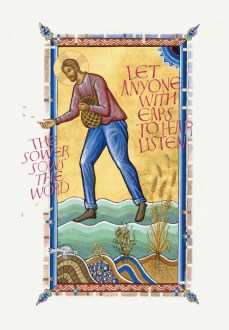
Today’s scripture comes from Matthew 13 which contains several parables from Jesus talking about the Kingdom of Heaven. In Matthew’s gospel, Jesus not only inauSower_and_the_Seed_image_onlygurates the personal presence of God in the world; Jesus sets out the plan for how his followers will engage the world when he’s gone.

Listening to our text today, you may be very familiar with it. It’s well known and we are tempted to begin hearing its wisdom and automatically flash sort our impressions of it and immediately categorize where we are in the parable. Let’s try not to do that and simply listen to the text as though you’ve never heard it before. Listen to the Word of the Lord!


Matthew 13:1-9, 18-23

13.1 That same day Jesus went out of the house and sat beside the sea.2Such great crowds gathered around him that he got into a boat and sat there, while the whole crowd stood on the beach. 3And he told them many things in parables, saying: “Listen! A sower went out to sow.4And as he sowed, some seeds fell on the path, and the birds came and ate them up. 5Other seeds fell on rocky ground, where they did not have much soil, and they sprang up quickly, since they had no depth of soil.6But when the sun rose, they were scorched; and since they had no root, they withered away. 7Other seeds fell among thorns, and the thorns grew up and choked them. 8Other seeds fell on good soil and brought forth grain, some a hundredfold, some sixty, some thirty. 9Let anyone with ears listen!” …18“Hear then the parable of the sower. 19When anyone hears the word of the kingdom and does not understand it, the evil one comes and snatches away what is sown in the heart; this is what was sown on the path. 20As for what was sown on rocky ground, this is the one who hears the word and immediately receives it with joy; 21yet such a person has no root, but endures only for a while, and when trouble or persecution arises on account of the word, that person immediately falls away. 22As for what was sown among thorns, this is the one who hears the word, but the cares of the world and the lure of wealth choke the word, and it yields nothing. 23But as for what was sown on good soil, this is the one who hears the word and understands it, who indeed bears fruit and yields, in one case a hundredfold, in another sixty, and in another thirty.” [1]

Did you hear it? Did you notice how Matthew bookends the first part of our text to make sure we get it? Jesus begins by telling his followers, “Look here!” and he ends the parable with, “Listen up, now!”  He wants us to be sure to get what he is trying to say because what he said is the key to breaking the code of this parable!

Professor of New Testament at Whitworth University, Dale Bruner remarks, “Listening to Jesus’ words is the key to life; our ears are the soil of our lives. Ears attentively devoted to the Word of Jesus are good soil; ears that are distracted, inattentive, casual, or diffused in concentration are the several unfruitful soils of the parable.”[2]  You see, friends, all the different soils received the seed, i.e. heard the Word from Jesus yet only one paid attention to what he said and produced a crop. Beloved, Jesus is grabbing our collars and looking at us in the face and wants us to get that the key attitude in the spiritual life is the attitude of listening to Jesus’ Word![3] Are we?

So, what type of soil represents you? I mean, you’re tuned into worship and all and that’s a good thing! If you’re participating in worship then surely you’re the good soil! Let’s unpack that a little.

Jesus is speaking to the disciples and to you and me, the Church. He is speaking to four various types of people who have comprised the Church’s community since the days of Jesus himself. Within the Church, there are Path Soil people, Rocky Soil people, Thorny Soil people, and Good Soil people. My colleagues Pam and Nic are mathematicians and they would indicate that statistically as you and I look at the whole group, each of us has a one in four shots to be in the Good Soil camp. There are four options; we get to choose one.  The unfortunate reality is that seventy-five percent of us will not get, hear, and internalize the message Jesus is trying to convey. As scholar Dale Bruner reminds us, only one in four will understand the Word but yet all four soil types are in the church.[4] It’s a reminder of the Old English proverb that says, “Not all people who go to church say their prayers.”

First, there are Path Soil people. The gracious, whimsical Sower enthusiastically scatters seeds and some of it lands on the path. The path, the road, is heavily used and the soil has been compressed tight from all the weight of the people tramping on it over the years.  The seed, the Word of God, isn’t able to penetrate the soil because the soil is dense and the seed is exposed to birds who swoop in and eat it before it has a chance to germinate. Jesus is telling us that there are some people in the faith community who are so hard-hearted that even when the Word is shared, it fails to penetrate their surface.  Have you ever seen Path Soil people in the Church?  They’re here.

Next, there are Rocky Soil people. These are the people who are spiritually all drive-shaft but no engine, tall hat but no saddle. They look well put together and behave like Christians are supposed to behave on the outside but there’s not a whole lot of spiritual substance to them on the inside. First-level thinkers, they tend to go with the flow of what others are saying but once another compelling story or personality and charismatic preacher, speaker, or author come along, when problems arise, they forget the Good News Word Jesus has proclaimed. Have you ever seen Rocky Soil people in the Church? They’re here.

Third, Jesus says there are Thorny Soiled people. These are attentive hearers of the Word of Jesus but they have the attention span of a Labrador retriever puppy; they hear the Word but are distracted by too many other things.  Jesus says they are consumed by anxiety about life or they are too wrapped up in their financial portfolio to let the Word of God take root.  Driven by issues and distractions, their inability to be still and quiet inhibits them to really absorb the Word of Jesus into their lives. Have you ever seen Thorny Soil people in the Church? They’re here.

Finally, we have Good Soil people. These are people who hear the Word of Jesus and take it down deep into their hearts and lives only to have the seeds grow and blossom into bountiful fruit everyone can see and experience! These are the Christ-Followers whose lives of faith explode with a harvest producing yet more seeds to catch the wind and have the chance to grow as well. Have you ever seen Good Soil people and the results of their planting in the Church? They’re here.

Friends, the positive test of a good soil sample is simply the fruitfulness of the disciple and the church. Jesus claps his hands and shouts, “Look! Listen!” He’s telling us that when you and I hear the Word and receive it deeply into the soil of our heart, then our life, our ministry, our church will be fruitful. A person’s or a church’s fruitfulness and faithfulness are first and foremost determined by whether you and I, whether we as a Church, receive the Word of Jesus into our lives.  It’s not rocket science. You and I, the Church, is useful and fruitful and productive for the Kingdom of heaven when we simply place ourselves under the Word and receive it.

The path’s soil heard the Word but did not receive it.

The rocky soil people heard the Word and received it with great joy but when the pressures came, they let it go.

The thorny soil people heard the Word and held it in one hand while they filled their other hand with anxieties and wealth and couldn’t hold onto both and the Word slipped away.

The good soil people hear the Word and cups both hands together to catch all the seed to keep it safe for its intended use; they take the good seed and strategically plant it in good soil for the greatest amount of fruitfulness to occur.

Beloved, what’s the state of the soil of your Spiritual life? Is it hard, rocky, thorny, or prepared to receive the seeds from the Word of Jesus? What’s the state of the soil for our particular church? Is it hard, rocky, thorny, or prepared to grow deep in the Word?  How shall we really know? Well, I suppose we will have to get through this season and see how much fruit we bear and can give to others in Christ’s and the Kingdom’s Name. Faithfulness, i.e. fruitfulness to the Word of Jesus is determined by the crop we generate and how much seed we spread for the Kingdom of Heaven. God help us be a part of that 25%!

Let those who have ears listen!

Patrick H. Wrisley, D.Min.
Senior Pastor & Teaching Elder
First Presbyterian Church
401 SE 15th Avenue
Fort Lauderdale, FL 33301

© 2020 Patrick H. Wrisley. Sermon manuscripts are available for the edification of members and friends of First Presbyterian Church, Fort Lauderdale, Florida, and may not be altered, re-purposed, published, or preached without permission.   All rights reserved.

[1] New Revised Standard Version (NRSV). New Revised Standard Version Bible, copyright © 1989 the Division of Christian Education of the National Council of the Churches of Christ in the United States of America. Used by permission. All rights reserved.

[2] Dale Frederick Bruner, Matthew. A Commentary. The Churchbook, Matthew 13-28, Vol. 2 (Grand Rapids: William B. Eerdmans Publishing Company, 1990), 4.

[3] Ibid.

[4] Ibid., 23.

Posted in Sermon | Leave a comment

The Little Foxes that Spoil the Vine; Song of Solomon 2:8-15

Sermon:        The Little Foxes Spoil the Vines
Scripture:     Song of Solomon 2:8-15
Preacher:      Patrick H. Wrisley, D.Min.
Location:      First Presbyterian Church, Fort Lauderdale, FL
Date:             July 5, 2020

Today we are looking at a text from one of the only two biblical books that does not exclusively mention “God” throughout the book.[1] It’s also the only time this book of the Bible is referenced in the lectionary readings for Sundays. Specifically, we will be taking a look at the Hebrew text from The Song of Solomon, or sometimes referred to as the Song of Songs.

In its most basic form, the Book of Songs is a lyrical and very passionate love poem written from the voice of a woman as she expresses herself to her beloved. It is loaded with physical euphemisms to the point some have argued over the centuries whether it should even be in the Jewish and Christian canon of scripture! Yet, as far back as the first century, Rabbi Akiba ben Joseph, renowned Jewish scholar and biblical commentator described the Song of Solomon this way:

The whole world is not worth the day on which the Song of Songs was given to Israel, for all the Scriptures are holy, but the Song of Songs is the Holy of Holies (Mishnah Yadayim 3:5).

What made this late first-century rabbi say such a thing? He said it because it describes the overflowing passionate love of God for her beloved! Even though the Temple in Jerusalem had already been torn down, Akiba reminded people that the beauty and essence of God could be found in the words of the Song of Solomon. Reciting the poem, a person can feel the passion and longing of God for her beloved.[2] The love expressed is holiness indeed! Later Christian scholars believe it’s an allegory that describes Christ’s passion for the church.

I will be reading Song of Solomon 2:8-15. Listen to the Word of God!

Song of Solomon 2:8-15

8The voice of my beloved! Look, he comes, leaping upon the mountains, bounding over the hills. 9My beloved is like a gazelle or a young stag. Look, there he stands behind our wall, gazing in at the windows, looking through the lattice. 10My beloved speaks and says to me: “Arise, my love, my fair one, and come away; 11for now the winter is past, the rain is over and gone. 12The flowers appear on the earth; the time of singing has come, and the voice of the turtledove is heard in our land. 13The fig tree puts forth its figs, and the vines are in blossom; they give forth fragrance. Arise, my love, my fair one, and come away. 14O my dove, in the clefts of the rock, in the covert of the cliff, let me see your face, let me hear your voice; for your voice is sweet, and your face is lovely. 15Catch us the foxes, the little foxes, that ruin the vineyards— for our vineyards are in blossom.”[3]

The two lovers’ eyes meet and they are totally smitten with the other.  They cannot stop staring at one another through the lattice on the fence and they begin to utter sweet words of love to each other. They are words of longing, pleading, desiring and there are words of warning.  Did you catch them?

Note verse 15 in our story.  In the midst of their intimate exchange come words of warning. “Let us catch the foxes, the little foxes, that ruin the vineyards – for our vineyards are in blossom.”

The lovers are enraptured with each other. Their love and passion for one another are in full bloom; the enticing fragrance of love is literally in the air; it is palpable! Their desire is real, it is beautiful, it is good! The relationship is strong and fruitful but because it is real, beautiful, and good, the couple must first catch the little foxes that spoil the vineyard. These little foxes are the little things that can intrude into the couple’s relationship and cause havoc in their love together.

You know those little relationship foxes, don’t you?  Telling trivial half-truths to your partner. Using the credit card too much without the other’s knowledge. Saying that you will do something for the other but you never do; you only say what you know will to get them off your back. It’s the little things that are the genesis for larger problems.

How do the little foxes destroy a vineyard? First, foxes are nocturnal and come out at night where their mischief cannot be seen. And from where do they come from? They come from their dens and tunnels burrowed under the vineyards. Have you ever seen a dog digging? They are no respecter of the damage they’re doing. They’ll tear through anything – roots, dirt, rocks. You see, when foxes start burrowing near a food source like a garden, they will create a network of underground tunnels that damage the integrity of the ground as well as by chewing and digging through the garden’s root systems. The garden may not only fall in on itself but the fruit or vegetables will be destroyed because the root systems aren’t getting nourishment to the fruit. On the outside of things, everything looks great in the garden; it’s only after time the damage done beneath the surface begins to visibly impact what others see on the vineyard’s surface.

Furthermore, Foxes, if they go unchecked, attract other pests and rodents like mice and rats; when those other critters begin smelling the dying fruit of the vine, they will come running. Then come the bugs and insects swarming to eat the leaves of the vines or the fruit itself. Foxes may be awfully cute (which makes it so hard to do anything to hurt one of them!) but they are an invasive species for a vineyard or garden and we all know about invasive species here in south Florida don’t we? We’ve got everything from Bufo Toads, curly-tailed lizards, and our beloved chicken of the trees, iguanas! A little fox in the vineyard is a catalyst for all sorts of problems in a garden.  Hence, the urging of verse 15, “Catch the little foxes that spoil the vineyard.”

So, if Rabbi Akiba is correct and Songs is a glimpse into the Holy of Holies where you and I encounter the Living God, what are those little foxes we need to be aware of in our own vineyards that will prohibit our relationship with Jesus Christ from growing into a beautiful love story?

Little Fox number one:  Excuse making. Making excuses for failing to do something or not in a relationship will kill the relationship over time. It conveys to the other, “You’re really not that important to me because I would do what you asked if you really mattered.”

What excuses do you and I make with God? Are there aspects in your walk with Christ that you consistently make excuses for not doing? “I don’t have enough time to read the Bible” but you do have time to play golf. “I don’t have enough to give to the church’s ministry” but you can drop $500.00 on a night on the town? Golf and nights out are all good things, friends, but when God hears our excuses over and over again for not living and demonstrating basic Christian practices and values, Jesus will shrug and move on assuming we really don’t care.

Little Fox number two: Failing to spend time with the other. Our society has bought into the lie of “quality time.” Don’t misunderstand me, quality time spent with others is important but so is the quantity of time spent with others.  I may take you on some of the finest, most glamorous dates you have ever been on but unless we consistently spend time with each other on a somewhat daily basis, our relationship will not grow very deep. What happens is the dreaded marital drift. By spending less time with the one you love, your love for them loses its passion and glow and grows duller. In the midst of marital drift, lies are a little easier to say, excuses are easier to make, and absence all the more desirable.

Church, how much time are you spending with God? Let’s not go to little fox number one and start making excuses, but seriously reflect, “Am I spending quantitative and quality time with the Lord?” At the very least, quality and quantity time with Christ is expressed through our worship habits, our growth in spiritual maturity and knowledge, our giving of our time and talents for the care of others and in service to others, and in sharing our financial resources on Kingdom work. You show me a person living consistently displaying these habits and I will show you a person who is devoting time to maintain a holy relationship.

Finally, Little Fox number three:  A relationship is damaged when both people fail to say, “I love you,” on a consistent basis. I cannot tell you how many people I have counseled with over the years who have longed their entire life to have a parent or sibling simply say, “I love you.”  I cannot tell you how many couples I have met with whose wife or husband yearns to hear their beloved say, “I love you.” I cannot tell you how many parents dream of hearing their child say, “I love you.”  You see, when we fail to say, “I love you” we demonstrate that we are taking the other person for granted, or in the words of an old movie, “I’m not all that into you.”

I have named three little foxes that can destroy a relationship’s garden: Making excuses; failing to spend time together; and neglecting to say, “I love you.”  There are countless others, my friends, and over the Fourth of July Weekend, I encourage each of us to reflect on those little foxes spoiling our relationship with God and with those who matter to us. We have lots of homework, beloved! Go in peace. Amen.

Patrick H. Wrisley, D.Min.
Senior Pastor & Teaching Elder
First Presbyterian Church
401 SE 15th Avenue
Fort Lauderdale, FL 33301
pwrisley@drew.edu

© 2020 Patrick H. Wrisley. Sermon manuscripts are available for the edification of members and friends of First Presbyterian Church, Fort Lauderdale, Florida and may not be altered, re-purposed, published, or preached without permission.   All rights reserved.

[1] The other scriptural book that does not mention God is the Book of Esther.
[2] Song of Solomon 2:8-13 Commentary by Kathryn M. Schifferdecker in Working Preacher – Preaching This Week (RCL). Accessed on July 2, 2020 at http://www.workingpreacher.org/preaching.aspx?commentary_id=385.
[3] New Revised Standard Version (NRSV). New Revised Standard Version Bible, copyright © 1989 the Division of Christian Education of the National Council of the Churches of Christ in the United States of America. Used by permission. All rights reserved.

Posted in Sermon | Tagged , , , , , , , | 1 Comment

The Plan: Motivation, InSpiration, and Personalization; Matthew 9:35-10:8

Sermon:        The Plan: Motivation, InSpiration, and Personalization
Scripture:     Matthew 9:35-10:8
Preacher:      Patrick H. Wrisley, D.Min.
Location:      First Presbyterian Church, Fort Lauderdale, FL
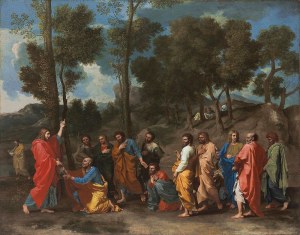
Date:             June 14, 2020poussin_ordination_grt

Our text today comes from Matthew 9:35-10:8. Jesus has a plan he wants you and me to follow and this plan revolves around three words I want us to remember: Motivation, InSpiration, and Personalization. As we hear our text, keep in mind Jesus is reflecting upon the words of the Prophet Ezekiel. In Ezekiel 34, Ezekiel confronts the sad reality that the spiritual and social leaders of Israel were failing to do their God-directed jobs to be the leaders, the shepherds for their flock, the Jewish people[1]. Listen to Matthew’s Story.

 Matthew 9:35-10:8

                  35Then Jesus went about all the cities and villages, teaching in their synagogues, and proclaiming the good news of the kingdom, and curing every disease and every sickness. 36When he saw the crowds, he had compassion for them, because they were harassed and helpless, like sheep without a shepherd. 37Then he said to his disciples, “The harvest is plentiful, but the laborers are few; 38therefore ask the Lord of the harvest to send out laborers into his harvest.”

10.1 Then Jesus summoned his twelve disciples and gave them authority over unclean spirits, to cast them out, and to cure every disease and every sickness. 2These are the names of the twelve apostles: first, Simon, also known as Peter, and his brother Andrew; James son of Zebedee, and his brother John; 3Philip and Bartholomew; Thomas and Matthew the tax collector; James son of Alphaeus, and Thaddaeus; 4Simon the Cananaean, and Judas Iscariot, the one who betrayed him.

5These twelve Jesus sent out with the following instructions: “Go nowhere among the Gentiles, and enter no town of the Samaritans, 6but go rather to the lost sheep of the house of Israel. 7As you go, proclaim the good news, ‘The kingdom of heaven has come near.’ 8Cure the sick, raise the dead, cleanse the lepers, cast out demons. You received without payment; give without payment.[2]

This is one of three times in Matthew’s gospel that he outlines Jesus’ job description and purpose.  Did you hear it? Jesus traveled about and did what three things consistently? He preached, he taught, and he healed.[3] This is the outline for his ministry. He preached the good news, taught, and healed broken people. Straight away, Matthew is outlining what Jesus’ purpose was and is and our text is showing you and me that it should be our purpose as well.

A picture is worth a thousand words. Dr. Hunter Farrell, the Director of the World Mission Initiative at Pittsburgh Theological Seminary, began his presentation by showing the audience a picture. It was a shot of a college-aged student on a mission trip. She was an attractive young woman, her eyes are fresh and bright, magnified by this beautiful smile. She was sitting on the ground and was surrounded by several poor children of color, presumably from Africa. Her arm was extended out with her cell phone in hand and was smiling for the camera but all the bedraggled children in the photo with her looked puzzled and confused. You see, the only one smiling in the picture was the young woman.

Dr. Farrell went on to say that the Church, particularly the Presbyterian Church and other Mainline denominations, who were once known for the power and impact of their mission endeavors, have over the last several decades traded impactful mission for photo-ops. He said, “Whereas there was a time when churches were known for building universities, schools, and hospitals, the church’s current mission seems to fulfill the needs of the missionary as opposed to the ones for whom the mission is to be done. We’ve exchanged meaningful mission for mission selfie experiences that last for a fleeting moment.  Sure, they make us feel good but is our work making a meaningful impact in the long term?”[4]

What Farrell is getting at is what is the motivation behind our missions? We look for our motivation to be modeled after Jesus’ motivation which was what? Compassion for the people. “For they were like helpless sheep without a shepherd.”

Friends, compassion is not just a feeling for someone; it’s experiencing the actual brokenness, sorrow, and needs with that person. Their need becomes our personal desire to alleviate because we feel their pain. Dr. Denise Thorpe, also from Pittsburgh Theological Seminary, writes, “Compassion frames what Jesus sees, his vision of the harvest. It shapes his charge to the disciples (9:36–37). Participation in that harvest is given to the disciples; received without payment. They live in grace’s unrepayable debt (10:8).”[5]

Can you think of the only publicly held team in the NFL? It’s the Green Bay Packers!  It is not owned by a family or a corporate sponsor but by the fans of the Packers themselves! So, when in January 2012, The Green Bay Packers were to play the New York Giants for a Divisional Playoff game at Lambeau Field after a night of nearly a foot of snowfall, the fans who had an investment in the team came to shovel out all the tons snow in the stands and on the field.  The City workers did not do it. A private company did not do it. The fans were motivated by their investment and stock in the team did it!  At 4:30 in the morning of the game, nearly 1,300 people showed up in the subfreezing temperatures to wait for the privilege to blow, shovel, and clean the stadium from tons of snow. On that day, the spectators became the players on the field. It was the spectators who made the game possible in the first place![6] Their feelings for their beloved Packers were the motivation to get them engaged, involved, and making a difference.

What kept Jesus going was his motivation to make a difference in the lives of his countrymen and women by proclaiming the kingdom of heaven was near, correctly teach what the Old Testament prophets actually taught, and brought healing to the broken ones.

God’s got a plan and there is specific motivation driving it. God’s plan must also have InSpiration. Throughout the gospel stories, Jesus is always trying to get away alone and pray. Another way to think of prayer is that it is a time of and for InSpiration. Our English word for inspiration comes from two Latin words “in” and “spirare” which literally is translated, “To be in-breathed, in-Spirited.” Isn’t that what we are about while we pray?  It’s a time to be in-Spirited, inhabited with Spirit, as we seek God’s way in our prayers.

Jesus rues with his disciples, “The harvest is plentiful but the workers are few; pray to the Lord of the harvest for workers to glean the harvest that awaits!”[7]  Missional work requires in-Spiration, in-Spiriting from God! In other words, beloved, we have to be in prayer so that God reveals 1) what mission you and I are to undertake, 2) what mission we as a church are to undertake, and 3) that God will gift our motivation for that mission with resources of gifted persons and financial and tangible resources to make the mission a reality.

God’s got a plan for mission and it requires motivation and inspiration. Yet, the plan is just a plan until it receives personalization! So, Jesus looked out at the motley crew in front of him and he began to personally call out twelve of his followers to help in fulfilling that inspired motivation.  There was Matthew, a despised tax collector. There was Peter, wrapped up in compulsivity whose mouth always blurted out the first thing that came to his mind. There was big-hearted John Zebedee who deeply felt Jesus’ compassion.  There was Andrew, the quiet networker who had this gift of getting the right people together at the right time. Oh, and there was Judas, who in his extremist views ended up selling Jesus out because Jesus did not fulfill his personal expectations.

Jesus calls out personal individuals, warts and all, to put skin on his compassion for others in the world. Jesus is motivated, driven by his love for people and for their relationship with God and with each other. He uses the in-Spirited resources he has to get the job done even when others reflect at the end, “Who would have ever thought?”

Beloved, what motivates you in your life in Christ? Is it primarily what you “get” from God in Jesus or is it that burning compassion for those he loves in the world?

Beloved, are you taking time throughout the hours of the day to be in-Spirited by God in prayer? Are you taking the time to hold yourself up to God and say, “Lord, I’m motivated, now reveal to me if I have or can discover the resources needed to make a difference.”

Beloved, are you personally making yourself available for mission, or are you expecting someone else to do it for you?

Motivation, InSpiration, and Personalization – this is God’s plan. The question is, are we motivated. Are we inSpired? Are we making it personal?  Let’s think about these things. Amen.

Patrick H. Wrisley, D.Min.
Senior Pastor & Teaching Elder
First Presbyterian Church
401 SE 15th Avenue
Fort Lauderdale, FL 33301

© 2020 Patrick H. Wrisley. Sermon manuscripts are available for the edification of members and friends of First Presbyterian Church, Fort Lauderdale, Florida, and may not be altered, re-purposed, published, or preached without permission.   All rights reserved.

[1] See Ezekiel 34.

[2] New Revised Standard Version (NRSV). New Revised Standard Version Bible, copyright © 1989 the Division of Christian Education of the National Council of the Churches of Christ in the United States of America. Used by permission. All rights reserved.

[3] See Matthew 4:23-24 and Matthew 11:2-6.

[4] Dr. Hunter Farrell at a plenary presentation for the June meeting of the Central Florida Presbytery, Wycliffe Bible Translators Discovery Center on June 7, 2017.

[5] Dr. Denise Thorpe, Connections: A Lectionary Commentary for Preaching and Worship: Year A, Volume 3, Season After Pentecost by Joel B. Green, Thomas G. Long, et al. https://a.co/44GHthe.

[6] “Packers fans wait hours for chance to shovel Lambeau Field,” by Alex Morrell, Green Bay Press-Gazette, January 13, 2012. Accessed on 6/14/2017 from http://content.usatoday.com/communities/thehuddle/post/2012/01/packers-fans-wait-hours-for-chance-to-shovel-lambeau-field/1.

[7] Matthew 9:38.

Posted in Sermon | Tagged , , , , , , , , , , , | Leave a comment