
A Sermon Delivered on December 21, 2025 by the Rev. Dr. Patrick H. Wrisley.
All the little open windows on our Advent calendars are beginning to show that there are not many days left before Christmas. In just a few days, we will gather around trees, tables, and televisions. We will travel snow-covered roads, scrape windshields in the dark, and hope the weather cooperates just enough to get us where we need to go. Here in Upstate New York, Advent often arrives bundled in gray skies, early sunsets, and the steady patience required to wait out winter.
This morning, on the last Sunday of Advent, all four candles on the wreath are lit. Only the Christ Candle remains, waiting quietly in the center. The church seems to hold its breath; we are almost there.
As we turn to Matthew’s Gospel, it’s worth noticing how differently each of the four Gospels tells the story of Jesus’ birth. Mark doesn’t tell a birth story at all; he begins with an adult Jesus proclaiming the Good News in the wilderness. John’s Gospel reaches all the way back before time itself, before creation, before anything that could possibly resemble a manger. Luke gives us angels, shepherds, Mary, songs, and wonder. Matthew, however, gives us Joseph.
Matthew’s Christmas story is grounded, practical, and is quietly unsettling. It unfolds through the life of a working-class man whose plans are suddenly and irrevocably disrupted. Matthew tells us the story not from the perspective of angels or kings, but from the view of someone trying to live a decent, faithful life and who suddenly discovers that faithful obedience is going to cost him far more than he expected.
Hear now the Word of the Lord from Matthew 1:18–25.
Now the birth of Jesus the Messiah took place in this way. When his mother Mary had been engaged to Joseph, but before they lived together, she was found to be with child from the Holy Spirit. Her husband Joseph, being a righteous man and unwilling to expose her to public disgrace, planned to dismiss her quietly.
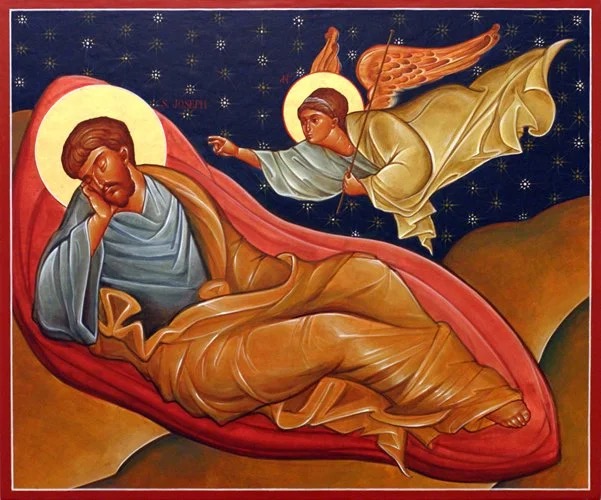
But just when he had resolved to do this, an angel of the Lord appeared to him in a dream and said, “Joseph, son of David, do not be afraid to take Mary as your wife, for the child conceived in her is from the Holy Spirit. She will bear a son, and you are to name him Jesus, for he will save his people from their sins.”
All this took place to fulfill what had been spoken by the Lord through the prophet: “Look, the virgin shall conceive and bear a son, and they shall name him Emmanuel,” which means, “God is with us.”
When Joseph awoke from sleep, he did as the angel of the Lord commanded him; he took her as his wife, but had no marital relations with her until she had borne a son; and he named him Jesus.
Matthew’s account feels believable precisely because it is so understated. There is no burst of heavenly light, no chorus of angels. God comes to Joseph quietly, in a dream. And like so many dreams, it leaves Joseph with a decision to make when he wakes up.
Joseph’s life, up until this moment, had been moving along just fine. He had done everything right. He had secured a future, paid the dowry, followed the law, and made plans. He was doing exactly what responsible people are supposed to do. And then life happened, or as John Lennon famously said, “Life is what happens to you while you’re making other plans.”[1]
Mary is pregnant. Not his child. Not his plan.
In Joseph’s world, this was not just a personal crisis; it was a public one. His reputation, his livelihood, Mary’s safety, all of it hung in the balance. Joseph holds the power to quietly walk away from it all, or he can expose Mary and protect himself. The Law allows it and the society kind of expects it.
But Matthew tells us Joseph was righteous. And righteousness, it turns out, is not about rigid rule-following, but about mercy. Joseph chooses compassion before he fully understands the full story of what’s the come.
Then comes the dream.
We don’t know how Joseph slept that night. We don’t know how convincing the dream felt. What we do know is this: when Joseph wakes up, he believes that God has spoken, and he acts obediently.
Joseph could have said no. He could have dismissed the dream as indigestion or anxiety. He could have chosen safety over faith. Instead, Joseph steps into uncertainty, trusting that God is already at work in the middle of the mess.
Faith, Matthew tells us, is not certainty. Faith is obedience in the absence of guarantees. Faith is obedience in the absence of guarantees.
That may sound familiar to us. Many of us know what it is like to have our plans interrupted whether by illness, job loss, family strain, grief, or change we did not choose. Living in this part of the world, we understand that not everything unfolds according to schedule. Snowstorms reroute us. Power outages slow us down. Long winters teach us patience we never asked for. Joseph’s story reminds us that God often does God’s deepest work precisely when our plans all fall apart.
The angel tells Joseph to name the child Jesus, “for he will save his people from their sins.” We often hear that phrase in a narrow sense of just getting into heaven; salvation is so much richer and larger. Salvation in Scripture means healing, restoration, rescue, and wholeness. Jesus is born not just to forgive, but to make things right and to bring light into darkness, warmth into cold places, hope into weary lives.
And then Matthew gives us the name Emmanuel: God with us. It’s not God above us. It’s not God far away. Rather, it’s God right here with us, right in the midst of all our uncertainty, in our disruption, in our risk, and in our faith.
Joseph does not understand everything. He does not get answers to all his questions. But he does step out and do the next faithful, obedient thing. And that is how God’s salvation enters the world.
Beloved, Advent reminds us that God still works this way. God’s work often passes through ordinary people making faithful choices in complicated situations. God’s purposes still move forward through quiet courage, through listening, through obedience when it would be easier to walk away.
As we stand on the threshold of Christmas, may we, like Joseph, remain open to God’s voice. May we trust that even when our plans are disrupted, Emmanuel is still with us.
In the name of the Father, and of the Son, and of the Holy Spirit. Amen.
© 2025 Patrick H. Wrisley, Pastor, First Presbyterian Church of Glens Falls, 8 West Notre Dame Street, Glens Falls, New York, 12801. Sermon manuscripts are available for the edification of members and friends of First Presbyterian Church of Glens Falls and may not be altered, re-purposed, published or preached without permission. All rights reserved.
[1] See https://www.brainyquote.com/quotes/john_lennon_137162.


