A Sermon Delivered by the Rev. Dr. Patrick H. Wrisley on Sunday, August 10, 2025.
Luke 12:32-40
32“Do not be afraid, little flock, for it is your Father’s good pleasure to give you the kingdom. 33Sell your possessions, and give alms. Make purses for yourselves that do not wear out, an unfailing treasure in heaven, where no thief comes near and no moth destroys. 34For where your treasure is, there your heart will be also. 35“Be dressed for action and have your lamps lit; 36be like those who are waiting for their master to return from the wedding banquet, so that they may open the door for him as soon as he comes and knocks. 37Blessed are those slaves whom the master finds alert when he comes; truly I tell you, he will fasten his belt and have them sit down to eat, and he will come and serve them.38If he comes during the middle of the night, or near dawn, and finds them so, blessed are those slaves. 39“But know this: if the owner of the house had known at what hour the thief was coming, he would not have let his house be broken into. 40You also must be ready, for the Son of Man is coming at an unexpected hour.”
This morning, we hear some of the most tender and reassuring words Jesus ever spoke. Words that were not shared the large masses nor to the powerful or the prominent, but to those closest to him – the vulnerable, the uncertain, the anxious. Did you hear them?
“Do not be afraid.”
This phrase, “do not be afraid,” is one of the most repeated commands in both the Old Testament and New Testaments; in fact, Jesus uses it three times just in this one chapter of Luke. The phrase shows up again and again because the entirety of scripture is full of humanity’s best and worst moments. Fear is prominent thread throughout the Bible and Jesus knows we need to hear this reminder over and over again; he especially knows this when we are emotionally fragile, are confused, or weighed down by the chaos our present world.
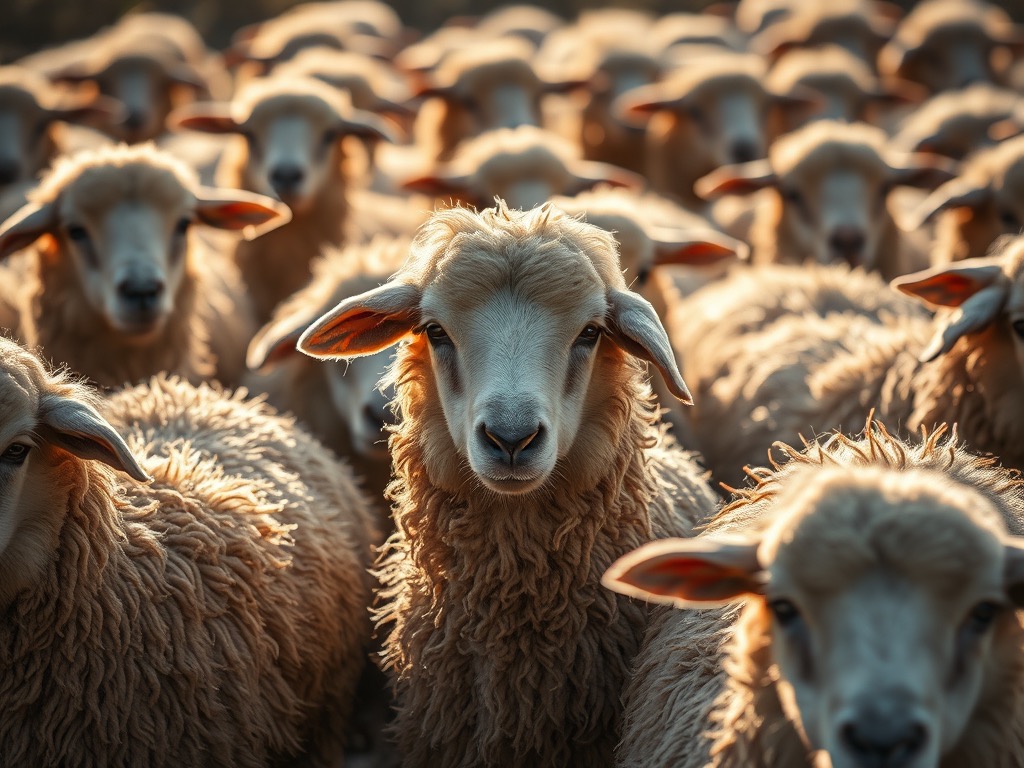
Secondly, did you notice how Jesus addresses us? He said, “Don not be afraid, little flock.” We are his little flock. It’s intimate and affectionate. It’s as though he is telling us, “No fear, my little lambs.” It’s a shepherd talking to his sheep. We are the lambs. As such…
We are vulnerable.
We are not the strongest or the wisest animals out there.
We sometimes push and jostle one another at feeding time.
We don’t see very well. We are smelly.We get scattered and distracted.
We bleat, grumble, and snort a lot.
And the deal is this: we are not lone lambs and sheep in the wilderness. We are part of the larger flock with others and this one point that makes all the difference. You see, when one lamb can’t quite hear the Shepherd’s voice, the rest of the flock helps listen out for it. We sheep rely on each other, we draw strength from one another, we stay connected to one another; we do this, not just out of instinct, but because that’s how the Shepherd designed it. The flock is not a random collection of individuals; it is a community, a body, a people called the Church who are to look out for one another when the Shepherd seems distant or when one among us is lost.
Even when the Shepherd must go searching for the one who’s gone astray, he leaves the flock knowing we’ll hold together. And while the Shepherd may seem to tarry, we trust he will return—because that’s who the Shepherd is. The Shepherd cannot be anything other than what the Shepherd is at his very core: loving, faithful, generous, attentive. The Shepherd lays down his life for the sheep. The Shepherd’s one purpose is to care for us. Consequently, the Shepherd reminds us we need not be afraid.
Friends, what comforting words for such a swirly mixed-up, muddled up time as this. We live in a world where fear seems baked into our daily headlines. Terrorism, political division, climate change, runaway costs of living, the rise of Christian nationalism and violence, and yes, even the growing national anxiety that our economic, civic, governmental and religious institutions are not as stable as they once were. It’s enough to make you wonder: how do people get through the day without some grounding in faith?
Beloved, there is hope and assurance for those of us in the faith because we are part of the little flock called the Church. We are not left to fend for ourselves. We have a Shepherd. We have one another. We are the Church – the gathered community of lambs and smelly sheep. We are created to be a community of comfort, courage, and connection for each other in the midst of fear.
Yet even as we rest in the Shepherd’s care, Jesus gives us a word of challenge. Be ready, he says. Be dressed for action. Keep your lamps lit. In other words, don’t get too comfortable or complacent. Jesus calls us to be alert and watchful. He calls us to live intentionally, strategically.
And how do we do that? He says we must travel light. As fearful sheep, we have a proclivity to grab hold of stuff whether real or imagined to give us a sense of security and safety. When we start grabbing stuff out of fear, we let go of God’s hand to do so. So, Jesus tell us tells us to let go of the stuff and reach out for God’s hand.
Let go of the possessions and priorities the world tells us we must cling to.
Let go of the wealth or the drive to acquire more things that weigh us down.
Let go of the distractions that numb our spirit.
Because all the stuff we either store up or fail to accumulate in our in barns, bank accounts, or closets can rob us of our focus and our joy. And in the end, it only fuels our fear.
Did you know that one of the root meanings of the word fear is “to hesitate” or to balk at something? That makes sense. Fear causes us to freeze up and second-guess our decisions or even other people. Fear pulls us back when we should move forward.
It’s like teaching a teenager to drive. You tell them, “If you’re going to change lanes or turn across traffic, you must commit. Don’t hesitate, just go. Once you start the turn, see it through.” Fearful hesitation can cause more harm than action. It’s the same in our spiritual life. Fear causes us to hesitate when God is calling us to move, to commit.
This, Jesus says, is how to live in the Kingdom of God. Let go of the things that burden you. Carry only what truly matters. Travel light and trust God has the rest. But if we’re honest, that is not always easy to do.
I remember a moment when I had to confront this truth in myself. I was spending a few days in the mountains of eastern Tennessee, surrounded by snow and silence. A friend had a beautiful cabin perched on a ridge with views that stretched for miles. I sat outside puffing on a pipe admiring the scene’s beauty taking it all in. I began thinking, “Wouldn’t it be nice to have a place like this one day? I wish I could afford it.” I began feeling this deep sense of envy creeping, dare I say jealousy?, into my gut. Just then in this mystical moment, the Spirit whispered,
Patrick, you don’t have to own this to enjoy it. These are my hills, my valleys—and they are yours too. When you hold nothing, you can receive everything. When you own nothing, you possess it all.
That’s the paradox of the Kingdom of God – when we let go and in doing so, we inherit it all.
So, I ask you, beloved: What are you still clinging to? What fears, what possessions, what ambitions or grudges or insecurities are weighing you down and keeping you from fully living in the presence of God that is already at hand?
Jesus is inviting us to put it all down. He is asking us to lay everything at his feet without any hesitation. The Lord wants us to open our hands so we can receive more of the promised blessing.
Kayla McClurg, a pastor whose writing I admire, once reflected on this passage. She wrote,
Do not be afraid, little flock—even in times of assault and violence, disrespect and meanness, when even the ones we call leaders speak all manner of evil against you. Do not be afraid. God is, right now, growing among us a different kind of kingdom, a realm of love and hope. How shall we live if we want to practice this realm of be-not-afraid? Jesus says, for one thing, to go ahead and release everything we cling to, and start to give. Start carrying new kinds of purses for our real valuables, the kind that do not wear out, that no thief can steal away from us.[1]
Church, Jesus never asks us to do what he hasn’t already done himself. On the night before he died, in the Garden of Gethsemane, Jesus faced his own deep fears; he too hesitated. He prayed, “Father, if it’s possible, take this cup from me.” He hesitated. He balked. But ultimately, he let go. “Not my will, but yours be done.”
He surrendered everything so his fledgling, scared, smelly little flock of followers could be restored to God. This morning, I invite us to reflect upon what causes us fear and anxiety. What are we holding onto that is keeping us from living fully in God’s presence? And once we each know what it is, remember Jesus words: Don’t be afraid little flock.
© 2025 Patrick H. Wrisley. Sermon manuscripts are available for the edification of members and friends of First Presbyterian Church of Glens Falls, 8 West Notre Dame Street, Glens Falls, NY 12801 and shall not be altered, re-purposed, published or preached without permission. All rights reserved.
[1] Kayla McClurg, Be Not Afraid, Inward/Outward, August 7, 2016. Accessed on 8/7/16 at http://inwardoutward.org.


