
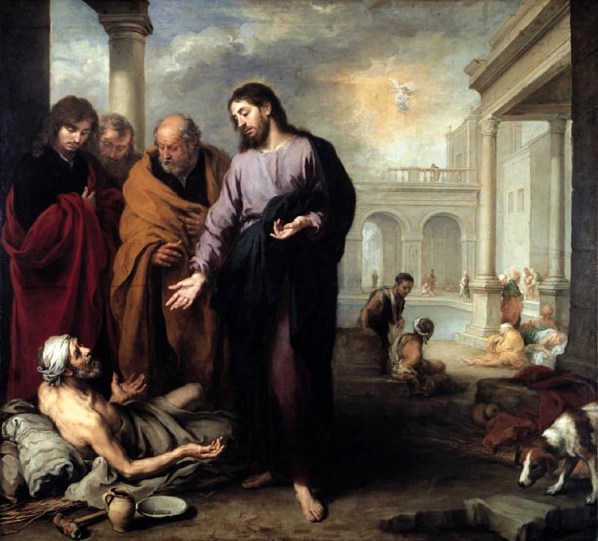
A Sermon delivered by Rev. Dr. Patrick H. Wrisley on Sunday, May 25, 2025.
For giggles and grins one afternoon, I typed into Google, “If I could ask Jesus one question, what would it be?” I was curious what people would ask. As I began to read some of the answers, one person wrote, “How’s my mom, doing?” Another asked, “Why did I get sick?” A third person asked what I thought was a great one: Jesus, how am I doing down here? As I read the answers, it hit me: I was asking Google the wrong question. The better question is, “If Jesus were to ask me one question, what would I want it to be?” A derivative of that question is, “What is one question I would not want him to ask me?”
What if he were to ask you, “Why do you drink so much?”
What if he asked, “Why do you continue to live in an abusive relationship?
He might ask you, “Why are you so afraid?” Or “Why don’t you trust me?” There are all types of questions Jesus could ask but the one that would make me shake in my boots would be if Jesus drew his face close to mine and he gives a doggy-head-tilt and asks, “Really?”
Think about how unnerving a question that would be to get asked by him.
“Really….what?” Now you’re worried that whatever you say is going to come out wrong and you begin to shuffle from side to side. Is he questioning something I have said or done? Is he incredulous with me? Today we have a Story where Jesus asks someone a pointed question and it is a question loaded with grace.
Today we find Jesus in Jerusalem at one of the Jewish festival days. The city would be teaming with people and animals for the Temple sacrifices. In the northeast part of the city, there was a small obscure gate into Jerusalem called the Sheep Gate and nearby a pool that was known for its healing qualities. It was a favorite location for people who were sick or wounded and off the beaten path for those Jews who wanted to remain ritually pure by staying away from “those types of people.” In other words, Jesus made a point to go there. Listen to the Word of the Lord.
John 5:1-18
5.1 After this there was a festival of the Jews, and Jesus went up to Jerusalem.
2 Now in Jerusalem by the Sheep Gate there is a pool, called in Hebrew Beth-zatha, which has five porticoes. 3 In these lay many invalids—blind, lame, and paralyzed. 5 One man was there who had been ill for thirty-eight years. 6 When Jesus saw him lying there and knew that he had been there a long time, he said to him, “Do you want to be made well?” 7 The sick man answered him, “Sir, I have no one to put me into the pool when the water is stirred up; and while I am making my way, someone else steps down ahead of me.” 8 Jesus said to him, “Stand up, take your mat and walk.” 9 At once the man was made well, and he took up his mat and began to walk.
Now that day was a sabbath. 10 So the Jews said to the man who had been cured, “It is the sabbath; it is not lawful for you to carry your mat.” 11 But he answered them, “The man who made me well said to me, ‘Take up your mat and walk.’ ” 12 They asked him, “Who is the man who said to you, ‘Take it up and walk’?” 13 Now the man who had been healed did not know who it was, for Jesus had disappeared in the crowd that was there. 14 Later Jesus found him in the temple and said to him, “See, you have been made well! Do not sin any more, so that nothing worse happens to you.” 15 The man went away and told the Jews that it was Jesus who had made him well. 16 Therefore the Jews started persecuting Jesus, because he was doing such things on the sabbath. 17 But Jesus answered them, “My Father is still working, and I also am working.” 18 For this reason the Jews were seeking all the more to kill him, because he was not only breaking the sabbath, but was also calling God his own Father, thereby making himself equal to God. (John 5:1–18, NRSV)
I read this Story and it’s all I can do is to shake my head and ask, “Really? Did this guy stiff Jesus like that?” Jesus goes out of his way, approaches a man who is well-known to have been hanging out by the pool for a long time, and asks him a simple question. “Do you want to be healed?” Interestingly, the man does not even answer Jesus’ question but begins making excuses why he cannot get to the pool. Jesus at once diagnoses the real problem. The problem is not that the man cannot walk; the problem is the man is mentally and socially stuck in his learned helplessness. The man’s physical ailments were symptoms of a deeper brokenness; you see, the man had grown comfortable in his discomfort. His illness had become part of his identity.
Jesus did not approach him and say, “Hi, I’m Jesus. Peace upon you.” He did not say, “Hi, what’s your name?” Jesus knew who he was and did not waste time in small talk. He understood the man’s identity was wrapped up in his illness. Biblical scholar, Amy-Jill Levine writes, “Identity can become so caught up in the sense of infirmity, especially if coupled with appreciation of sympathy and the willingness of others to help, that the status quo becomes the more comfortable position. Physicians have greater success rates when their patients want to be healed. Not everyone does.”[1]
Years ago, I had to take part in a family intervention for a member of the family who was an alcoholic. We all loved this person dearly but did not love the way we were treated when they had too much to drink. So, one Sunday morning at about 7 a.m., a psychologist who was trained in addiction issues came to the house. The whole family got up and we awakened our beloved who had the drinking problem and gathered in the den. One by one, we went around the room and said, “I love you very much but your drinking hurts me. When you have too much to drink, your personality changes and you say ugly things to me which you do not remember saying. I remember what you said and did and it hurts me deeply.” Then another child adds, “I love you, too. Yet, the other night when I had my friends over, you were so drunk you could not form your words. I was so embarrassed and had to defend your actions later to my buddies. I do not feel safe bringing my friends over.”
And one by one, we each expressed our love to this person but were also honest about our concern how this person’s drinking directly affected each of us. We wanted to jar them into realizing their identity was not tied to alcohol but with their vital relationship with all the members of his family.
For all those years, this man had someone each day take him and place him by the Sheep Pool. It shaped how he saw himself and how he looked at life. Jesus who is the wellspring of Living Water offers healing and wholeness the pool’s waters could not provide. Jesus perceives the man’s need and acts upon it. The man stands up and walks. No longer can he rely on his old identity; now he has the opportunity to form and create a new identity for himself because of God’s graciousness toward him. And what does he do? He takes his mat and walks away. There is no record he even said, “Thank you” to Jesus. Sometime later, Jesus finds the man in the Temple and reminds the man of his new identity and gives him a gentle warning to live into it. Once again, Jesus is not acknowledged for what he has done; instead, the man goes to the religious officials and reports on Jesus; from this point on in John’s Gospel, Jesus begins to be persecuted. I can almost hear Jesus asking the healed man, “Really?” It would appear the man’s broken identity remained even though his broken body had been healed.
This morning, we too are asked by the text, “Do you want to be whole? Do you want to be well?” What is it in your life and in mine that defines who we are in ways that are not healthy or beneficial to us or others? This morning, we are given the invitation to lift those broken places within us and ask for healing and wholeness. Please pray with me…
© 2025 Patrick H. Wrisley, Pastor, First Presbyterian Church of Glens Falls, 8 West Notre Dame Street, Glens Falls, NY 12801. Sermon manuscripts are available for the edification of members and friends of First Presbyterian Church of Glens Falls, New York, and shall not be altered, re-purposed, published, or preached without permission. All rights reserved.
[1] The Gospel of John: A Beginner’s Guide to the Way, the Truth, and the Life by Amy-Jill Levine -see https://a.co/dOEou2f.


 patrick h wrisley