
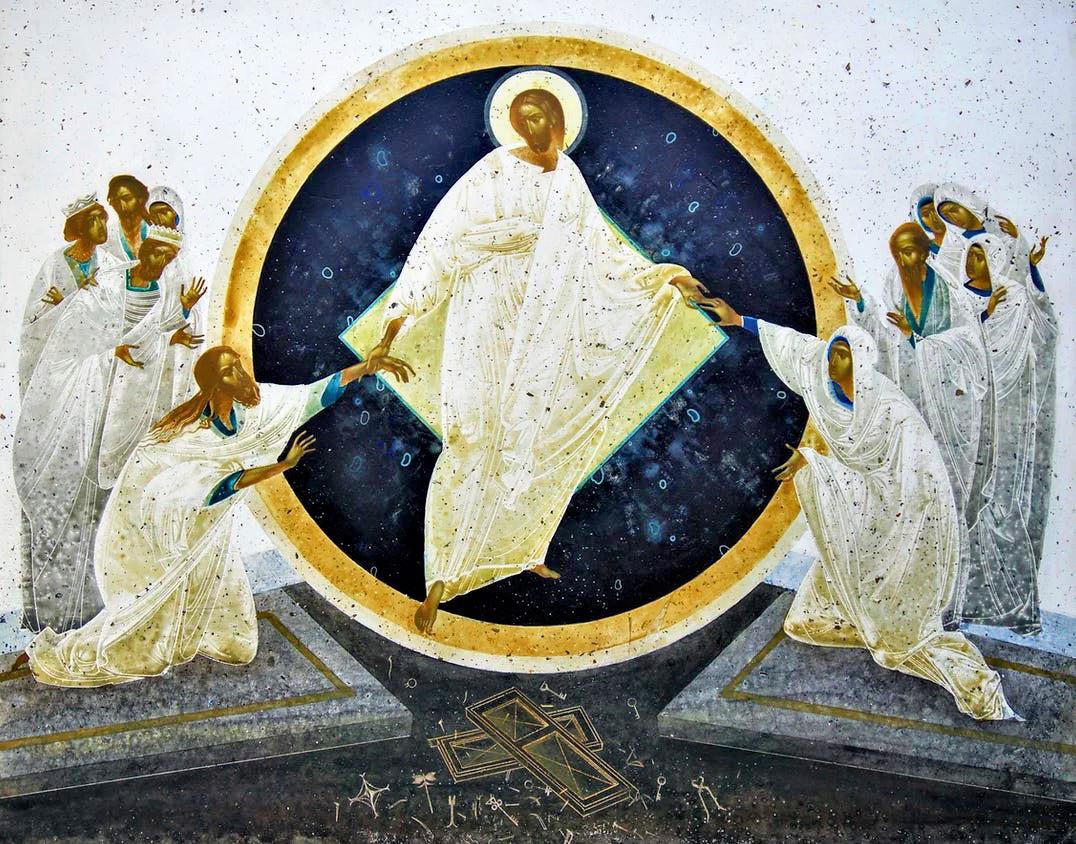
An Easter Sermon delivered April 20, 2025 by the Rev. Dr. Patrick H. Wrisley
Luke 24:1-12 (NRSV)
24But on the first day of the week, at early dawn, they came to the tomb, taking the spices that they had prepared. 2They found the stone rolled away from the tomb, 3but when they went in, they did not find the body. 4While they were perplexed about this, suddenly two men in dazzling clothes stood beside them. 5The women were terrified and bowed their faces to the ground, but the men said to them, “Why do you look for the living among the dead? He is not here, but has risen.6Remember how he told you, while he was still in Galilee, 7that the Son of Man must be handed over to sinners, and be crucified, and on the third day rise again.” 8Then they remembered his words, 9and returning from the tomb, they told all this to the eleven and to all the rest. 10Now it was Mary Magdalene, Joanna, Mary the mother of James, and the other women with them who told this to the apostles. 11But these words seemed to them an idle tale, and they did not believe them. 12But Peter got up and ran to the tomb; stooping and looking in, he saw the linen cloths by themselves; then he went home, amazed at what had happened.
This Easter, I find myself paying closer attention to what Easter is really means. Frankly, it’s been a tough, lugubrious Lenten journey with the never-ending winter and all the turmoil that’s churning out of Washington, DC impacting global affairs.
Beloved, Easter opens the door for the people of God to see the world, each other, and God differently. Easter is God’s holy ophthalmological procedure—one that reshapes our vision, so we see the world anew, our very lives, with clarity, hope, and transformation.
Mary Magdalene, Joanna, Mary the mother of James, and the other women entered the tomb with certain expectations that were completely shattered —and they left the tomb with Easter eyes[1].
Peter ran to the tomb with his own preconceived assumptions and stooped low looking inside, and inspected the linen wrappings—and he, too, began to see with Easter eyes.
But the rest? Locked in a house, clinging to disbelief, they remained blind—spiritually cataracted, unmoved by the story the women brought them. For them, the women’s report was non-sensical; Easter morning was just another Sunday.
Here’s the thing: Jesus’ resurrection, the whole Easter event, must be explored personally by each of us. It cannot simply be observed from a distance – we cannot take the word of others when we each have to go to the tomb, experience it, and see for ourselves. And when we do explore it—when we dare to wrestle with its meaning — God meets us in that place and blesses us with new sight. The Holy Spirit gives us Easter eyes.
So, have you begun to see the world through your Easter eyes?
Does the resurrection change how you see your life, your death, the people around you? Or are you like most of the disciples that first Easter morning who thought the story was a mere idle tale and failed to check it thoroughly for themselves? Friends, the thing is, one typically obtains Easter vision only through a crisis of some sort.
For the women and the disciples, the crisis was the death of Jesus—their Master, their teacher, and their hope.
Most people do not realize it, but this preacher wears two prominent tattoos. On my right shoulder, I wear a Celtic cross and on my left shoulder, I have a tattoo made up of two Chinese characters that together mean “crisis.” One character means risk and the other represents the word for opportunity. That’s what a crisis is — a moment when risk and opportunity meet, and the possibility of a new way forward opens in front of you. A new way of seeing comes into focus. I’ve lived by the mantra that I never waste a good crisis because it opens pathways that move me forward in a new direction. What personal crisis have you been through that has opened the way forward in your life?
The Triduum — the three holy days from Maundy Thursday to Easter morning — was the greatest crisis in cosmic history. There was the risk of political rebellion in Jerusalem and the subsequent violence inflicted upon the people by Roman garrisons. There was the risk, on God’s part, of giving His beloved Son into the hands of sinners. There was the risk of religious leaders losing their grip on power and influence. But Jesus, in his crisis of betrayal and the cross — even amid all the risk — he saw opportunity:
Jesus saw an opportunity to restore those who were broken back to the Source, the Fountain of All Healing.
Jesus saw the opportunity to realign the world’s values and ethics with the principles aligning to the will of God.
Jesus saw the opportunity to live out what the Jewish Law was really proscribing to build just, caring communities.
Jesus saw the opportunity to model the very character of God through self-sacrificial love.
Yes, Jesus’ death and crucifixion was risky move on God’s part. But oh – look at the
opportunity that literally rose out of it! The empty tomb reorders our reality. It enables us to see — truly see — again. It affirms that nothing, not even death, can separate us from the love of God in Christ Jesus.
Fellow Presbyterian pastor, Pendleton Peery, writes: We tend to see the resurrection as the epilogue to the story of Jesus’ life and death.[2]
He’s right.
We build up to Easter, celebrate the empty tomb, and then… pack it away with the baskets and chocolate. But friends — we’ve got it backwards. Easter is not the epilogue. It’s the prologue. It’s the beginning of a new story! Easter is the beginning of our transformation — not the end of Jesus’ drama.
Former professor, Walter Brueggemann, puts it this way: The new truth of Jesus is that self-giving love is the wave of the future… because love is the very character of God.[3]
You see, Easter places our feet in two worlds:
One foot is placed in the brokenness of this world as it is.
The other foot is grounded in the Kingdom of God as it is becoming.
And now, we must choose where to focus our gaze. Will we stare into the despair and division of the past? Or will we, like the women, bow our faces to the ground, remember what Jesus taught, and rise to proclaim that everything has changed?
You see, once you see the risen Christ, you cannot unsee him. Have you ever had an experience when you saw something and there is no way to unsee it?
I remember watching my daughters — Lauren and Kate —being born. I cannot unsee the strength on my wife, Kelly’s, face. I cannot forget the moment the doctor held up each one of my girls for the first time. That moment changed me. It changed how I saw everything. Their births were moments when everything in my life changed and evolved – my priorities, my values, and the depth of love I never knew one could feel.
That’s what the women at the tomb experienced.
That’s what Peter experienced when he peered inside.
The women and Peter may not have fully understood it all yet — but they knew: nothing would ever be the same. They were jolted into a new way of seeing and experiencing their world. They were given Easter eyes.
Does the empty tomb still jolt us today? In the original language of the New Testament, the
words for “tomb” and for “remember” share the same common root word. A tomb is a place of remembering. It’s a place one goes to reflect upon former days of people we lost.
But on Easter morning, the angels said, “Remember what he told you… He is not here!” For us, the tomb no longer holds memory. It points forward to hopeful possibility we have not looked for before and urges us forward.
Jesus is not among the dead.
He is among the living — and he is calling us to join him there.
With Easter eyes, we see others as bearers of God’s image.
With Easter eyes, we see injustice and do something about it.
With Easter eyes, we see hope—radical, resurrection hope—alive in the world again.
With Easter eys, we wake each day not with fear, but with faith.
We live as a people who, as one scholar said, “Refuse to participate in the anxiety of the world—because we know the One who clothes the lilies and feeds the birds will care for us, too.”[4] Beloved, Easter is our day to remember that everything has changed. Easter means we don’t doomscroll through the news and think the worst; with Easter eyes, we see opportunity on where Christ wants to get us working.
So, this morning, as you walk out of these church doors, step outside with new vision, new hope, new joy. And may the Spirit give you my beloved… Easter Eyes. Amen.
© 2025 by Patrick H. Wrisley, Pastor, First Presbyterian Church of Glens Falls, 8 West Notre Dame Street, Glens Falls, NY 12801. Sermon manuscripts are available for the edification of members and friends of First Presbyterian Church Glens Falls, New York and shall not be altered, re-purposed, published or preached without permission. All rights reserved.
[1] I am indebted to colleague and friend, Dr. Robbie Carol, for this phrase ‘Easter Eyes’. It was in the title of a sermon he preached in 1987 at the Decatur First Presbyterian Church in Atlanta.
[2] Feasting on the Gospels–Luke, Volume 2: A Feasting on the Word Commentary by Cynthia A. Jarvis, E. Elizabeth Johnson, Presbyterian Publishing Corporation, 948 (https://a.co/2jlyxm3).
[3] Brueggemann, Walter. A Way other than Our Own (p. 86). Presbyterian Publishing Corporation. Kindle Edition.
[4] Ibid, https://a.co/gpM7aqc.


