
The Message: The Cost to See Jesus; John 12:20-26

Preached by Patrick H. Wrisley, D.Min. on March 21, 2021

            The row between Jesus and the religious officials is growing and we join the Story after Jesus entered Jerusalem for the Passover festival. The crowds are full and they have heard the rumors that Jesus has raised his best friend, Lazarus, from the dead. Jesus’ mere presence is causing an uproar. I will begin my reading with John 12:19 – 26. Hear the Word of the Lord!

John 12:20-26

                  12:19 The Pharisees then said to one another, “You see, you can do nothing. Look, the whole world has gone after him!” 20 Now among those who went up to worship at the festival were some Greeks. 21 They came to Philip, who was from Bethsaida in Galilee, and said to him, “Sir, we wish to see Jesus.” 22 Philip went and told Andrew; then Andrew and Philip went and told Jesus. 23 Jesus answered them, “The hour has come for the Son of Man to be glorified. 24 Very truly, I tell you, unless a grain of wheat falls into the earth and dies, it remains just a single grain; but if it dies, it bears much fruit. 25 Those who love their life lose it, and those who hate their life in this world will keep it for eternal life. 26 Whoever serves me must follow me, and where I am, there will my servant be also. Whoever serves me, the Father will honor.[1]

Our text this morning is a major turning point in John’s narrative and this shift is demonstrated three different ways in our brief seven verses.  First, we have the introduction of Greek God-fearers who seek to know about Jesus.  They go hunt down Philip, also of Greek descent, to see Jesus for themselves. The Pharisee’s words prove to be true:  People from the larger, Greek-speaking world, are beginning to hear the Gospel. 

Second, there is a trigger phrase John has used in his Gospel several times when Jesus has been in tough straights.  Though the people have been upset with Jesus before, John always made sure that we knew, “The hour had not yet come.”  Well, that’s all changed because in verse 23, Jesus reminds the disciples, “The hour has come for the Son of Man to be glorified.”

Third, our text this morning highlights a shift in John’s Story as it summarizes three sobering truths for those of us, who like the Greeks, want to see Jesus. These three truths are John’s way of making sure we who wish to see Jesus are truly up for the task. Standing like a Drill Sargent face to face with a fresh Marine recruit, verses 24-26 are John’s ways of asking, “Do YOU have what it takes to do this!?”  This, my friends, is what we are going to look at this morning. You see, these three verses add up the cost for you and me to come and see Jesus. The rest of John’s gospel story has Jesus personally showing you and me how to do it through his own example.
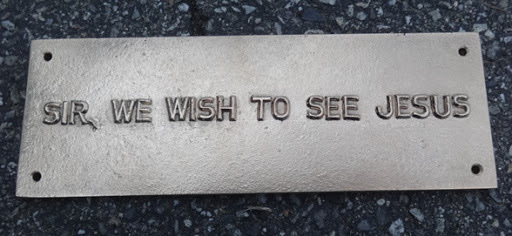
Unbeknownst to many of you, there is a little message that is inscribed on pulpits that you never see. It’s been carved into the wood or placed on brass plaques on pulpits from all the various Christian traditions from Presbyterians, Methodists, Episcopalians, to Baptists. Sometimes it placed on the lectern itself so you are forced to see it as you preach like it is on our pulpit. Other churches have it placed more discreetly on the back of the pulpit furniture so it’s eye height as the preacher sits in the chair behind it and sees it before she gets up to preach. The “secret” message only preachers see? It’s six simple words taken from today’s text: Sir, we wish to see Jesus.

These six words stare at preachers from pulpits to remind us that the world, i.e. you, are eagerly searching for the grace and power of God in your life that is manifested in Jesus. You eagerly want to be touched by his touch, embraced by his arms, have your face cradled in his hands as well. Every time we pastors preach, we are reminded that you, beloved, want to see Jesus and it’s up to us as the preachers of the Good News to paint you an accurate picture of who Jesus is and what Jesus requires of us. “Sir, we wish to see Jesus” is the warning label on church pulpits that as pastors, we had better get it right.

Unfortunately, too often we have not done a very good job at accurately showing Jesus to others. In many churches, Jesus has left the building and isn’t talked about much at all. Other times, preachers have wrapped Jesus up in the American flag and have paraded him around to create a hostile Christian nationalism. Then there is the soft, silky Armani Suit Jesus of the prosperity Gospel that preachers highlight that says if you give your money, you will be blessed with blessings. Too often we preachers, out of fear of offending members of our churches, preach a watered-down and diluted Jesus to make him more palatable for you; you see, if we make Jesus palatable to you, comfortable for you, then you’re more apt to give to or join the church! On behalf of preachers everywhere, I say for all of us, “We repent.” When we dilute Jesus and the Gospel, we are showing a disservice to you and we are dishonoring the Christ. Our reading from John verses 24 to 26 demonstrate what it really takes to see Jesus; these few verses remind us that the six words, “Sir, I wish to see Jesus” truly is warning label not to be taken lightly!

Verse 24. Jesus says, “Listen up and pay close attention: I tell you that unless a grain of wheat falls into the earth and dies, it remains just a single grain; but if it dies, it bears much fruit.”

The cost to see Jesus means a hard spiritual reboot.  It means life is not solely about me and my needs; no, life is meant to be lived as life together – you and me side-by-side.  I give up of parts of myself in order to compensate for the parts you lack in yourself. You give of yourself in order to compensate for the parts lacking in me. This is what Jesus did; it’s what we are called to do as well. I have to die so that together we can live! You have to die to self in order that together we can live! This is a high price to pay in order to see Jesus.

Verse 25.  Jesus says, “Hey listen up and pay close attention: Those who love their life lose it, and those who hate their life in this world will keep it for eternal life.”

If the first cost to see Jesus is a spiritual reboot, the second cost to see Jesus is an entire reinstall of the hardware, software and operating system! Jesus is telling the disciples that those who befriend and love the way the world as it is and currently works have already lost what it means to truly live today. Like our world, Jesus’ world was full of consumerism, sexism, ageism, colonialism, racism, and every other -ism there is out there. The cost to seeing Jesus is for you and me to name and claim all those -isms of our world that we cling to so desperately and swap them out with a new, Spirit-guided operating system that values sacrificial love and justice for the ‘least of these’ in our midst. This is a high price to see Jesus.

Verse 26.  Jesus says, “Hey listen up and pay close attention! Whoever serves me must follow me, and where I am, there will my servant be also. Whoever serves me, the Father will honor.”

The cost to see Jesus in this verse is that we must follow Jesus where he goes; and where does he go from here in John’s Gospel? Jesus travels to the Cross. In order to see Jesus, you and I must follow him to his Cross as well as our own. Easy-going, laissez faire Christianity is an oxymoron; it does not exist, beloved. Jesus-following faith pinches a bit, my friends! This is a high price to see Jesus.

“Sir, we wish to see Jesus.”

As your pastor and preacher, I pray I preach the full picture of Jesus and what it means to follow him in a life of love, service, and joy. I pray that I paint all the colors of what it means to live an eternal life this very day. I pray that I do not lead you on a primrose path of convenient Christ-followership that makes you feel all comfortable and cozy.  If so, I have failed and I repent.

But if I have preached faithfully, well …

There is a cost to see Jesus.  His gift of new and eternal life is free for the taking but we have to get up and out of our seats and pursue it. It requires us to reboot, reinstall, and follow his directions.  As a preacher, I do not know how to make it any more clear than that.  And all of God’s people say together, “Amen.”

© 2021 Patrick H. Wrisley, Pastor, First Presbyterian Church, 401 SE 15th Avenue, Fort Lauderdale, FL. 33301.  Sermon manuscripts are available for the edification of members and friends of First Presbyterian Church, Fort Lauderdale, Florida and may not be altered, re-purposed, published or preached without permission. All rights reserved.


[1] New Revised Standard Version (NRSV). New Revised Standard Version Bible, copyright © 1989 the Division of Christian Education of the National Council of the Churches of Christ in the United States of America. Used by permission. All rights reserved.

Posted in Sermon | Tagged , , , , , , , , , , , | 1 Comment

The Message: Patio Time, John 3:14-21

A sermon delivered on March 14, 2021 by Patrick H. Wrisley, D.Min.

In just two chapters, John’s densely packed gospel has already revealed Jesus’ true origins as the Eternal Word from the beginning[1]. It has shown us how Jesus calls together a community of disciples of ordinary people to follow him[2]. It highlights who Jesus is as Messiah as he turned water into wine[3]. It revealed last week his destiny as he cleared the Temple and gave us a glimpse of what he came to do with a reference to his resurrection[4]. Now as we move into chapter three, John reveals to us “why” of Jesus.

Turn in your Bible to John 3:14-21. Our Story today is a part of an extended conversation between Jesus and a Jewish religious scholar named Nicodemus. We note at the beginning of chapter 3, Nicodemus has come over one evening and is engaging Jesus in some thoughtful conversation about what it means to be born spiritually and in the midst of their visit, Jesus outlines the “why”, the purpose of his coming.  Listen to the Word of the Lord:

John 3:14-21

 14 And just as Moses lifted up the serpent in the wilderness, so must the Son of Man be lifted up, 15 that whoever believes in him may have eternal life.

16 “For God so loved the world that he gave his only Son, so that everyone who believes in him may not perish but may have eternal life.

17 “Indeed, God did not send the Son into the world to condemn the world, but in order that the world might be saved through him. 18 Those who believe in him are not condemned; but those who do not believe are condemned already, because they have not believed in the name of the only Son of God. 19 And this is the judgment, that the light has come into the world, and people loved darkness rather than light because their deeds were evil. 20 For all who do evil hate the light and do not come to the light, so that their deeds may not be exposed. 21 But those who do what is true come to the light, so that it may be clearly seen that their deeds have been done in God.” [5]

Ever since I was a teenager, I have longed and loved for the ability to get away with someone and sit around a campfire. After football season was over, my buddy Dave and I would load up his used car and go camping in the north Georgia mountains. We would often sit under the cold dark night sky listening to a fire crackle; sometimes we talked but oftentimes we would sit in the silence and listen to the dreams God was instilling in our adolescent hearts. Sitting alone in the dark in the mountains can be a scary thing but the fire and its light create a circle of light that feels secure. The glow of the light creates a place of refuge and safety where the world falls away and you are suspended in time that very moment feeling the fire’s warmth as you hear the wood crackle breaking the night’s silence. The troubles of our teenaged-angst ridden world like the pressures of high school, working, wondering if my old high school flame, Marian Chan, was going to dump me, or us trying to figure out what we were supposed to be when we grew up – all of it seemed to melt away during those moments. It’s been over fifty years and I still travel back to those campfires in my mind.

Throughout my life and spiritual walk, I have sought to recreate those moments with those I love. A portion of my days has always included time of just sitting with those I care about and be with one another. I don’t sit around campfires anymore; after all, we do live in Florida! I’ve discovered a lit candle flickering on the table while on the patio works just fine.

Patio time. Through the years my days have developed a rhythm of devotion and prayer in the morning and patio time in the evening. Patio times are those moments when Kelly and I sit outside and simply be together and share what is most deeply impressed upon our hearts. Sitting in the patio’s candlelight over the years, we have strategized on how to raise our daughters and worked out things in our marriage. We have shared our fears of illness and death and what we want life to be. In the patio time’s silence, we have heard how God was speaking to each of us and discerned what God is calling us to do today. My daughters and I shared patio time as they grew up. The older they became, we would sit on the patio by candlelight and talk about their day, their dreams, and their boyfriends. Oftentimes, we would just sit together – a daddy and his girl – enjoying the presence of the other.

Over the years, I have also had special patio time with members of my churches. We sit and chat, sometimes enjoy a good cigar, and around the lit candle on the table, you share with me your hopes, your dreams, yours joys and your fears. The light’s glow creates a space of safety and comfort and you can just simply be your true self.  Patio time.

We have in our text today a snapshot of Jesus’ version of patio time. Nicodemus, a ruler and noted rabbi of the Jews comes to Jesus and wants to visit around the fire. Some take the fact that Nicodemus coming to Jesus at night points to his fear of being found out by the other Pharisees. Maybe. I like to think that maybe Nicodemus knows, that like you and me, that at the end of a busy day, one just needs someplace, someone safe to let your hair down with. Nicodemus was wise enough to know that in order to truly understand his spiritual life and faith in God, he would need time to pull away from the day’s bustle and have a conversation with Jesus.

 Nicodemus shows up three times in John’s gospel. He next shows up in chapter seven when he is sticking up for Jesus as others were trying to get Jesus arrested and then later on in chapter 19 when Nicodemus joins another Pharisee, Joseph of Arimathea, in asking Pilate for Jesus’ dead body in order to bury him.  Nicodemus is introduced in our patio time story this morning and we see the depth of his discipleship grow deeper in his other gospel appearances. He moves from asking about faith and belief to dynamically living that faith and belief out in defending Jesus publicly and by honoring him with a decent burial.

Now, like many of you, Nicodemus comes to Jesus as a man who already has faith in God. He already had an active spiritual life! But something was lacking. The Spirit in Nicodemus was needling him to delve deeper and move beyond the letter of the Torah and seek its deeper Truth.  Something in him wants to move beyond his first level thinking and delve deeper. First level thinking is when you and I take for fact that what we just see in front of us. What’s needed is second level thinking where we push beyond what we think we see and know and actively burrow to experience Truth at a more profound level[6].  This is why Nicodemus was looking for patio time with Jesus.

Jesus says, “A person must be born from above” and Nicodemus asks, “What do you mean? How is that possible?” Jesus replies that, “Just like Moses lifted the serpent up in the wilderness to heal the people, so the Son of Man must be lifted up so that those who see and believe will have eternal life” (3:15).  And it’s at this point Jesus reveals his purpose and the “why” of his life and coming:

16 “For God so loved the world that he gave his only Son, so that everyone who believes in him may not perish but may have eternal life. 17 “Indeed, God did not send the Son into the world to condemn the world, but in order that the world might be saved through him. 

Jesus reveals during his patio time that God so loves the entire cosmos that everyone, not just the children of Abraham, who believe in him will have eternal life; indeed, the Son of God does not condemn the world but is willing to die to save it. Jesus is pushing Nicodemus to grow beyond the first level thinking and spirituality of simply following the Law; Jesus is pushing Nicodemus to a deeper, more thoughtful, critical and active life of discipleship in living out the Law with others.  Lest we forget, believing is a verb and not a noun. Believing is about living out one’s faith in ever deepening, penetrating ways. Believing is not signing onto a bunch of propositions like following the Ten Commandments; no, believing is living into the active life of the one whom we believe in and that’s Jesus. Jesus took Nicodemus where he was and in that patio time gave him the room and the tools to grow deeper, grow more mature, in his spiritual life.

Beloved, as we journey to the Cross together this Lent, I encourage you to engage in some patio time with someone you know and trust and invite the Spirit of Jesus to join you. In the intimacy of your fire or candle’s glow, I want you to plumb with one another how you can deepen your understanding of the Lord. Are you still a first-level thinking disciple or are you letting Spirit guide you to places you never dreamed you would go? In this patio time, just like Nicodemus, assess what you think you believe and know as true and let Jesus expand and challenge your thinking of what you think “you know” about God. During this patio time with Jesus and someone you trust, plumb the depth of your belief – is your belief an active verb or simply a static object, a noun.  Go find your patios my beloved and Jesus will meet you there!

© 2021 Patrick H. Wrisley, Pastor, First Presbyterian Church, 401 SE 15th Avenue, Fort Lauderdale, FL  33301.  Sermon manuscripts are available for the edification of members and friends of First Presbyterian Church, Fort Lauderdale, Florida and may not be altered, re-purposed, published or preached without permission. All rights reserved.


[1] John 1.1-28.

[2] John 1:29-51.

[3] John 2:1-11.

[4] John 2:12-23.

[5] New Revised Standard Version (NRSV). New Revised Standard Version Bible, copyright © 1989 the Division of Christian Education of the National Council of the Churches of Christ in the United States of America. Used by permission. All rights reserved.

[6] Read https://fs.blog/2016/04/second-order-thinking/.

Posted in Sermon | Tagged , , , , , | Leave a comment

Message Title: What Tables of Yours Need Flipping?, John 2:13-22, Third Sunday in Lent, Year B

A sermon delivered on March 7, 2021 by Rev. Patrick H. Wrisley, D.Min.

Welcome to this third Sunday in our Season of Lent for 2021! This morning, our two scriptures really fit nicely together as they call us to reflection and examination which is very appropriate for our Easter preparation as well as for a communion Sunday as we get ready to eat the Lord’s Supper in a few moments.[1]

Turn in your Bible to John 2 and we will be looking at 2:13-22.  It is a Story that appears in all the Gospel accounts but John places his Temple Story near the very beginning of his gospel whereas the other three place it towards the end. John the Apostle, author of our Story, is not trying to create revisionist history; rather, John places our Story early in Jesus’ ministry for artistic reasons in order to highlight what is going to happen throughout the rest of his gospel narrative.

John chapter two serves as the book’s overture for what he is going to unpack throughout the rest of the Story. The scripture immediately preceding ours in this chapter is Jesus turning ordinary water into wine at a wedding in the village of Cana. John does not call this a miracle but rather a sign pointing to who Jesus is. Our Whip and Table Story today points to what Jesus is ultimately going to do.[2] Listen to the Word of the Lord!

John 2:13-22

13 The Passover of the Jews was near, and Jesus went up to Jerusalem. 14 In the temple he found people selling cattle, sheep, and doves, and the money changers seated at their tables. 15 Making a whip of cords, he drove all of them out of the temple, both the sheep and the cattle. He also poured out the coins of the money changers and overturned their tables. 16 He told those who were selling the doves, “Take these things out of here! Stop making my Father’s house a marketplace!” 17 His disciples remembered that it was written, “Zeal for your house will consume me.” 18 The Jews then said to him, “What sign can you show us for doing this?” 19 Jesus answered them, “Destroy this temple, and in three days I will raise it up.” 20 The Jews then said, “This temple has been under construction for forty-six years, and will you raise it up in three days?” 21 But he was speaking of the temple of his body. 22 After he was raised from the dead, his disciples remembered that he had said this; and they believed the scripture and the word that Jesus had spoken.[3]

The Jewish Passover was near. The Passover is the yearly festival that faithful Jews celebrate to mark their release from slavery from the bonds of the Egyptians; it’s a time they remember how God led them through the wilderness to the Promised Land. Passover is all about liberation, freedom, and bright hopes for the future. Passover was the time faithful Jews looked out for the new messiah to come and deliver them from their current pain and turmoil.[4] The Passover was a festival all Jews had to observe and they came from all over the ancient world to celebrate it in Jerusalem. Just like Fort Lauderdale during Spring Break, the sidewalks were packed and there was a carnival atmosphere.

The center of the celebration was the Temple where the people would come and make their sacrifices and offerings to God. In what is known as the Court of Gentiles, animal vendors would set up shop selling lambs, doves and other animals for sacrifice by the Levitical priests for their sins, their thanksgivings, and for other spiritual obligations.  Since it drew people from all over the ancient world, you would also see these tables like you see at international airports where you exchange your American dollar into British pounds. The money taken at the Temple for Jewish sacrifices could not be impure, dirty money from Rome or Persia; rather, it had to be exchanged for local untainted, purified Jewish funds.  The sale of animals and the exchange of money was not the problem for Jesus; it was where all the buying, selling, and exchanging was taking place: It occurred in a set-aside place of worship for those seeking God.

The Court of the Gentiles was included in the Temple architecture in order to welcome uncircumcised God-fearers into a place of worship. It was designed for those Gentiles who believed in the one God but who were not ethnically Jewish.  So here was a place that was set-aside for a group of people seeking to worship and find a God they did not yet fully know but whose worship location had been taken over for a marketplace. It was a literal regentrification of a divine worship space!  

Jesus was torqued. God’s house was turned into a marketplace, an emporium, a spiritual Walmart at Christmastime of sorts. A place for spiritual seekers to come in contact with God was displaced for carnival’s expediency.  No longer was the Temple about encountering God; the Temple had become a place where transactional business took place.  It was symbolic how the Holy was usurped by the secular. And Jesus was torqued. 

His response? He started flipping tables and swooshing the animals out with a make-shift whip. Jesus was upset! As scholar Dale Bruner reminds us, Jesus’ anger is provoked by the people’s and religious leaders’ spiritual obtuseness through their mixing of the sacred with the profane. His flipping of tables was his dramatic act of trying to restore the honor of God within the confines of God’s house! And the people did not understand or get it.[5]

Confronted by put-out vendors and religious officials who demanded to know what Jesus is doing, he simply replies, “Destroy this temple, and in three days I will raise it up” (2.29). What the crowd and disciples did not know then but we as his disciples should know now is that Jesus is telling them that the Temple no longer will be the center of their spiritual orbit in encountering God; he is telling them that he will be the One people will come to in order to encounter God. This was Jesus’ battle cry for a new order in the world, in worship and in the soul.

So, Jesus implying that he is now the new epicenter of a person’s worship! Later in John’s Story we hear Jesus say, “Abide in me as I abide in you” (15.4), and we learn that we are called to worship and serve the Lord who now resides, not in a Temple of stone, but within our hearts of flesh. The Lord in my heart, your heart, all of our hearts joined together called Church become the location for the Beloved of God and is called to be made holy and set apart. God moves His Presence from a singular place in Palestine to a corporate place in his disciple’s hearts and souls. God in Jesus is dwelling in you and me and through this and other churches! Wow!  Think about that fact for a moment!

So, Church, what does Jesus find when he enters the Temple of the Holy Father now residing in each of our hearts and in the heart of the American church?  What does Jesus discover as he enters our heart’s door leading to the Holy? What tables will he discover?

Perhaps over there is a table of bitterness that you have towards those who disagree with you.  Then again, maybe it’s the table of veiled prejudice and bigotry expressed through casual words or remarks. Maybe it’s the table of spiritual superiority you set up with your feelings that you know better than that person, that elder or deacon, that pastor and you let everyone know how right you really are.  Then again, I’ve seen those tables in people’s hearts that are oblivious as to what is going on in their own life and don’t realize there has been spiritual drift in their walk with Jesus and they are not really honoring God anymore.

Beloved, as we come to the Lord’s Table this morning, let’s remember that it is a spiritual table that connects the table in your heart to mine, mine to yours, and ours to Jesus and the saints’ that have gone before us. It’s a Table and meal that interlaces each of our lives through the Spirit to others in our community. But before we get to Easter, before we get to this Table this morning, each of us has to discern which destructive tables in our hearts have to be flipped over.  Let us pray…

© 2021 Patrick H. Wrisley, Pastor, First Presbyterian Church, 401 SE 15th Avenue, Fort Lauderdale, FL. 33301.  Sermon manuscripts are available for the edification of members and friends of First Presbyterian Church, Fort Lauderdale, Florida and may not be altered, re-purposed, published or preached without permission. All rights reserved.


[1] The Hebrew Scripture lesson is from Exodus 20:1-17, The Ten Commandments.

[2] Frederick Dale Bruner, The Gospel of John. A Commentary (Grand Rapids: William B. Eerdmans’s Publishing Company, 2012), 141.

[3] New Revised Standard Version (NRSV). New Revised Standard Version Bible, copyright © 1989 the Division of Christian Education of the National Council of the Churches of Christ in the United States of America. Used by permission. All rights reserved.

[4] Diane, Chen, Connections: Year B, Volume 2: Lent through Pentecost (Connections: A Lectionary Commentary for Preaching and Worship) by Joel B Green https://a.co/1CkURzk.

[5] Bruner, 143-144.

Posted in Sermon | Tagged , , , , , , , , , , , , , , , | Leave a comment

Filling Space with Empty Words, Transfiguration Sunday, Mark 9:2-9

A sermon delivered by Patrick H. Wrisley, D.Min., 2/14/2021

Turn in your Bible to Mark 9:2-9. It literally falls in the very center of Mark’s Story and serves as a continental divide of sorts for the gospel. The first half of Mark has laid out who Jesus was and described the works he did: He preached; he taught; and he healed.  He demonstrated authority over the courses of nature and unexplainable demonic influences. The first half of the Story leads us to this point: The revelation of the glory of God in Jesus.  The second half of Mark’s gospel describes how well the world understood and responded to this revelation of Jesus’ true identity. As we approach the season of Lent, we will have forty days to wade into the Story of how the religious, political, and economic systems rejected this revealed identity. We will also have the opportunity to reflect on how each of us has rejected it as well.

In the chapter leading up to today’s reading, some pretty exciting things have happened that point to the fact the disciples were still not really “getting it” when it came to Jesus.  Peter has told Jesus that he is the Christ of God, which is all well and good, but when Jesus began describing what that really entailed, Peter flinched (Mk 8:30-33). Jesus’ understanding of what it means to be the Christ of God did not align with Peter’s triumphalist view. Jesus even sternly told Peter, “You’re acting like the Evil One; get behind me.”

 So this morning, we hear Jesus call three of his disciples to join him on an outing. Peter, James, and John have accompanied Jesus before on these special trips like the time they were invited to the bedside healing of a twelve year old girl in Mark 4.  Later in Mark’s Story, we will see Jesus invite this group again to stay with him while he prays alone in the Garden of Gethsemane. Peter, James and John were the first line of Jesus’ spiritual support system[1]. These were his proverbial soul brothers who knew him better than anyone!  Well, at least thought they did. Listen closely to this compact and rich encounter. Listen to the Word of the Lord!

Mark 9:2-9

Six days later, Jesus took with him Peter and James and John, and led them up a high mountain apart, by themselves. And he was transfigured before them, and his clothes became dazzling white, such as no one on earth could bleach them. And there appeared to them Elijah with Moses, who were talking with Jesus. Then Peter said to Jesus, “Rabbi, it is good for us to be here; let us make three dwellings, one for you, one for Moses, and one for Elijah.” He did not know what to say, for they were terrified. Then a cloud overshadowed them, and from the cloud there came a voice, “This is my Son, the Beloved; listen to him!” Suddenly when they looked around, they saw no one with them any more, but only Jesus.

As they were coming down the mountain, he ordered them to tell no one about what they had seen, until after the Son of Man had risen from the dead.[2]

So, let’s unpack our text. For a person acquainted with the Jewish spiritual stories, you would immediately hear all types of Old Testament allusions in our text.  You have the great prophets mentioned and you have earnest disciples encountering God on a high mountain. There is familiarity to this Story. We should know where it’s headed and be able to call out the punchline before the Story is even finished! Like a simple math equation, Great OT Prophets plus a High Mountain plus a Select Few People equals an epiphany, a revelation! We know that God shows up at these times!  God speaks through burning flames in bushes and clouded and misted mountaintops. God reveals Godself on the top of mountains through wind, earthquakes, with booming voices and sometimes just through gentle whispers like with Elijah.

Friends, this is now the second time God speaks in Mark’s Story.  The first time was at Jesus’ baptism when a voice from heaven said, “You are my son, the beloved.”[3] The second time is today but this time God lets others hear the declaration as well: This is my Son, the beloved. Listen to him!

I don’t know about you, but in my imagination I can hear a tone of annoyance in God’s voice when Peter, James and John are told this. Think about it: They are invited to the mountain whereupon they witness the mystical, spiritual revelation of Jesus talking with Moses and Elijah! Not only was Jesus talking with them, but this is the moment when Peter, James, and John get a glimpse of the heavenly glory of who this Jesus is! This Jesus of Nazareth is the Christ of God!  What an ecstatic spiritual moment and experience for these three disciples!  What a privilege it is to be there, to hear conversations only angels are able to hear! What a magical, luminous moment!

And then Peter starts talking.

He interrupts the Divine board meeting. 

Dear Peter. Once again, he opens his mouth and sticks his foot in it. Once again, he is presented with an opportunity to fully see Jesus for who Jesus is and misses the point. I’m grateful Peter is loved and is close to Jesus because that gives me hope for you and me as well!

We don’t fully get it either if we’re honest.  We like Peter want to turn our encounter with the glorified Christ into a personal moment on the mountaintop. We like Peter fail to see that Jesus is not on the same plane as Moses and Elijah; Jesus is not another prophet but is the very Presence of the Divine I Am! Like Peter, we have an encounter with the Living God and we get uncomfortable and feel we have to do something.

God’s reply, “This is my Son, the Beloved. Can you hush up and just listen to him!” Maybe God is trying to tell us don’t just do something but simply sit there and be still for him! Listen to what Jesus, the Beloved, has to say!

In fairness to Peter, he does what we all typically do. We like to fill space and silence with empty words.  When there is a lull in the conversation, when something spectacular happens, we feel the need to hit the pause button on this awe-filled experience and interrupt it. Like a father to a teenaged son who is trying to instill a life lesson at a poignant time, God is telling Peter, “Won’t you just hush up and pay attention!” Peter’s busyness gets in the way of his ability to see who Jesus really is. Instead of just being consumed in the moment, taking it in, seeing how Jesus is similar but oh-so-very different from Moses and Elijah, Peter disrupts the moment. As soon as Peter opened his mouth, the glorified encounter was over.

We don’t like silence. We get uncomfortable in silence. Silence can feel overwhelming and heavily present. So we open our mouths and say something silly to fill the empty space and void. For example, a friend may say to you and me, “My child just died from cancer” but instead of sitting in that holy moment and experience the pain and loss of your friend, you or I feel uncomfortable and say something that makes us feel better like, “I guess God needed them more than you right now.”  What!?

Beloved, as we begin the change of season from Epiphany to Lent, we are invited into prayerful, thoughtful, silent and contemplative reflection on what happens to Jesus in the second half of Mark’s Story leading to persecution, arrest, and crucifixion.  It’s a time we are invited into the space where we hold our own pain, our own loss, our own disappointment up to the Glory of Christ and just sit with him. We are invited to be still and simply be in his transfigured Presence soaking up what the Spirit is trying to teach each one of us in our own place. But we have to be still.  We have to learn to be comfortable in the silent and sometimes uncomfortable Presence of God.

Over the years, you may have picked up on a tradition I have at the beginning of every worship service. I invite us to be still and listen!  “Shhhh!” I say, “The Spirit of God is in this place.”  Have you wondered why I do that? It’s to call us back to the Mount of Transfiguration where we like Peter, James and John surround ourselves with Prophets and stories from old and can sit in the Presence of God…if only we would be quiet and listen!  Amen.

© 2021 Patrick H. Wrisley, Pastor, First Presbyterian Church, 401 SE 15th Avenue, Fort Lauderdale, FL. 33301.  Sermon manuscripts are available for the edification of members and friends of First Presbyterian Church, Fort Lauderdale, Florida and may not be altered, re-purposed, published or preached without permission. All rights reserved.


[1] See Mark 14:32 ff.

[2] New Revised Standard Version (NRSV). New Revised Standard Version Bible, copyright © 1989 the Division of Christian Education of the National Council of the Churches of Christ in the United States of America. Used by permission. All rights reserved.

[3] Mark 1:9-11.

Posted in Sermon | Tagged , , , , , , , , , , , , , , , | Leave a comment

The Power of Communion!, 1 Corinthians 9:16-23


A sermon by Patrick H. Wrisley, D.Min., 2/7/2021.

Today we find our beloved but beleaguered Apostle Paul having to defend himself against upstarts in the church who are challenging his leadership and teaching. You see, after Paul left the area, other pastors came into the church of Corinth and began to teach things that went against the good news Paul was trying to share. Some wanted the Corinthian Christians to follow old Jewish ways and laws.  Others were promoting a more libertine lifestyle like eating food that was sacrificed to idols. Writing from afar, Paul is encouraging the church to pause and take a breath.  He wants them to relax and remember the basics of the faith which is a life of love focused on sharing the gospel, literally, the good tidings, of Jesus Christ.  Listen to Word of the Lord from 1 Corinthians 9:16-23.

1 Corinthians 9:16-23

16If I proclaim the gospel, this gives me no ground for boasting, for an obligation is laid on me, and woe to me if I do not proclaim the gospel! 17For if I do this of my own will, I have a reward; but if not of my own will, I am entrusted with a commission. 18What then is my reward? Just this: that in my proclamation I may make the gospel free of charge, so as not to make full use of my rights in the gospel.

19For though I am free with respect to all, I have made myself a slave to all, so that I might win more of them. 20To the Jews I became as a Jew, in order to win Jews. To those under the law I became as one under the law (though I myself am not under the law) so that I might win those under the law. 21To those outside the law I became as one outside the law (though I am not free from God’s law but am under Christ’s law) so that I might win those outside the law. 22To the weak I became weak, so that I might win the weak. I have become all things to all people, that I might by all means save some. 23I do it all for the sake of the gospel, so that I may share in its blessings.[1]

            Some years ago, actor Tom Hanks played the part of Army Ranger, Captain John Miller who was tasked to find a young man, Private Ryan, in the midst of the Second World War serving somewhere in France. One of the first scenes in the movie lasted some 24-minutes, and when a writer or director slows down a scene to last that long in story-time, he or she wants us to really pay attention and soak in what’s happening. The scene is probably one of the most exhausting things I have ever experienced. The film’s director, Steven Spielberg, shoots the film from the perspective that you and I are taking part in the D-Day invasion and are being sent ashore on Omaha Beach. For 24 long minutes we experience what it might have been like to feel the fear as our landing craft came closer to shore, hearing the whizzing of bullets rip through the flesh of our fellow soldiers, and experience the horror of desperate battle. We could smell the gun powder, feel our wet feet trying to run in the sand as we literally scurried to save our lives.  The battle scene succeeded in what Spielberg wanted it to do and that is to force us to slow down and let us viscerally feel the horror of war as well as what it feels like to be an ordinary man being asked to do extraordinary things. You did not storm the beaches of Normandy because you were wanting to per se; you did it because of the call of duty placed upon you by your nation and superiors.

            This is what Paul is getting at today. He was given a call of duty by Christ himself to go and share with anyone and everyone the good news that God so loved you and me that the Lord God became a human being so as to guarantee that wherever we find ourselves, God will be right there next to us. Paul learned through the storming of his own spiritual beach that making it safely to God’s waiting arms is not about following the rules of the Law; a life with God is about throwing all caution to the wind as we rush headlong into God’s embrace while pulling as many people along with us as we can! As we shall learn in a few minutes, this is the power of communion.

            Paul has a call placed upon him by God to share this winsome news and Paul has no choice but do it because he is under orders. If it meant he had to use the high logic, rhetoric, and background as a Jewish scholar, he would do it.  If it meant he had to take off his religious and scholarly robes to relate to the common person, he would do it.  If it meant he would bend social convention and hang out with, you know – “those kind of people” – he would do it.  Why? It’s because of what he says in verses 22 and 23:

I have become all things to all people, that I might by all means save, literally – restore to wholeness and healing – those I encounter. I do it all for the sake of the gospel, the winsome news that God is with us, so that I may share in its blessings.

            Friends, Paul grew to learn in his own life as he fought his way along his own spiritual Omaha Beach that he was not more special than any other person trying to find their way to God. He learned to realize that he himself was “one of those people.” He was passionate about telling the Corinthian church that a bona fide walk with the Anointed of God is not about the rules you follow or break, it’s not solely believing in your head what your heart wants to know, it’s not about the clothes you wear or the food you eat; rather, Paul says it’s about the whimsical way we throw Jesus’ love around as we try to bring the stragglers fighting their own way across their spiritual beach – whoever they are – to the safe embrace of God.  And the thing is, Paul reminds us, is that when we do become all things to all people in order to pull them into God’s embrace, we receive a double blessing from the Lord ourselves. As Paul says, “I do it so that I may share in its blessings.”

            This morning is communion Sunday. The power in this meal, as simple as it is, is that it’s Jesus’ tangible way of showing us that Paul got it right. God became all things to all people in order that God might save some, heal some, restore some for the sake of the blessings involved. And what are those blessings for God?  God gets to love on us.  God gets to be loved-on by us. And so, God became a human being, born of a woman into a scandalous situation, and lived in poverty so that Jesus would experience everything that you and I do, including death. The Lord’s Supper is the reminder that Jesus of Nazareth is the Christ, the Anointed, of God who conquered death and invites you and me to join him and sit at the heavenly banquet table of eternal life. This is the power of communion! Amen.

© 2021 Patrick H. Wrisley, Pastor, First Presbyterian Church, 401 SE 15th Avenue, Fort Lauderdale, FL. 33301.  Sermon manuscripts are available for the edification of members and friends of First Presbyterian Church, Fort Lauderdale, Florida and may not be altered, re-purposed, published or preached without permission. All rights reserved.


[1] New Revised Standard Version (NRSV). New Revised Standard Version Bible, copyright © 1989 the Division of Christian Education of the National Council of the Churches of Christ in the United States of America. Used by permission. All rights reserved.

Posted in Sermon | Tagged , , , , , , , , , | Leave a comment