
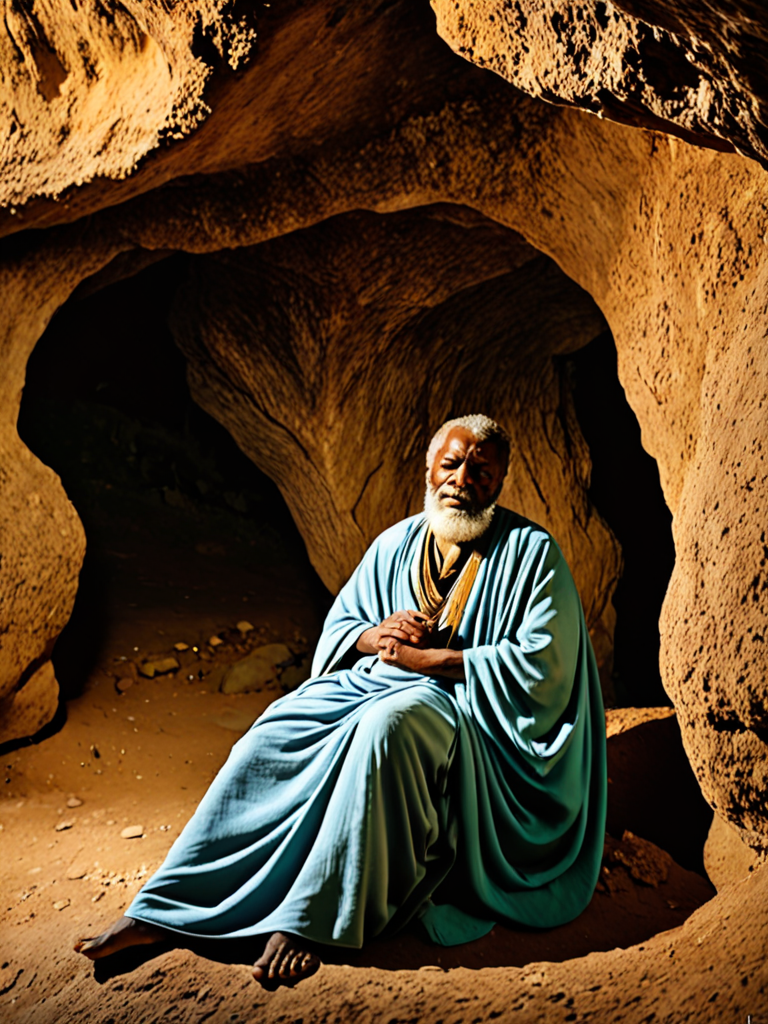
Overcoming Depression: The Story of Elijah – Finding Solace in God’s Silence, 1 Kings 19:1-14

A Sermon Delivered on August 11, 2024 by Patrick H. Wrisley, D.Min.

Today’s Story with the biblical giant Elijah is one all of us can relate with in our own lives. Let us review what is going on in Elijah’s life in the before chapter, 1 Kings 18, so we can better find with him.

In 1 Kings 18, God has dazzled the king and queen of the northern Kingdom of Israel Ahab and Jezebel with dramatic displays of divine power. Elijah has showed that their 450 prophets of Baal are charlatans, and he then kills those prophets by the sword. Queen Jezebel is none too pleased about this and places a fatwah of sorts on Elijah’s head. She has killed the Lord God’s prophets before, and she promises to take Elijah’s life as well. What is Elijah’s response?

Elijah turns tale and runs. He runs some 100 miles to the remote southern part of Judah and then he flees another 100 miles southwest towards Egypt! He is putting as much space between him and Jezebel as he can, and he ultimately winds up where God first began to define his relationship with the people of Israel. This is where we pick up in the Story.

1 Kings 19.1-14

19.1Ahab told Jezebel all that Elijah had done, and how he had killed all the prophets with the sword. 2Then Jezebel sent a messenger to Elijah, saying, “So may the gods do to me, and more also, if I do not make your life like the life of one of them by this time tomorrow.” 3Then he was afraid; he got up and fled for his life, and came to Beer-sheba, which belongs to Judah; he left his servant there. 4But he himself went a day’s journey into the wilderness and came and sat down under a solitary broom tree. He asked that he might die: “It is enough; now, O Lord, take away my life, for I am no better than my ancestors.” 5Then he lay down under the broom tree and fell asleep. Suddenly an angel touched him and said to him, “Get up and eat.” 6He looked, and there at his head was a cake baked on hot stones, and a jar of water. He ate and drank, and lay down again. 7The angel of the Lord came a second time, touched him, and said, “Get up and eat, otherwise the journey will be too much for you.” 8He got up, and ate and drank; then he went in the strength of that food forty days and forty nights to Horeb the mount of God.

9At that place he came to a cave, and spent the night there. Then the word of the Lord came to him, saying, “What are you doing here, Elijah?”10He answered, “I have been very zealous for the Lord, the God of hosts; for the Israelites have forsaken your covenant, thrown down your altars, and killed your prophets with the sword. I alone am left, and they are seeking my life, to take it away.” 11He said, “Go out and stand on the mountain before the Lord, for the Lord is about to pass by.” Now there was a great wind, so strong that it was splitting mountains and breaking rocks in pieces before the Lord, but the Lord was not in the wind; and after the wind an earthquake, but the Lord was not in the earthquake;12and after the earthquake a fire, but the Lord was not in the fire; and after the fire a sound of sheer silence. 13When Elijah heard it, he wrapped his face in his mantle and went out and stood at the entrance of the cave. Then there came a voice to him that said, “What are you doing here, Elijah?” 14He answered, “I have been very zealous for the Lord, the God of hosts; for the Israelites have forsaken your covenant, thrown down your altars, and killed your prophets with the sword. I alone am left, and they are seeking my life, to take it away.” [i]

What strikes me about this Story is that the Prophet Elijah, who is usually spot-on with next God’s lead and direction, has totally gone off script. The one time when he should be inquiring of God as what to do next in his life, he instead charts his own path, and zig zags his way to a place where he can be alone.

Elijah is overwhelmed with all the events of his life. He is filled with both fear and amnesia. Fear in that life events are too big for him and are out of control; his world seems as though it was crumbling down all around him. His all-encompassing fear and fatigue causes Elijah to act in ways he normally would not have acted. His fear bred within him a sense of amnesia.

His fear made him forget to stop and first listen to God for direction.

His fear made him forget that not once has God let him down.

His fear made him to forget that God has performed dramatic events of divine power and has listened to Elijah’s prayers.

His fear made him forget that he, in fact, was not the last prophet of the Lord God left; he knew there were hundreds of others.

His fear turned his once normally indefatigable lion-hearted spirit into a shattered shell of a man who became enveloped in hopelessness.

Has that ever happened to you? Have life events so swallowed you up that their waves come one after the other beating on you and in their battering, you forget that you know how to swim? This is where Elijah is.

Look with me at verse 9 in our text. We read, “At that place he came to a cave, and spent the night there.”  Another rendering of this verse is, “At that place, he entered into a depression and spent the night there.”  Considering all that is going on in Elijah’s life, considering how a bounty has been placed on his head, considering his spiritual amnesia, there is a wonderful play on words in our Story. Elijah was literally in a depression.

 Friends, we live in swirly time. Many of us know or personally suffer from some sort of depression or feeling overwhelmed by life. Did you know that 32% of young people between the ages of 13 and 18 in our country suffer from sort of anxiety disorder?[2] The National Institute of Mental Health notes, “An estimated 22.1 percent of Americans ages 18 and older—about 1 in 5 adults—suffer from a diagnosable mental disorder in a given year.”[3]  Over 52% of those who suffer from depression do not get medical help for their illness.[4]

When a person is in a depression, they easily fall into a state of amnesia; in other words, they forget the way a normal life feels and really is.

When a person is in a depression, overwhelmed with life, they forget to pause and listen for God’s direction and solace.

When a person is in a depression, they forget that in honest hindsight, God has never let them down before so why would God forget them at this point?

When a person is in a depression, they tragically feel this sense of being the only one who really understands the pain they are feeling; though they are surrounded by other people who care, their depression prevents them from seeing those who are ready and willing to help.

So, what exactly does God do with Elijah as he is stuck in his depression? God does three things. The first thing we note is God goes and meets Elijah where he is. Even into depression’s deep recesses, God can speak with clarity. God can penetrate the cave’s depths with God’s very Word. I love what the great philosopher, Soren Kierkegaard wrote where he says, “When human knowledge can’t see a hands-breadth before it in the dark night of suffering, then faith can see God, for faith sees best in the dark.”[5]

The second thing that we note is how God patiently meets Elijah in the depression itself. Does God lay into Elijah for not praying for direction or help during his plight? Does God tell him, “You don’t have it that bad; there are people worse off than you!”? Does God tell him, “Suck it up and pull yourself up by the bootstraps”? Absolutely not. God simply asks, “Elijah, what are you doing here? Go stand outside the depression as I will come by you.”

What follows are all these dramatic displays of divine power from greats winds, earthquakes, and fire. No amount of divine fireworks would pull Elijah out from his depression. But then, God becomes silent – or as one person described, “grindingly silent.” This piercing silence calls out to Elijah, and I wonder what he is thinking.

“Is God gone?”

“Why isn’t God trying to get my attention?”

“Has God abandoned me?” 

These are common feelings for those who are overwhelmed with the pressures of life. I wonder what drew Elijah out of the depression. Was he at all curious to know if God was still there? We just do not know.

This leads us to the third thing God did and that was to give Elijah something to do. God did not give up on him even though Elijah had given up on himself. God knew that Elijah’s gifts and graces were not being put to work while he was stuck the depression, that cave, that he was huddling inside. Elijah seems quite content to stay in the depression he was in, but God needed to lure him out.

This is a common behavior for those who feel overwhelmed with all that life is throwing at them. They want to hunker down into the cave even further away from anyone or anything. You see, people overwhelmed by life or in a depression really do not have the energy or want to do anything; it is simply too hard to muster the energy. The Lord God wants Elijah to do the very thing Elijah is afraid of and that is re-engaging life. God is asking him to do the counterintuitive response to crawl outside the cave and get back into life with all its winds, earthquakes, and fires. God is calling Elijah back out into life and purpose. Once again, God simply asks Elijah, “Elijah, what are you doing here?” Once again, Elijah goes through his list of woes, but God knows the path back to fullness and life for Elijah is to get out of the cave and back down the mountain. God tells him, “Elijah, I hear you. Trust me. But you see, there is life to be lived and the only way you are going to overcome the overwhelming events you are feeling is to honestly acknowledge them and lean into them. I am with you. I need you to You have to get back to work; it will be good for you, I promise. Now, backtrack your route and be the Prophet you are wired up to be. Go and anoint Hazael as King over Aram.” God knew that to break out of that depression, Elijah needed to be about something useful.

So, what has this to do with you and me? It affirms that even those loved, called, and cared for by God will at times become overwhelmed with the pressures of life and that sometimes those pressures will drive us into a depression of immobility.

It affirms that when we meet those who are in those depressions in life, we, like God, are to refrain from offering helpful advice and comments like, “You don’t have it so bad.” “There are a lot of people worse off than you.”  “Suck it up and pull up your bootstraps.”  No, that type of advice simply drives people further into the cave, the depression.

Instead, it affirms that when we meet people overwhelmed by life because of illness, broken relationships, rut-like jobs, or mental illness – we are most caring when we, like God, are silent with them. We are to be a quiet, loving presence that patiently waits lets others come out of the cave when they feel safe to do so.

Finally, like God, when people do come out of their cave and depression, we are to meet them with a simple question and not overload them with advice. God asked Elijah, “Eli, what are you doing here?”  We are simply to ask, “Sister, brother, how are you doing? Remember, you are not alone.”

It is a great comfort to know that a spiritual giant like Elijah felt overwhelmed by life just like we do at times. It is also a blessing to remember that God followed him there and never let him alone.

© August 11, 2024 Patrick H. Wrisley. Sermon manuscripts are available for the edification of members and friends of First Presbyterian Church, DeLand, Florida and not be altered, re-purposed, published or preached without permission.  All rights reserved.


[1] New Revised Standard Version (NRSV). New Revised Standard Version Bible, copyright © 1989 the Division of Christian Education of the National Council of the Churches of Christ in the United States of America. Used by permission. All rights reserved.

[2] See https://adaa.org/understanding-anxiety/facts-statistics. Accessed August 8, 2024.

[3] The National Alliance on Mental Health at https://www.nami.org/About-Mental-Illness/Mental-Health-By-the-Numbers/. Accessed on August 6, 2024.

[4] Ibid.

[5] As quoted in Estelle Frankel’s, The Wisdom of Not Knowing. Discovering a Life of Wonder by Embracing Uncertainty (Boulder: Shambhala, 2017), 55.

Posted in Sermon | Tagged , , , , , , , , , , , | Leave a comment

Measuring Christian Maturity: Insights from Ephesians 4:1-16

 A sermon delivered by Patrick H. Wrisley on August 4, 2024

This morning’s scripture lesson comes from Paul’s letter to the church in Ephesus. Many presume he wrote it some 35 plus or minus years after Jesus died, most likely from a prison cell in Rome. There are two prominent themes running through the whole letter. First, Christ has reconciled all creation to himself. Second, Christ has reconciled people from all nations into the church and so expects people within the church to be reconciled to one another. Today we pick up in chapter 4 and its first sixteen verses. Listen to the Word of God.

Ephesians 4:1-16

4.1 I therefore, the prisoner in the Lord, beg you to lead a life worthy of the calling to which you have been called, with all humility and gentleness, with patience, bearing with one another in love, making every effort to maintain the unity of the Spirit in the bond of peace. There is one body and one Spirit, just as you were called to the one hope of your calling, one Lord, one faith, one baptism, one God and Father of all, who is above all and through all and in all.

But each of us was given grace according to the measure of Christ’s gift. Therefore it is said (in Psalm 68.18),

“When he ascended on high he made captivity itself a captive; he gave gifts to his people.”

9(When it says, “He ascended,” what does it mean but that he had also descended into the lower parts of the earth? 10 He who descended is the same one who ascended far above all the heavens, so that he might fill all things.) 11 The gifts he gave were that some would be apostles, some prophets, some evangelists, some pastors and teachers, 12 to equip the saints for the work of ministry, for building up the body of Christ, 13 until all of us come to the unity of the faith and of the knowledge of the Son of God, to maturity, to the measure of the full stature of Christ. 14 We must no longer be children, tossed to and fro and blown about by every wind of doctrine, by people’s trickery, by their craftiness in deceitful scheming. 15 But speaking the truth in love, we must grow up in every way into him who is the head, into Christ, 16 from whom the whole body, joined and knit together by every ligament with which it is equipped, as each part is working properly, promotes the body’s growth in building itself up in love.[1]

Let us start today with a simple, straightforward question: Are you a grown up? A twist on that might be, have you grown up yet? Young people hear their parents tell them, “When you start acting like a grown-up, then you can go and do such-in-such!” Parents attach certain characteristics to what it looks like to act like an adult in the world and we try to teach those to their children.

What are signs you look for in a person that decides their level of maturity? Is it how someone dresses? Is it how they act in various circumstances? Do we measure maturity by age or by how knowledgeable someone is? Then again, maybe we measure someone’s maturity by how well they handle increased responsibility.

The Apostle Paul is writing the church and is imploring them to grow up and act like mature followers of Christ. Apparently, Paul had some rubrics and a set of metrics that measured both a person’s and a church’s maturity, and we will unpack those from our text today. He gives us at least three basic indicators for measuring the maturity of a disciple and as a church. First, a disciple’s life will quietly but consistently show the tone and timbre of Christ’s personality. Second, every follower of Christ is given unique gifts to use for the greater good. Finally, a disciple of Christ is committed to a life-long learning of the faith.

The first metric used to measure a Christ-follower’s maturity is whether their life even reflects the tone and timbre of Jesus’ personality. In other words, can people even tell whether we are a disciple of Christ’s or not? Now, looks can be deceiving and what we see going on on the outside may not always show what is going on on the inside. We have all met those Christians who say and who act all pious and such like carry a Bible everywhere, go to church, and bring a casserole to the pot-luck picnic; the problem is, but these same people will also gossip about folks, put people down behind their backs and withhold the love of Jesus if they disagree with you. When I say our life needs to look like a disciple’s life, I mean our life consistently reflects internalized core virtues and values which emulate Jesus’ personality from our inside out.

Paul says for us to lead a life worthy of our calling, literally our vocation, as a disciple of Jesus, then our life will bloom with the buds of virtues and values that smell like Christ. He says our lives will be steeped in humility and gentleness. Our lives will show patience and longsuffering. A disciple’s life reflects its ability to put up with and have a good relationship with others in the Christian community. Another way to say that is a mature disciple will patiently get along with others for the help of the greater good of the church. Humility, gentleness, patience, and putting up with those you disagree with are virtues and values developed over time and practice but there is intentionality in their development. It’s only when these virtues and values show the tone and timbre of Jesus’ life that all the pieces fall in perfect alignment and the grandeur of the One Spirit, the One Lord, the One God, and Father of us all is displayed. People will look at you and see the face of Jesus.

The second indicator of a mature Christian is seen in their use of the unique gift the Spirit has endowed each of us. The list of gifts in our lesson today is not meant to be an exhaustive list because Paul is echoing other verses from Romans and Corinthians that also have lists of spiritual gifts. As a result of Christ’s death and resurrection, each Christian is particularly gifted to foster an environment where the ministry of Christ is practiced in Christian community. Why? It is so the collective Christian community, that is the Church, can learn to take vibrant ministry out into the world.

The Church is where we learn and practice the art of being an apostle, a prophet, an evangelist, a pastor, and a teacher. The Church is the place where we practice using our gifts of giving liberally, the context we learn to be hospitable to strangers, and the living room we can safely stretch our faith. The Church is to be the safe environment to explore our gifts and graces so that we can fully use them in the larger community. The Church should be teeming with people who are eager jump in and use their gifts. The Church should be the place disciples come together to work on and through tough issues and show the world how to lovingly agree to disagree and carry forth together with the mutual ministry God has called us into. And let us be brutally honest here: If we in the church can’t get along and practice our faith together, we can’t expect people in the world to do it. The Church is bar setter for the culture and larger world.

So, Christian maturity is measured by the show of basic virtues and values that show Jesus’ personality. Maturity is measured by how well we are using our spiritual gifts both individually and corporately. The third measure of Christian maturity is a disciple’s commitment to life-long learning about God and their faith. Paul is imploring us to grow maturely in our knowledge of the faith so we will not be blown about in the wind by the many spiritual, cultural, or political snake oil salesmen out there in the world today.

 Beloved, how are you growing in your knowledge of the faith? Are you?

Think with me a moment. Think about a person’s emotional development. As a person grows older and at various phases of her life, her personality changes, the way she processes information changes, and the way she relates and communicates with others changes as well. In a person’s psycho-social development, isn’t it obvious when an adult behaves like an adolescent? If a person is not growing in their psycho-social development, we get worried and call-in specialists and counselors to help them get unstuck. Well, did you know growth in our spiritual maturity is the same? It’s no different. One’s spiritual maturity and knowledge is supposed to grow and develop, too!

 Unfortunately, over the 35 years of ordained ministry, I have seen too many Christian adults act like they are stuck in spiritual adolescence. Their faith is still stuck with what they remember from children’s Sunday school and youth group but now their lives are besieged by mature adult problems in a very swirly world. They have matured intellectually, physically, emotionally, professionally, and socially but spiritually they stay stuck in the past and have not grown in their maturity of the faith. The existential adult whirlwinds of crisis, of health, of politics, of climate change, and environmental sustainability can’t be solved nor addressed with a teenaged-depth faith. American Christians need to grow up.

Jewish New Testament scholar, Amy-Jill Levine, in her book, The Misunderstood Jew, The Church and the Scandal of the Jewish Jesus, notes the overall culture of religious ignorance in our country. She poignantly writes, “Christians from Tanzania to Tennessee gain their dominant impressions of Jews and Judaism by combining selective readings from the church’s Scriptures with Fiddler on the Roof, current Israeli policies, and an occasional episode of South Park.”[2]

Friends, the reality is the Devil knew his scriptures. The Pharisees and Sadducees knew their Torah and the Law inside and out; that was not the problem. Jesus reminded them, he reminds us, it is how we apply what we know in the Bible with others that measures whether we are both a God-honoring disciple and church or not. Jesus is not so concerned how well you and I can quote scripture as he is if we can apply the ethical, moral, and theological teachings in our everyday life. But yet, we must be well enough acquainted with the scriptures to even learn what the ethical, moral, and theological teachings are that we are to to follow.

Beloved, what virtues and values does your life show?

What spiritual gift or gifts are you graced with and are you using them?

Is your faith maturing ethically, biblically, theologically, and missionally or are you riding the coattails of what you learned years ago as a child? Join me on reflecting upon these things this week. In the Name of the One who is, who was, and who is yet to come. Amen. Let us pray…

© August 4, 2024 by Patrick H. Wrisley. Sermon manuscripts are available for the edification of members and friends of First Presbyterian Church of Glens Falls, 8 West Notre Dame Street, Glens Falls, NY 12801and may not be altered, re-purposed, published, or preached without permission. All rights reserved.


[1] New Revised Standard Version (NRSV). New Revised Standard Version Bible, copyright © 1989 the Division of Christian Education of the National Council of the Churches of Christ in the United States of America. Used by permission. All rights reserved.

[2] Amy-Jill Levine, The Misunderstood Jew. The Church and the Scandal of the Jewish Jesus (New York: Harper-Collins Publishers, 2007), 11.

Posted in Sermon | Tagged , , , , , , , , , , , , , , , , , | Leave a comment

Which One Do You Relate with?, or, The Lord’ll Provide, John 6:1-15

The Mount of the Beatitudes and the Feeding of the 5,000 overlooking the Sea of Galilee.

A Sermon delivered on July 28, 2024 by Rev. Dr. Patrick H. Wrisley.

Some 81 years ago, a young German pastor named Martin Niemoller stood with a delegation of leaders of the German Evangelical Lutheran Church confronting Adolf Hitler about human rights abuses. When he returned home, his wife asked him what he thought about the meeting. Niemoller told her, “I discovered that Herr Hitler is a terribly frightened man.”[1] It was Hitler’s contagious fear that caused the genocide of millions of people during WWII in his “Final Solution” – a mindset and belief that quickly spread among right-minded, rational German citizens. Family and friends turned on one another and betrayed each other to the Reich out of the fear Hitler and others were sowing among the people.

At best, fear is our human response that keeps us out of trouble or harms way. At worst, fear is the engine that drives paranoia and suspicion. We learn this at an early age. Watch two children play for a while. Presented with a cache of toys, each child gravitates to the object of their desire, takes it, and begins a pile of the toys he or she wants. It does not take long before the little brother or sister goes to the coveted pile of the other and takes a toy they want. Soon thereafter the arguing and crying begins because, “Bobby took my toy! It’s MINE!” Soon, mom must come over and explain the concept of sharing and taking turns. She reminds the children, “You both have plenty of toys to play with. Take turns with them and share with each other.” Little children are afraid they won’t have the toys to play with that they want. There’s an actual word for that made popular by Generation Z: FOMO. Fear of Missing Out.

It’s one thing when a child experiences FOMO over toys. It’s another thing entirely when nations go to war over resources another country enjoys. It’s another thing when large corporations enter a community and make a land grab to pursue its exploration of coal, gas, water, or some other minerals. We’ve seen this in our own country from indigenous peoples saying no to pipelines running through their land. We have witnessed the entire removal of a civilization as the Cherokee were forced to leave southern Appalachia and go west on a death March called the Trail of Tears because white settlers wanted their land.

The reality is, the other side of fear is greed. Taken together, they produce an engine of consumption, exploitation, and selfishness. Consequently, Church, it is good to remind ourselves that as a people of God, we will always have just what we need.

Turn in your Bible to John 6:1-15. It is a story that appears in each of the four gospel accounts. The Jewish Passover is fast approaching, and large crowds are en route to Jerusalem for the festival. The word about Jesus and his healing and teaching has spread, and people cannot get enough of him. This is what is happening in today’s story. In it, I want you to listen for the two responses two different disciples make when confronted with a question. Listen to the word of the Lord.

John 6:1-14

6.1 After this Jesus went to the other side of the Sea of Galilee, also called the Sea of Tiberias. 2A large crowd kept following him, because they saw the signs that he was doing for the sick. 3Jesus went up the mountain and sat down there with his disciples. 4Now the Passover, the festival of the Jews, was near. 5When he looked up and saw a large crowd coming toward him, Jesus said to Philip, “Where are we to buy bread for these people to eat?” 6He said this to test him, for he himself knew what he was going to do. 7Philip answered him, “Six months’ wages would not buy enough bread for each of them to get a little.” 8One of his disciples, Andrew, Simon Peter’s brother, said to him, 9“There is a boy here who has five barley loaves and two fish. But what are they among so many people?” 10Jesus said, “Make the people sit down.” Now there was a great deal of grass in the place; so they sat down, about five thousand in all.11Then Jesus took the loaves, and when he had given thanks, he distributed them to those who were seated; so also the fish, as much as they wanted. 12When they were satisfied, he told his disciples, “Gather up the fragments left over, so that nothing may be lost.” 13So they gathered them up, and from the fragments of the five barley loaves, left by those who had eaten, they filled twelve baskets. 14When the people saw the sign that he had done, they began to say, “This is indeed the prophet who is to come into the world.” 15 Perceiving then that they were about to come and take him by force to make him king, Jesus withdrew again to the mountain by himself.[2]

Try to imagine this scene as though you were there. John describes a hillside covered with lush grass. We see people milling about, and there is Jesus sitting at the bottom of the hill, looking up at the masses. He sees thousands of physically and spiritually malnourished people who need attention. He sees the need, and now comes the time to understand whether the disciples see it as well. So, he turns and asks Philip, “Where are we to buy bread, so that these people may eat?”

Can’t you see the incredulity in Philip’s face when he hears that question? I can see Philip giving Jesus a doggy-head-tilt, mumbling, “Say what? What’s this “we stuff” Jesus? A day laborer working and saving for 6 months would only be able to give this crowd a tidbit.” Fortunately, Andrew, Simon Peter’s brother who used to be a student of John the Baptist, chimes in. What I love about Andrew is that he is a glass-half-full kind of guy. Andrew sees possibility when impossibility is all around them. “Jesus, there’s a kid over here who has five barley loaves and two fish.”

Andrew, having just pointed out the possibility and solution to the problem, then goes on and says something any old church committee member would say at a session or committee meeting. “What are they among so many?” In other words, Jesus, it’s not enough to go around. We don’t have the resources to pull it off. We can’t do it. It’s risky. We’ve never done something like this before. What if we fail? Have you ever heard those comments or remarks like them in a church committee before? As they would say in Minnesota, “Don’t ya’ know? You betcha!”

As commentator Max Lee writes, “The spiritual and material care of God’s flock is ultimately something miraculous that only God can do. Will the disciples of Christ be paralyzed by the impossibility of the task, or will they present what they have, however meager, and have faith that Jesus can make a miracle out of it?”[3]

Old Testament genius and ethicist, Walter Brueggemann, says, “The majority of the world’s resources pour into the United States. And as we Americans grow more and more wealthy, money is becoming a kind of narcotic for us. We hardly notice our own prosperity or the poverty of so many others. The great contradiction is that we have more and more money and less and less generosity – less and less public money for the needy, less charity for the neighbor.” [4] What’s the reason for this? He says as Christians we have bought into the myth of scarcity versus living into the belief of God’s abundance. We Americans have the propensity to operate out of scarcity, that we will never have enough and need to stockpile our resources. Do you remember the pandemic when you could not find toilet paper because the Smith’s next door hit Walmart with a pickup truck and bought it all out? They probably still have rolls stuck in their closet somewhere!

As Christians, we have forgotten that all that has, is, or ever will be is created by God’s sovereign hand. As Christians, we forget that God owns the cattle on a thousand hills. As Christians, we forget how God takes the infertile Sarah and Hannah and gives them children who are heralds of God’s promise. As Christians, we forget how the Hebrews during the exile grumbled against God and Moses because they were hungry and thirsty, and God provided manna and quail from heaven and water from the rock. As Christians, we forget how God used Jesus to transform a ragtag group of men and women into the Church – the holy ones, the separated ones, the Beloved ones of God. As Christians, we forget that in our text today, Philip operated out of the mindset of scarcity whereas Andrew operated out of the possibility of God’s abundance to use what was available. Who do you best relate to in our Story this morning? Philip or Andrew? Scarcity or Abundance?

Catholic activist and co-founder of the Catholic Worker Movement, Dorothy Day, wrote about her experiences working in a soup kitchen during the last century. She writes, “God has given us our vocation, as he gave it to the small boy who contributed his few loaves and fishes to help the multitude, and which Jesus multiplied so that he fed five thousand people. Loaves and fishes! How much we owe to God in praise, honor, thanksgiving! . . . How many times, all through my life, have I surveyed these tables full of people and wondered if the bread would go around; how many times have I noticed how one heaps his plate and the last one served has little, how one wastes his food and so deprives his brother. (My colleague) German George grumbles as he brings out more sticks of margarine, and refills bread plates, coffeepots, sugar bowls. Where does it all go? Where do all the people come from? How will it all be paid for? But the miracle is that it does get paid for, sooner or later. The miracle is, also, that seldom do more people come than we can feed.”[5]

  There’s an old song by Mike Cross that goes like this:

Big old Buzzard sitting on a fence,watchin’ them chickens play
He’s sitting with his best friend ol’ Chicken Hawk, Chicken Hawk jump up and say,”Why don’t we invite us a chicken home for supper today?”           

And the Buzzard looks at him with a baleful eye,
takes a few seconds ‘fore he give a reply,
turn his neck nearly all the way around,
points to the sky and he says with a frown,
The Lord’ll provide, yes the Lord’ll provide,
just be patient brother and the Lord’ll provide.”

Chicken Hawk says but I’m hungry, my stomach startin’ to rumble like a train,He spies a fat chicken in the barn yard,
Chicken Hawk jumps up and screams,
” I hear the Lord helps them who helps themselves my friend.”
“The Lord’ll provide, yes the Lord’ll provide”,
that’s all brother Buzzard said, “the Lord’ll provide.”

Chicken Hawk starts to chasin’ chickens,
chickens start to squawking and run,
the farmer comes out of the farmhouse,
farmer got a BIG shotgun,
the farmer he blows that Chicken Hawk to kingdom come.

And the Buzzard looks at him with a baleful eye,
takes a few seconds ‘fore he give a reply,
turn his neck nearly all the way around,
and he looks at the Chicken Hawk laying on the ground,
“The Lord’ll provide, yes the Lord’ll provide”,
that’s all brother Buzzard said, “the Lord’ll provide.[6]

Do we believe the Church? Do we really believe the Lord will provide? If the animals do, why don’t we? If we do believe that God is a God of abundance and not of scarcity, it will change the way we live our life and serve as a church. Amen.

©July 28, 2024, by Patrick H. Wrisley. Sermon manuscripts are available for the edification of members and friends of First Presbyterian Church of Glens Falls, NY, and may not be altered, re-purposed, published, or preached without permission. All rights reserved.


[1] Walter Brueggemann, “The liturgy of abundance, the myth of scarcity”, The Christian Century, March 24, 1999. Accessed on July 26, 2024, at https://www.ngkok.co.za/Artikels/Brueggemann-Abundance-Scarcity.pdf.

[2] The New Revised Standard Version, copyright 1989, 1995 by the Division of Christian Education of the National Council of the Churches of Christ in the United States of America. Used by permission. All rights reserved.

[3] Max Lee, Connections: Year B, Volume 3: Season after Pentecost (Connections: A Lectionary Commentary for Preaching and Worship) by Joel B. Green, Thomas G. Long, et al., https://a.co/57YUIBf..

[4] Brueggemann, Ibid.

[5] Dorothy Day, Loaves and Fishes (New York: Harper & Row, 1963), 210–12. Words in parentheses were added for rhetorical clarity.

[6] Mike Cross, The Lord Will Provide. See Lyrics. Accessed on 7/37/24. To listen to the song, which really is worthwhile, please go to this YouTube Channel.

Posted in Sermon | Tagged , , , , , , , , , , , | Leave a comment

Coepit Facere et Docere, Mark 6:14-29

Salome by French artist Jean Benner (1836–1906) c.1899. 

A sermon delivered on July 14, 2024, by Rev. Dr. Patrick H. Wrisley

One of the daily readings for the lectionary this week was from Matthew. It registered with me considering what happened last evening in Pennsylvania as well as with the general tone and tenor of our bifurcated Divided States of America. Matthew 24.12 reads, “Because of the increase of lawlessness, the love of many will grow cold.”  Over the past 15 or so years, we have undergone the Great Regression as bigotry, hate speech, and discrimination towards people of color, ethnicity, and sexuality have increased. Individuals who believe they are wiser than you and me and who believe they are entitled to take the law into their own hands have done so. Whether it was Kevin Monahan[1] who shot a 20-year-old girl who simply pulled into the wrong driveway in Hebron a year ago or the individual who believed he had the right to take out a former President, people are showing a lack of trust within their communities and government.

Some American governors have such disdain for the Federal government that they are recruiting and building their own private state militias who are only responsible to the governor in power at the time.[2]

There are even churches that have had to hire mediation experts to ensure members of the same congregation could play nicely together in the same sandbox. Yes, this mistrust of each other in our nation has seeped into every layer of our country and the result is the death of Civitas. Civitas, the shared values a community believes in and lives into, is vital for a stable nation. Civitas defines who and what a community is and how it behaves.

Centuries ago, the Church Father and Theologian Augustine wrote a book entitled, The City of God, which describes two competing cities. One is the Earthly City whose ambitions are all about power and greed. The other is the City of God, the spiritual city, where God and the spiritual powers reign in implementing a way of life that is consistent with the Gospels and Jesus’ ethics. This disparate juxtaposition is highlighted in our Gospel lesson this morning.

In a poll of my preacher-friends on what text they are preaching this morning, every single one was avoiding this text in Mark about the death of John the Baptist. “C’mon Wrisley, it is just too messy.” And it is. It is a text that hoists a mirror in front of our face that we must gaze into. It is a dramatic text that forces us to look at ourselves, our nation’s Civitas, and our church’s Civitas, and realize the Church of Jesus Christ, i.e., you and me, are striving to live into the City of God.

At least we should be.

Last week, we read how Jesus scandalized the people in the synagogue he grew up in, and then he commissions the Twelve Disciples to go out two-by-two to preach and heal. Between their sending and their return, Mark inserts our Story about John’s death. It is a Story about the confrontation of political power and prophetic faith.[3] It paints a shadow of what comes next with Jesus, Pilate, and the Crucifixion in chapter 15. Before we hear the text, let me introduce some of the characters to you.

The first person we meet is King Herod. This is not the larger-than-life Herod the Great but one of Herod’s sons, Antipas. Antipas petitioned Caesar to become an actual king, but Caesar refused and made him a tetrarch, one of four governors who ruled Palestine. Even though Caesar did not make him a king, Antipas felt the freedom to call himself one. Antipas could care less about the Jewish way of life. He even built his magnificent palace in Tiberius on top of an ancient burial ground which discouraged Jews from coming to visit him because the palace defiled a graveyard.

Next, we hear about Jesus. Perhaps it was because of the 12’s preaching and healing tour in Jesus’ name that word got to Antipas, but the wannabe king began to second guess his rash act in killing John. Herod’s confusion about Jesus made him think it was a reincarnated John the Baptist who came back to haunt him. Others said Jesus was the prophet, Elijah.

We then hear about this woman named Herodias. She was a cousin of Herod Antipas who was married to one of his half-brothers, Phillip. Antipas convinced her to divorce Phillip and marry him instead. John the Baptist called Antipas out on this which caused Herodias to hate and despise John. And then we meet another Herodias who is Mother Herodias’s daughter. Later church tradition gives her the name Salome.[4] She is Herodias’ daughter and Antipas’ stepdaughter and niece, and who by all accounts, was quite the dancer. Did you get all that? Hear the Word of the Lord.

Mark 6:14–30

6.14 King Herod heard of it, for Jesus’ name had become known. Some were saying, “John the baptizer has been raised from the dead, and for this reason, these powers are at work in him.” 15 But others said, “It is Elijah.” And others said, “It is a prophet, like one of the prophets of old.” 16 But when Herod heard of it, he said, “John, whom I beheaded, has been raised.”

17 For Herod himself had sent men who arrested John, bound him, and put him in prison on account of Herodias, his brother Philip’s wife because Herod had married her. 18 For John had been telling Herod, “It is not lawful for you to have your brother’s wife.” 19 And Herodias had a grudge against him and wanted to kill him. But she could not, 20 for Herod feared John, knowing that he was a righteous and holy man, and he protected him. When he heard him, he was greatly perplexed; and yet he liked to listen to him. 21 But an opportunity came when Herod on his birthday gave a banquet for his courtiers and officers and for the leaders of Galilee. 22 When his daughter Herodias came in and danced, she pleased Herod and his guests; and the king said to the girl, “Ask me for whatever you wish, and I will give it.” 23 And he solemnly swore to her, “Whatever you ask me, I will give you, even half of my kingdom.” 24 She went out and said to her mother, “What should I ask for?” She replied, “The head of John the Baptist.” 25 Immediately she rushed back to the king and requested, “I want you to give me at once the head of John the Baptist on a platter.” 26 The king was deeply grieved; yet out of regard for his oaths and for the guests, he did not want to refuse her. 27 Immediately the king sent a soldier of the guard with orders to bring John’s head. He went and beheaded him in the prison, 28 brought his head on a platter and gave it to the girl. Then the girl gave it to her mother. 29 When his disciples heard about it, they came and took his body, and laid it in a tomb.[5]

Presbyterian Pastor and Professor of New Testament at Luther Seminary, Matthew Skinner writes that this is a story, “About an elite culture that plays by its own twisted, pernicious rules. Rome chose a pompous leader to govern Galilee, and (Antipas) represents a culture fueled by power and privilege that will do anything to extend its capacity to pursue its own desires, (to) hold onto power, (to) trumpet its own self-importance, (to) eliminate criticism, and (to) resist the justice and peace that God longs to bring to fruition.”[6] This is a Story of personal political expediency and privilege over and against the Civitas of Jewish ethics.

With subtle hyperbole, Mark weaves a narrative exposing two brilliantly lit extremes: Herod and his partygoers expose a life, conscience, and government devoid of grace and God’s justice in the pursuit of power and prurient self-interest. John, in stark contrast, is a Nazarene who has lived a strict, ascetical life devoid of any worldly pleasure or power. Our is a Story of political ambition and expediency, seduction, sexual lust, abuse of power, and murder. This is one of only two scenes in Mark’s gospel Jesus is not the center of the plot. The plot is pitting the way we treat each other in society and the way we resent the in-breaking of God’s presence into our realm.

Mark frames his narrative in a way the Jewish people would hear because they have heard of this Story before. First, they are reminded of how Queen Jezebel manipulated her husband King Ahab in her hatred of the prophet Elijah. There are echoes of the Book of Esther when a drunken Persian King named Ahasuerus made a promise to Queen Esther to give her half of the Kingdom should she want it.[7] Furthermore, Jewish biblical scholar, Amy-Jill Levine, notes that the Greek word for Jairus’ 12-year-old daughter Jesus previously healed in chapter five is referred to as a korasion, i.e., a virginal young child. Queen Esther when she is brought before King Ahasuerus is referred to as a korasion in the Greek version of the Old Testament. Salome in today’s text is also called a korasion![8]

This Story is full of disgusting behavior. An uncle has his 12-year-old stepdaughter and niece dance seductively before kings, princes, queens, state officials, and businesspeople of the day and then promises her something he does not have the authority to give. The daughter has no sense of Civitas or conscience and is manipulated by a disgruntled and hateful mother. Herod is a drunken wannabe king who makes a rash offer only to be given a rash ultimatum in return by a twelve-year-old.  “Daddy, immediately give me on a dinner platter, the head of John the Baptist.” As Professor Levine remarks, “The platter was (Salome’s) idea. She does not question her mother’s desire for John’s death; she adds to it. She thus transforms John into another course at the banquet.”[9]

Theologian Cheryl Bridges Johns says, “The execution of John forces the reader to gaze into a world of corruption, lust, and power…Herod’s court is in a far country whose horizon seems so distant from ours.”[10]  But is it, really? Our Story of John’s execution should shake us up, my friends. His world is not that much different from ours. It reminds us of the seduction of power and prestige which encourages us to act out on our own because I sure cannot trust you nor can I trust my neighbor! It reminds us of John, the person whom Jesus called, “The greatest man born of woman, was killed over a cocktail wager.[11]

The point of Mark’s Story, Church, is that to be a Christian disciple means it is not going to be easy. It teaches us that as members of the Church, we have the spiritual obligation to speak Truth to power even when it’s inconvenient and dangerous to do so. If there ever was a time our country needed her churches to stand up and do just that is right now; now is the time for the Church to speak Truth to Power.

My sermon title is a bit esoteric this morning and I do not mean it to be, but it captures well the goal of our text’s teaching. It is derived from Acts 1:1 where it says, “Jesus began to do and teach.”  Coepit facere et docere – is a Latin phrase that describes a concept which means, “We cannot preach what we do not practice.” We cannot preach what we do not practice. Friends, now is the time to put into practice our belief in Jesus and his ethic of loving each other even in our nasty politics and swirly state of social affairs. It means we do this when it is unpopular and difficult to do so.

In the name of the One who is, was, and is yet to come. So be it.  

© July 14, 2024, by Patrick H. Wrisley. Sermon manuscripts are available for the edification of members and friends of First Presbyterian Church of Glens Falls, NY, and may not be altered, re-purposed, published, or preached without permission. All rights reserved.


[1] New York man who fatally shot woman who was mistakenly driven up his driveway sentenced to 25 years to life in prison,” from CBS News, March 1, 2024.  See https://www.cbsnews.com/news/kevin-monahan-sentenced-kaylin-gillis-killed-pulling-into-driveway/.

[2] “The Florida Guard Looks Like Desantis’ Own Militia,” The Miami Herald, February 1, 2024. Accessed 7/8/24 at https://www.miamiherald.com/opinion/editorials/article284959592.html.

[3] Bartlett, David L.; Taylor, Barbara Brown. Feasting on the Word: Year B, Volume 3: Pentecost and Season after Pentecost 1 (Propers 3-16) (Feasting on the Word: Year B volume). Presbyterian Publishing Corporation. Kindle Edition.

[4] See Josephus Antiquities of the Jews (Book XVIII, Chapter 5, 4.

[5] The New Revised Standard Version, copyright 1989, 1995 by the Division of Christian Education of the National Council of the Churches of Christ in the United States of America. Used by permission. All rights reserved.

[6] Connections: Year B, Volume 3: Season after Pentecost (Connections: A Lectionary Commentary for Preaching and Worship) by Joel B. Green, Thomas G. Long, et al. See https://a.co/3CMDvQB. I added the word (to) for rhetorical clarity.

[7] See Esther 7.

[8] Levine, Amy-Jill. The Gospel of Mark: A Beginner’s Guide to the Good News (pp. 39-40). Abingdon Press. Kindle Edition.

[9] Ibid., 40.

[10] Bartlett, David L.; Taylor, Barbara Brown. Feasting on the Word: Year B, Volume 3: Pentecost and Season after Pentecost 1 (Propers 3-16) (Feasting on the Word: Year B volume) . Presbyterian Publishing Corporation. Kindle Edition.

[11] James R Edwards, The Gospel According to Mark (Grand Rapids: William B Eerdmans Publishing Company, 2002), 189.

Posted in Sermon | Tagged , , , , , , , , , | Leave a comment

Sometimes It Happens to the Best of Them, Mark 6:1-13

Jesus rejected in Nazareth.

A sermon delivered July 7, 2024 by the Rev. Patrick H. Wrisley, D.Min.

Last week in Mark’s gospel, we noted the power of an interruption in our lives. Jesus and the others just landed in Capernaum where he was immediately inundated with people demanding things of him. The synagogue ruler, Jairus, begs Jesus to come heal his dying daughter and then a bleeding women sneaks up and touches Jesus’ clothes and is healed. In both cases, Jesus stops where he is and intently focuses on the people who interrupt him and their needs. Today, we find that Jesus and the Twelve have traveled west-southwest up into the mountains some 32 miles to Jesus’ hometown of Nazareth. Hear the Word of the Lord!

Mark 6:1-13

He left that place and came to his hometown, and his disciples followed him. 2On the sabbath he began to teach in the synagogue, and many who heard him were astounded. They said, “Where did this man get all this? What is this wisdom that has been given to him? What deeds of power are being done by his hands! 3Is not this the carpenter, the son of Mary and brother of James and Joses and Judas and Simon, and are not his sisters here with us?” And they took offense at him. 4Then Jesus said to them, “Prophets are not without honor, except in their hometown, and among their own kin, and in their own house.” 5And he could do no deed of power there, except that he laid his hands on a few sick people and cured them. 6And he was amazed at their unbelief. 

Then he went about among the villages teaching. 7He called the twelve and began to send them out two by two and gave them authority over the unclean spirits. 8He ordered them to take nothing for their journey except a staff; no bread, no bag, no money in their belts; 9but to wear sandals and not to put on two tunics. 10He said to them, “Wherever you enter a house, stay there until you leave the place. 11If any place will not welcome you and they refuse to hear you, as you leave, shake off the dust that is on your feet as a testimony against them.” 12So they went out and proclaimed that all should repent. 13They cast out many demons, and anointed with oil many who were sick and cured them.[1]

Today’s text has a message the Church needs to hear. Whereas in 1965 when over 70% of Americans believed religion was “very important” in their lives, today only 45% of Americans hold to that view.[2] A Gallup Poll in March of this year revealed that 21% of Americans attend religious services every week and that’s down from 46% in 2009[3]. Just 11% attend once a month, and 56% rarely or never attend.  Remember, too, these statistics are for all faith traditions not just the Christian church.[4]

All of us have recollection of the Church’s “glory days” when worship was full, Sunday school was thriving, and churches were being planted everywhere. As much as we pine for those glory days, the American church needs to wake up from its Rip Van Winkley spirit and take to heart what Dorothy told Toto, “We’re not in Kansas anymore!” We live in an era where beautiful sanctuaries like ours have been turned into high-end condominiums in many places. There is no going backwards; Church today needs to bravely face forward and walk into the future, not with naive nostalgic wish dreams, but with a wholehearted commitment to the basics of the Gospel and its purpose and mission. Our text this morning gives us some tools and lessons for us as we move into that future together.

First, God does not force the Gospel on anyone. We see this clearly today as Jesus goes back to where he grew up, preaches, and tries to heal folks like he has already shown himself able to do. But hometown folks are hard to convince. Even Jesus’ own family thought he was out of his mind back in Mark 3:21. For the hometown crowds, Jesus was that quirky momma’s boy who worked as a day laborer.

Let’s remind ourselves what the “gospel” or good news is. The late Catholic priest and author Simon Tugwell, says, “Jesus is the full declaration of God’s “I AM”, present in our midst; and our faith is…essentially the acceptance of this fundamental truth of God’s being” whereby we make room for God in our lives and share that love with others in acts of love and mission.[5]  Jesus presented his homebodies with this presentation, and they were scandalized by what he said. Like Mighty Casey before his hometown fans, Jesus struck out in Nazareth. And so, even though we see how God does not force the gospel on anyone, that does not preclude our trying to share that gospel.

The second observation we get out of our text today is that as disciples, all of us are called to the ministry of evangelism and healing. The disciples have just seen Jesus’ rejection and now Jesus is sending them out on their own. Imagine how they must be feeling at that moment! Think what he is asking them to do: Leave your checkbook at home and simply take a hiking stick, a pair or sandals, and a tunic and tell others the Presence of God is afoot so turn back around and fall into God’s arms. The disciples’ proclamation was not just with their words, however. Mark says their witness was also through their healing ministry. The disciples went and physically reflected God’s healing presence through their acts of grace. We see how their very presence sent the evil spirits packing.  

All the disciples are sent to proclaim the news of God’s presence, even crusty old Judas. Friends, none of us gets a pass on this one. We confuse evangelism with church growth, and it is not the same thing. Church growth may or may not occur. Evangelism is simply disciples in the church sharing with others how God in Jesus has made a difference in their life, and they are now compelled to serve others in a healing, loving presence. It was not solely Jesus’ job. It is not the pastor’s job. It is the church’s job to proclaim God’s presence in our community’s midst, not only with words, but with demonstrable acts of healing and compassionate service.

The third observation from our text this morning is that a ministry’s success is not measured by how many people we convert; the disciples’ success is measured by their faithfulness to go and share the good news with words and healing per Jesus’ command. Jesus was not, dare I say — is not — concerned with conversions; Jesus is interested in healing transformation in a person and in a community’s life. A church’s ministry is measured by whether it is reflecting the graceful Presence of God in any given community or situation and that is everyone in the church’s responsibility.  Church, your ability to do just this thing will determine whether or not this congregation will exist 10 to 15 years from now. It’ll determine whether or not this beautiful building will be made into luxury condos as so many other churches have.

The former pastor of the Brick Presbyterian Church in Manhattan, Michael Lindvall, writes the disciples, “Need not have polished words, sophisticated theology, or fine-tuned dogma to speak of their faith. They are simply called to speak truth in love, from the heart, in their own words, and never be ashamed.”[6] That is all Jesus asked the disciples to do; that is all he is asking us to do as well.

We are not being asked to be Mother Teresa. Jesus is not asking us to be a Billy Graham or a Rachel Held Evans. Jesus is simply asking each and every one of us to be the best Patrick, Bryan, Jill, Ellen, Mary, and Randy we can be as we let others know what God has done in our life. Jesus did not send out six pair of spiritual giants into the villages. He sent a ragtag group of imperfect, callous, critical, opinionated, prideful, oftentimes squabbling people to go show in word and deed God’s presence in the community. Through his own hometown rejection, Jesus indicates he knows how intimidating that can be; yet he still sends them out two-by-two; yet, he still sends us out, too.

There is a story of a woman who worked in a bookstore. She was member of a mainline Christian church in town and one day got asked a question by a customer. You see, a man came in who dressed like a Hasidic Jew – a very conservative branch of Judaism. The clerk asked him, “May I help you?” and he softly replied, “Yes, you can. I would like to know about Jesus.” She directed him to the upstairs religious section of the bookstore where all the books about Jesus were and then turned her back and went about her business at the desk. The man did not move. Again, he softly said, “Excuse me, I don’t want to be shown books about Jesus; tell me what you believe.[7]

Beloved, if you were the store clerk that day and you were asked, “Tell me what you believe,” how would you respond?

Sometimes, rejection or failure happens to the best of them. Just like with Jesus. Just like with the disciples. Just like with the Church. And sometimes, just like there will be with you and me. And even though God does not force people to believe, God does send us out as disciples to share the transforming life and presence of the One we celebrate so passionately at Christmas and Easter. All of us are called to go and tell. But first, each of us needs to know what we believe about Jesus. Your homework this week is to reflect or write about what you believe about him so that when people meet us out there, we can also be the Lord’s healing presence to them.

In the Name of the One who is, was, and is yet to come. Amen.

© July 7, 2024, by Patrick H. Wrisley. Sermon manuscripts are available for the edification of members and friends of First Presbyterian Church of Glens Falls, NY, and may not be altered, re-purposed, published, or preached without permission. All rights reserved.


[1] The New Revised Standard Version, copyright 1989, 1995 by the Division of Christian Education of the National Council of the Churches of Christ in the United States of America. Used by permission. All rights reserved.

[2] “Why Americans are losing their religion,” by Dora Mekouar, April 23, 2024, from Voice of America News. See https://www.voanews.com/a/why-americans-are-losing-their-religion-/7576935.html.

[3] Lifeway Research, “Fewer Than Half of Americans Regularly Attend Church,” October 24, 2019. See https://research.lifeway.com/2019/10/24/fewer-than-half-of-americans-regularly-attend-church/, accessed 7/5/24..

[4] “Church Attendance Has Declined in Most U.S. Religious Groups. Three in 10 U.S. adults attend religious services regularly, led by Mormons at 67%,” by Jeffrey M. Jones, Gallup Research Center, March 25, 2024. See https://news.gallup.com/poll/642548/church-attendance-declined-religious-groups.aspx.

[5] Simon Tugwell, Prayer. Living with God (Springfield: Templegate Publishers, 1975), 85.

[6] Feasting on the Word: Year B, Volume 3: Pentecost and Season after Pentecost 1 (Propers 3-16) (Feasting on the Word: Year B volume) by David L. Bartlett, Barbara Brown Taylor. See https://a.co/85HPPiF.

[7] Feasting on the Word: Year B, Volume 3: Pentecost and Season after Pentecost 1 (Propers 3-16) (Feasting on the Word: Year B volume) by David L. Bartlett, Barbara Brown Taylor. See https://a.co/cyWfD4N.

Posted in Sermon | Tagged , , , , , , , , , , , , , , , | 1 Comment