Marcus Aurelius led Rome from 161 to 180 A.D. and was noted for his shrewd wisdom and leadership. He led his empire through periods of war, plague, and the complexities of messy international and local politics while maintaining a steady hand on the tiller with leadership marked with integrity. He understood that “What we do now echoes in eternity.”
The foundation of good leadership is a person’s virtue and integrity. According to Aurelius, a leader’s primary duty is to be morally upright leading with fair justice as you exercise programs for the general welfare of your people. In other words, one’s personal character matters.
The 2024 presidential election is now upon us. How does one choose the one to vote for?
There are many issues facing our nation. The growing gap between the wealthy and everyone else. Illegal versus legal, just immigration. The climate and the decaying environment. Women’s reproductive rights. Wars in eastern Europe and the Middle East. There is the economy with accompanying supply chain issues. Our nation’s, crumbling infrastructure. The degradation of our system of a democratic republic. Rebuilding from natural disasters. The dangerous arc of Christian Nationalism. The challenges we face our legion.
So, how do I as a Christian determine who to vote for? What criteria should I use to pick a candidate? Do I base it on their positions on government, immigration, party affiliation, or economics? All of these are vital and important but not one of them is the measure I shall use to decide my vote. The only criteria that makes the most sense to me as a follower of Jesus is the measurement of the leader’s character.
It needs to be said that no one’s character is pure and spotless. Every one of us has issues or agendas we advance that are self-serving and beneficial to ourselves. Yet the true moral quality of a leader is his or her ability to see their deficiencies and act virtuously to both address and correct them.
A leader’s character impacts the ways he or she will negotiate the plethora of challenges that confront our nation. The leader’s moral character will not cause those economic, judicial, or healthcare challenges to disappear; his or her character will determine how those problems will be addressed and negotiated. Moral character determines how a leader makes wise and intelligent decisions grounded in virtue and integrity. People of faith should instinctively understand and embrace this position; it’s perplexing why many do not.
Character matters, particularly with those men and women entrusted with any form of leadership. At the very minimum, or national leaders should be able to pass the elementary smell test of Rotary international:
Is it the truth?
Is it fair to all concerned?
Will it build goodwill and better friendships?
Will it be beneficial to all concerned?
A leader’s character is the trusted propulsion system that enables the various parts of the ship to run efficiently and with synchronicity. Beloved, this month, exercise your freedom to vote your conscience. Choose the candidate you believe has the character to run our great nation. God give us grace to have the moral character to respectfully respect the will of the people.
Listen for the Word of the Lord from Mark 12:28 – 34…
28 One of the scribes came near and heard them disputing with one another…
Now before we go any further, we need to pause and ask who is the “them” the scribe heard arguing. You see, after Jesus healed Blind Bartimaeus in Jericho last week, the whole group set out on the long journey. They trudged the hot 18-mile road up the mountains to Jerusalem. We find Jesus in the Temple area at the start of the Passover celebrations. As soon as he arrives, the entrenched religious and political establishment begin to argue with him.
First, the scribe heard the Pharisees and the Herodians trying to trip up Jesus about paying taxes to Rome. A second group called the Sadducees began nit-noiding Jesus on issues of the resurrection. They do not believe in life after death. The crowds are all pushing and shoving to see the upstart Rabbi take on the religious and cultural elite. The crowds were impressed by Jesus’ teachings and healings; Jerusalem had a carnival atmosphere about it. This is where we meet our scribe. A scribe is a Jewish theologian and teacher of the Jewish Law. He approaches Jesus and asks a penetrating question. Unlike the other absurd questions the other groups asked, the scribe approaches Jesus with a question of honest substance. Jesus responds by quoting Hebrew scripture the Scribe would know all too well.[1]Let us continue with the scripture reading.
Mark 12:28-34
28One of the scribes came near and heard them disputing with one another, and seeing that he answered them well, he asked him, “Which commandment is the first of all?” 29 Jesus answered, “The first is, ‘Hear, O Israel: the Lord our God, the Lord is one; 30you shall love the Lord your God with all your heart, and with all your soul, and with all your mind, and with all your strength.’ 31The second is this, ‘You shall love your neighbor as yourself.’ There is no other commandment greater than these.” 32Then the scribe said to him, “You are right, Teacher; you have truly said that ‘he is one, and besides him there is no other’; 33 and ‘to love him with all the heart, and with all the understanding, and with all the strength,’ and ‘to love one’s neighbor as oneself,’—this is much more important than all whole burnt offerings and sacrifices.” 34 When Jesus saw that he answered wisely, he said to him, “You are not far from the kingdom of God.” After that no one dared to ask him any question.[2]
In 1986, pop icon Tina Turner released a hit called, “What’s Love Got to Do with It?” Do you remember the refrain? “What’s love got to do, got to do with it? What’s love but a second-hand emotion? What’s love got to do, got to do with it? Who needs a heart when a heart can be broken?”[3]Well, Tina, I’ve got to disagree with you on three fronts.
First, love is not a second-hand emotion. Our scripture reminds us that it is top tier! Second, love is more than an emotion. Yes, it describes how we feel, but it is best understood as a verb[4]. In both our Hebrew and Greek texts this morning, love is a verb, not a noun! And finally, love does indeed break hearts and it is the broken heart that is the engine propelling love outward. I want to spend the rest of our time looking at the fact that love is a verb and that our breaking hearts are the engines moving the feeling of love into action.
Love is a verb. Love as a concept is noun. As a concept, as a noun, love is most pleasant to think about. It is lovely to read and write about it. Yet, love as a concept is impotent if it does not do something. Love moves from a noun, a concept, when love is doing something as a verb.
For example, I can tell you, “I love you” but it is only when I show you in physical ways that I love you does love become real and true.
I can say, “I love my neighbor” but it is only when I prove that love does it become tangible and real.
We can say, “We love the least of these who are in prison and love those who are hungry” but it’s only when we go and minister to those behind prison bars and their families, it’s only when we attempt to curb food waste and seek out ways and means to to address the issues of systemic food insecurity does our love move from a nice spiritual construct and notion to action. It moves from being talked about to done about.
Years ago, I heard the story of a little girl who was beginning to sleep in her very own bed in her bedroom. Mom and dad said prayers with her, kissed her goodnight, put on a small light, and went to bed. A little while later, the father heard muffled crying from his daughter’s bedroom. He went to see what the matter was. “Sweetheart, daddy’s here. What’s wrong?”
“Daddy, I got scared.”
“Well Little Bit, you know mom and I are right next to your room and God is with you and watching over you. You’re never alone.” The little girl looked up at her daddy with her arms stretched out saying, “I know daddy, but I needed to feel the love of someone with skin on.”
The little girl is correct. Love must be enfleshed.
The Greek word for love that we know so well, agape, is not just a feeling in your heart. It goes beyond mere emotions toward another person. Agape is an active, demonstrable, inconvenient, sacrificial, and willful expression of care for others. This is the word both Jesus and the scribe are using in today’s Story.
Christ-like love is a verb and is physically and emotionally demonstrated to others. But what is it that gives power to love? It is a broken heart.
Friends, a broken heart is the engine and motivation that puts love in action. Earlier in Mark’s gospel, Jesus crosses the Galilee with his disciples and lands on the other shore. While he was disembarking, people were swarming to him in droves and the text says, “When Jesus landed and saw a large crowd, he had compassion on them, because they were like sheep without a shepherd.”[5]A literal reading of that would be that when Jesus saw the large crowd, he felt for them so much his stomach hurt. The ancients believed emotions like love, compassion, and pity originated in a person’s gut. They thought these feelings were found in their bowels. Love arises out of a physical, visceral action that occurs in our body. When Tina Turner sang, “Who needs a heart because a heart can be broken,” she failed to realize she was hitting the nail on the head! Broken hearts move people to action.
When you and I pass a homeless woman sleeping in her car with her child, our hearts should break. This should prompt us to do something about homeless families.
When we see the news about how Palestinian families are being starved to death because of the IDF’s refusal to allow aide to flow into Gaza, our hearts should break and prompt us into some type of action.
When we see the ugly, outward signs of bigotry towards immigrants who are fleeing for a safer, better life like our own ancestors did, when we see the outward signs of bigotry towards people of a different sexual orientation, skin color, or religious heritage, our hearts should break inspiring us to work for justice and reconciliation.
Beloved, what do we think God sees and feels looking at our world? God peers down and sees a civilized democracy whose politicians spew lies, hate speech, and anarchy. God see countries committing genocide. The Lord sees the death of innocents because of a world leader’s lust for power. God watches as her beautiful creation is being abused and exploited. God’s heart breaks and that broken heart moved God into action by becoming one of us, a human, Jesus, whose heart broke as well. God knew that we needed to be loved on by someone with skin on, too! You see, a broken heart is the catalyst for transforming love as a concept into an active, engaging, inconvenient, self-sacrificing verb.
The Table before us is the greatest reminder of how God’s broken heart becomes the motivator for showing us love. Jesus lived, sacrificed, died, and rose again proving God’s infinite love for you and me. I pray the Holy Spirit haunt each of us as we reflect upon what breaks our heart and whether that broken heart is energizing us to put skin on that love and do something. So, let it be.
A Sermon delivered on October 27, 2024 by Rev. Dr. Patrick H. Wrisley
If you were Jewish and heard the city of Jericho, what comes to mind? You would remember that Jericho was the first city the Israelite’s came to as they entered the Promised Land after Moses died. Jericho was their first military triumph as they began to live into a new phase in their relationship with the Lord. And do you remember who led the Israelite’s over the Jordan river to capture the city of Jericho? God’s appointed leader, Joshua. Joshua is the leader of twelve tribes of nomadic Hebrews who leads them across the river to become the pioneering settlers who make up the new nation of Israel. This morning, we are back in Jericho as Jesus is making his way up to Jerusalem. And, oh, and what is Jesus’ Hebrew name again? Oh, that is right, it is Joshua. Friends, Mark is trying to get our attention.
This section of the Story in Mark’s gospel began at Mark 8:22. It was where we were first introduced to another blind man in the village of Bethsaida. In between these two stories of blind men is a series of teaching and events that have highlighted who Jesus is and the purpose of his coming. If we want to know Jesus’ identity and purpose for coming, we are to read the stories sandwiched between these two blind men healing stories.
Jesus has made it clear what was about to take place and what he came to do. Three times he tells his disciples about the events to come. He says, “The Son of Man must undergo great suffering. He will be rejected by the elders, the chief priests, and the scribes. He will be killed. After three days, he will rise again.”[1] The first time Jesus reveals his identity and purpose, Peter rebuked him. The second time he reveals his identity and purpose, the disciples immediately began to bicker amongst themselves. They argued about which one of the Twelve was the greatest disciple. The third time Jesus reveals his identity and purpose, the Zebedee brothers began talking about which one of them was going to be the new boss when Jesus comes into his glory. In each instance, those who plainly see and hear everything Jesus did were blind to his true identity. They did not recognize who Jesus was. With a flair of irony, Mark has the blind ones who see Jesus. As New Testament scholar and Episcopal priest, Andrew K. Adam writes, “Mark deploys these healing stories to underline the contrast between outsiders who see Jesus and insiders who remain blind to his true identity.”[2]
This brings us to our reading from Mark 10 this morning. We will start with verse 46; listen to the Word of the Lord.
Mark 10:46-52
46They came to Jericho. As he and his disciples and a large crowd were leaving Jericho, Bartimaeus son of Timaeus, a blind beggar, was sitting by the roadside. 47When he heard that it was Jesus of Nazareth, he began to shout out and say, “Jesus, Son of David, have mercy on me!” 48Many sternly ordered him to be quiet, but he cried out even more loudly, “Son of David, have mercy on me!” 49Jesus stood still and said, “Call him here.” And they called the blind man, saying to him, “Take heart; get up, he is calling you.” 50So throwing off his cloak, he sprang up and came to Jesus. 51Then Jesus said to him, “What do you want me to do for you?” The blind man said to him, “My teacher, let me see again.” 52Jesus said to him, “Go; your faith has made you well.” Immediately he regained his sight and followed him on the way (NRSV).
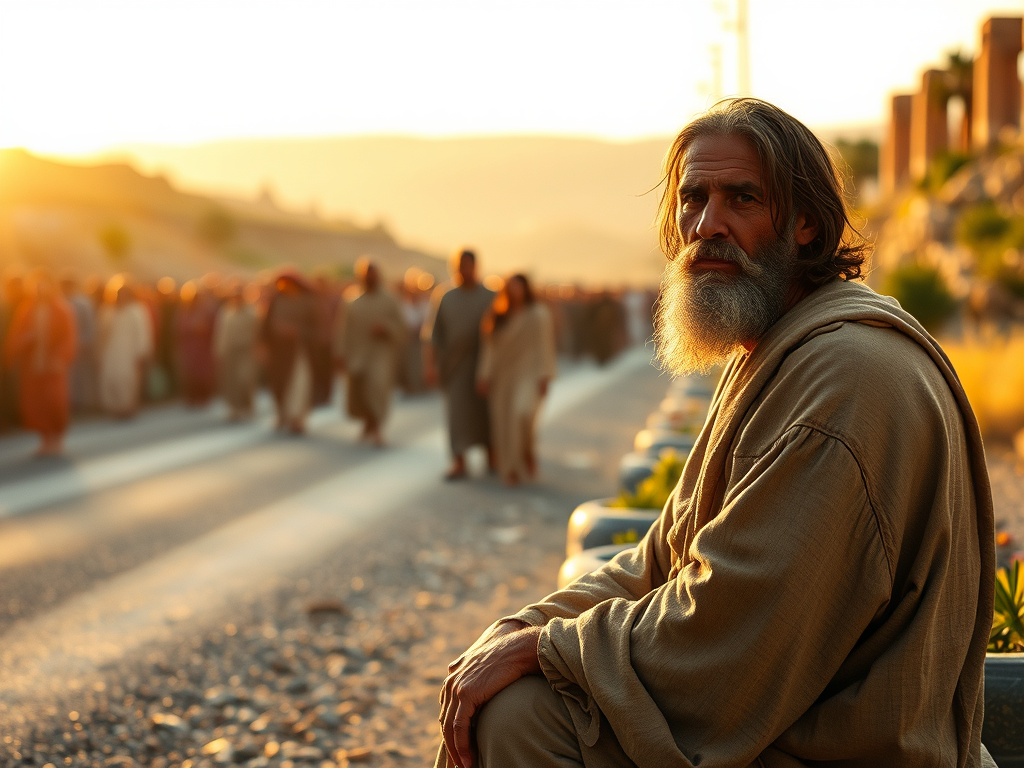
Mark is a clever writer. Jesus just instructed the Twelve to be servants of all and then gives us an object lesson on what that means. We find Bartimaeus sitting beside the road begging from passerby’s who are making a religious pilgrimage to Jerusalem for the upcoming Passover celebrations. He is a man who relies one hundred percent on the help of other people. Bartimaeus, blind beggar that he was, is pitied by some or is just a social nuisance in the eyes of others. He relies on the grace and kindness from those around him just to survive. Every single time he opens his mouth he is forming a prayer for someone to help him. We hear how people answered his pleas for help as they were on their way to Jerusalem for their religious observances: They yelled at him to shut up and be quiet. The good religious folk were blind to his needs. Alas, Bartimaeus will not be ignored. He shouts even more loudly, “Jesus, Son of David, have mercy on me!”
There in the midst of a thronging crowd, eight words spoken by a social castoff stopped Jesus in his tracks. Jesus, Son of David, have mercy on me. This man’s cry for help is heard above the din of the pushing crowd. Why? I am sure a lot of people were yelling things at Jesus so why did Jesus stop now? Because Bartimaeus saw in Jesus the one no one else see except the demons and evil spirits throughout Mark’s gospel. Peter gave us some hope back in chapter 8 when he called Jesus, the Christ, but then quickly proved he did not understand what that meant. Blind Bartimaeus saw it at once.
“Son of David.” Finally, someone clearly named who Jesus was! Son of David. Not only is Jesus, Joshua, leading the people to a new life, but we learn Jesus is seen by Bartimaeus as the Son of David. The term Son of David is not a throw-away line in Mark’s Story. The term is used for the long-awaited Davidic king who would deliver the people from Gentile occupation and establish a great nation. Son of David is a royal title indicating this king is of David’s lineage.[3]This man’s prayer, simple as it was, got Jesus’ rapt attention. We can learn much from these 8 words.
The Apostle Paul in 1 Thessalonians 5:17 implores the church to pray without ceasing. Well, that is easier said than done quite frankly in today’s frenetic pace of life. If only there was a prayer that we knew that would get Jesus’ attention and get an answer. If only I knew a prayer that would help me pray throughout the day. Beloved, we know of such a prayer, don’t we?
Jesus, Son of David, have mercy upon me. Eight words. Bartimaeus gives us a prayer that Jesus responds to as well as words that will enable us to pray without ceasing. Jesus, Son of David, have mercy upon me. For centuries, the Church have referred to Bartimaeus’ eight words as the Jesus Prayer, or the Prayer of the Heart. It is used to help disciples keep the presence of God in the forefront of their mind.
The Orthodox will pray a type of rosary called a chotki made of knotted wool rope. With each knot their fingers touch, the say the prayer, “Jesus, Son of David, have mercy upon me.” Then they touch the next knot and repeat the process until they pray through the whole rosary. Orthodox chotkis, prayer cords, usually have 104 knots to pray through. The idea is to pray it so that it becomes a part of your breathing. As you sit to pray, you breath in, “Jesus, Son of David,” and then you exhale, “have mercy on me.” You then breath in and out this prayer quietly for a period you wish to pray. Over time, it becomes an unconscious habit of praying throughout the day.
I do not carry a chotki around per se. However, as I showed the boys last week in the children’s message, I do carry a compass with a little string on it. Throughout the day, I will reach down into my right pocket and fondle the compass and silently pray, “Jesus, Son of David, have mercy on me.” If I am in a tense meeting, I will reach down for my compass and pray as the other person is speaking. Whether walking in the mall or sitting in a doctor’s waiting room, the Jesus Prayer just comes from within. I used to have a problem with rage. My praying the Jesus Prayer over the years has gotten rid of it. It forces me to slow my breathing down and give God attention.
What can you use to become a reminder to quietly pray the Prayer of the Heart? Perhaps, it is a ring you wear or a cross on your necklace. It does not matter what it is. The important thing is that it is a reminder to you to go to the Lord in prayer. The more you do it, the more it becomes a part of who you are. It just bubbles out like spring water from your heart. This is why it is called, The Prayer of the Heart.
Jesus, Son of David, have mercy on me. A prayer you can say in one breath. It certainly got Jesus’ attention. When it does, he will stop in his tracks. He will look at you and sweetly say your name, “What is it you want me to do for you?” I invite you to join me in this adventure of praying without ceasing! It will transform you, I promise. Amen.
[1] So, Mark 8:31. See also Mark 9.30-32, 10.32-34.
[2] Article written by A.K.A. Adam in Feasting on the Word: Year B, Volume 4: Season after Pentecost 2 (Propers 17-Reign of Christ) (Feasting on the Word: Year B volume) by David L. Bartlett, Barbara Brown Taylor. See https://a.co/hYFe3Ot
[3] See 2 Samuel 7:8-17: Now therefore thus you shall say to my servant David: Thus says the Lord of hosts: I took you from the pasture, from following the sheep to be prince over my people Israel; and I have been with you wherever you went, and have cut off all your enemies from before you; and I will make for you a great name, like the name of the great ones of the earth. And I will appoint a place for my people Israel and will plant them, so that they may live in their own place, and be disturbed no more; and evildoers shall afflict them no more, as formerly, from the time that I appointed judges over my people Israel; and I will give you rest from all your enemies. Moreover the Lord declares to you that the Lord will make you a house. When your days are fulfilled and you lie down with your ancestors, I will raise up your offspring after you, who shall come forth from your body, and I will establish his kingdom. He shall build a house for my name, and I will establish the throne of his kingdom forever. I will be a father to him, and he shall be a son to me. When he commits iniquity, I will punish him with a rod such as mortals use, with blows inflicted by human beings. But I will not take my steadfast love from him, as I took it from Saul, whom I put away from before you. Your house and your kingdom shall be made sure forever before me; your throne shall be established forever. In accordance with all these words and with all this vision, Nathan spoke to David.
A Sermon delivered by Rev. Dr. Patrick H. Wrisley on Sunday, October 20, 2024.
The people who put together the lectionary has our reading start with verse 35 which really waters down the scene and makes it ho-hum. We will add in the paragraph they cut which sharpens the text immensely. We will begin with verse 32 instead of verse 35. Last week, we heard the story of the pious rich man who Jesus told to sell his property and give it to the poor. The rich man just could not do it. Last week’s story ends with Jesus’ words, “But many who are last will be first and the first will be last.” Then comes our text for today. Hear the Word of the Lord!
Mark 10:32-45
32They were on the road, going up to Jerusalem, and Jesus was walking ahead of them; they were amazed, and those who followed were afraid. He took the twelve aside again and began to tell them what was to happen to him, 33saying, “See, we are going up to Jerusalem, and the Son of Man will be handed over to the chief priests and the scribes, and they will condemn him to death; then they will hand him over to the Gentiles;34they will mock him, and spit upon him, and flog him, and kill him; and after three days he will rise again.”
35James and John, the sons of Zebedee, came forward to him and said to him, “Teacher, we want you to do for us whatever we ask of you.” 36And he said to them, “What is it you want me to do for you?” 37And they said to him, “Grant us to sit, one at your right hand and one at your left, in your glory.” 38But Jesus said to them, “You do not know what you are asking. Are you able to drink the cup that I drink, or be baptized with the baptism that I am baptized with?” 39They replied, “We are able.” Then Jesus said to them, “The cup that I drink you will drink; and with the baptism with which I am baptized, you will be baptized; 40but to sit at my right hand or at my left is not mine to grant, but it is for those for whom it has been prepared.”
41When the ten heard this, they began to be angry with James and John.42So Jesus called them and said to them, “You know that among the Gentiles those whom they recognize as their rulers lord it over them, and their great ones are tyrants over them. 43But it is not so among you; but whoever wishes to become great among you must be your servant, 44and whoever wishes to be first among you must be slave of all. 45For the Son of Man came not to be served but to serve, and to give his life a ransom for many.”[1]
Let this scene sink in and marinate you for a moment. For the third time, and in much greater detail than the last two predictions, Jesus has announced his upcoming future. He reminds the disciples one of them will betray him by handing him over to the religious establishment who will condemn him to death. They, in turn, hand him over to the Gentiles – insert, “The Unclean Ones” – to do their dirty work so they can remain ritually pure. In a waterfall of cascading brutality, people will mock, spit, torture, and kill him. Jesus concludes his comments with a seven-word declaration of the Gospel which like everything else, flies over the disciples’ heads: After three days he will rise again.
Ponder a moment: Does it strike you a bit odd not one of the twelve ask Jesus, “Jesus, I’m just not getting it. Can you explain what you are talking about?” Instead, we have the Zebedee brothers brashly ask if they can be in charge when he comes into his own. Instead of asking for clarification, they are jockeying for power. Furthermore, they have the audacity to ask him in earshot of the other ten. That conversation went over pretty well, didn’t it? We get the feeling that this small group of future church leaders had splinter groups appearing from within. James’ and John’s request for power gives the impression they have by now disregarded Peter’s importance. To quote the title of Leonard Bernstein’s 1950 opera, “There’s Trouble in Tahiti!”
In reading the gospels, James and John have always seemed to come across as level-headed but then there is this. They just heard Jesus declare the first will be last and the last will be first and they not so much ask but demand, “Jesus, we want you to do for us whatever we ask of you.”
Really? Could you ever ask Jesus such a thing?
By this stage in the Story, Jesus has seen it all with the Twelve. The Twelve have been privately tutored by Jesus but they continue to show how obtuse they are. I imagine the scene went something like this –
“Hey Jesus, we want YOU to do whatever WE ask of you!”
Jesus furrows his brow and cocks one eye and replies, “And, pray tell, what is YOU want me to do for You?”
“WE want YOU to make us to be next in line to be in charge of the others!”
At this point, I can see Jesus stopping dead in his tracks and giving them a dogie head tilt – you know, that look a dog gives you when it’s really confused? Twisting his head looking at them and thinking to himself, “Did they really say what I THINK they said?” In essence, we need to hear Jesus’ next words as the dynamic equivalent of, “You are nuts! You have no idea what you are asking. Are you able to drink the cup I am about to drink and are you able to be baptized with the baptism I am baptized with?!”
Blissfully clueless as to what he was saying they reply, “Sure, we’re down for that!”
The cup Jesus was about to drink was the cup of suffering and pain he was about to endure at the hands of the religious and political empire. The baptism he was about to be baptized with was death by those empires. James and John nicknamed “The Sons of Thunder” have become nothing but blustery wind. Bless their heart and God love ‘em. New Testament scholar and professor of New Testament at Vanderbilt University, Amy-Jill Levine, writes, “Some things are incomprehensible: what remains vague in pronouncement can only be understood in personal experience.”[2]
She is right. There are certain things in life you can learn about, but you only fully understand them once you experience them yourself. It is like your first kiss. You have seen how magical it looks on Disney’s Cinderella but until you finally have your first kiss, you have no idea what it is like. It is like going to seminary thinking you know what a pastor does. You learn the mechanics of doing a funeral but it is not until you stand at the graveside with parents who have lost a child do you really know what grief is like and how best to minister to them. It is like a young couple who find out the wife is pregnant. They are filled with excitement about the upcoming birth but it is not until she is in active labor that she really knows what pain really is. Okay, so maybe Jesus was just a bit more patient with the brother’s demands than I made him out to be.
Yet, if we are all honest, we must admit that we have asked the same of Jesus as they did in some form or another. Each of us have looked heavenward and have humbly asked, demanded vociferously, or cried out, “Jesus, I want you to do this for me!” All of us make demands upon God to intervene in our life and world in some way. Hopefully, the demands we place upon God are not a brash desire for power like theirs, but we all ask Jesus for something sometime. I suppose the Zebedee brothers are a good reminder to be thoughtful about what we ask for from the Lord. They do remind us to be bold in our requests as well but perhaps with not as much hubris in the asking. Our scripture text this morning teaches us three important lessons for our takeaway.
We can approach God boldly in prayer.
Sometimes the best prayer is when no words no words are said. It is helpful to understand prayer as our consciously entering the awareness of God’s presence. No words are really necessary.
Finally, when we are through praying, we go to serve and love others as Jesus loved and served us.
That pretty much sums up what it means to follow Jesus and live a “good Christian life.” It’s pretty simple and that is the irony. It is simple but it is hard as heck to do it. Just ask Peter, James, and John.
The Spirit add understanding to these words in ways we each need to hear them. Amen.
Jesus and the Rich Young Ruler, by Heinrich Hoffman.
A Sermon delivered on Sunday, October 13, 2024 by Rev. Dr. Patrick H. Wrisley.
As we prepare to hear this morning’s scripture read, it is helpful to remember what precedes our reading. People were bringing little children to Jesus for blessing and the disciples sharply rebuked them. Jesus shoots back at the disciples, “Let the children come to me. Do not hinder them. To such belongs the kingdom of God. Whoever does not receive the kingdom of God like a child shall not enter it.” In other words, Jesus reminds the disciples that little children are dependent upon others to survive. Children know that they are reliant on others. Mark has a wonderful way of taking a teaching of Jesus and then offer a real-life example of that teaching in action. That’s what we have this morning in our scripture lesson.
And this brings us to today’s Story from Mark 10:17-31. Listen to the Word of the Lord.
Mark 10:17-31
17As he was setting out on a journey, a man ran up and knelt before him, and asked him, “Good Teacher, what must I do to inherit eternal life?”18Jesus said to him, “Why do you call me good? No one is good but God alone. 19You know the commandments: ‘You shall not murder; You shall not commit adultery; You shall not steal; You shall not bear false witness; You shall not defraud; Honor your father and mother.’” 20He said to him, “Teacher, I have kept all these since my youth.” 21Jesus, looking at him, loved him and said, “You lack one thing; go, sell what you own, and give the money to the poor, and you will have treasure in heaven; then come, follow me.” 22When he heard this, he was shocked and went away grieving, for he had many possessions.
23Then Jesus looked around and said to his disciples, “How hard it will be for those who have wealth to enter the kingdom of God!” 24And the disciples were perplexed at these words. But Jesus said to them again, “Children, how hard it is to enter the kingdom of God! 25It is easier for a camel to go through the eye of a needle than for someone who is rich to enter the kingdom of God.” 26They were greatly astounded and said to one another, “Then who can be saved?” 27Jesus looked at them and said, “For mortals it is impossible, but not for God; for God all things are possible.”
28Peter began to say to him, “Look, we have left everything and followed you.” 29Jesus said, “Truly I tell you, there is no one who has left house or brothers or sisters or mother or father or children or fields, for my sake and for the sake of the good news, 30who will not receive a hundredfold now in this age—houses, brothers and sisters, mothers and children, and fields with persecutions—and in the age to come eternal life. 31But many who are first will be last, and the last will be first.”[1]
Mark’s Story shows a contrast between two vastly diverse ways of living in the world. One involves dependence, and the other is about self-reliance. Little children are dependent, the rich man is self-reliant. He has amassed many possessions. The term describing his wealth refers to large swaths of land and estates. Dependence versus self-reliance. This is what the Story is about, and it is the one most important thing.
Let us make sure we see all this correctly. Jesus did not make judgments about wealth and say being wealthy is bad. There is nothing in the Story to show the man was insincere in his coming to Jesus. He could have been the president of Rotary and an upstanding elder at his local church for all we know. He shows deference to Jesus in that he falls to the ground before him, recognizing Jesus’ spiritual wisdom. It is through this spiritual wisdom Jesus correctly diagnosed the man’s real problem and then prescribes the cure. In all honesty, we all suffer from the rich man’s ailment of self-reliance.
“Teacher, what must I do to inherit eternal life?” The irony here is you do not do anything to inherit something. You are part of the family, and an inheritance is given to you by virtue of who you are. It is not given because of what you do. The rich man relied on himself not to kill anyone. He avoided sleeping with another’s wife. He did not steal. He refrained from telling lies or conducting shady business deals. He honored his parents. He was a good boy growing up! He simply wants to know what he can do to guarantee his seat on Heaven’s glory bus. The man wants the ticket to get on and Jesus reminds him the tickets are not for sale and are for family members. And it is right here Jesus gives him instructions on how to become part of the family.
Liquidate all your assets, invest them with the poor, and come, follow me.
Scholar Charles Campbell says, “Jesus (is) requiring an action that is more extreme than obedience to the commandments.”[2] Jesus’ instructions even unsettle his disciples who were with him. Their reaction is described as literally being blown away by what Jesus said. Wealth and good fortune were interpreted as a sign of God’s blessing for living a good life. And Jesus wants him to do what? Yup. Liquidate.
The rich man was relying on his self-made piety to be a good Jew. The rich man’s identity is wrapped up in his real estate holdings and wealth. Jesus does not demand the man to do anything. Instead, he places the answer to the rich man’s question right in front of him. It is up to the man to decide if he wants to pick it up and do something about it. Jesus never forces us to do anything; that is not the Lord’s way. The Lord simply shows us the path. Still, each of us is confronted with the decision whether or not to take it up.
The rich man lacked one thing: Total dependence on God. If you want to be a part of God’s family and receive the inheritance, you must act like it. You must depend on God for everything. You are to key your decisions in life on God’s provision, not your own. Jesus is trying to teach that you get by giving. You hang on by letting go. You lead by being last. Strength is displayed through humility. You live by dying. No wonder the rich man went away sad, and the other disciples were anxious about what they heard. Jesus’ calculus was turning everything on its head.
Come, follow me. A three-word invitation that will turn a person’s world upside down. Following demands a person to detach from where they are and orient themselves towards a different destination. It’s moving from self-reliance to dependence upon whom we are following.
Now up to this point, we have listened about this text as it relates to someone else — the dejected rich guy, who we do not know if he went and sold all his property and gave the proceeds to the poor or not. Where it pinches a bit is when we purposefully place ourselves into the Story and we ask Jesus a question.
Perhaps you do not have huge real estate holdings that you rely upon. But what holds you back? What prevents your total dependence on God? What is the one thing you need to give up for total dependence on Christ? How can you fully live into the kingdom of God? Perhaps, it is a relationship. Is it a job? Golf? A boat? School? Are you so spiritually minded you are no earthly good like the man in our Story? The good Lord knows it is not easy. The rich man was grievously sad at Jesus’ response. The disciples were left speechless by what Jesus asked the man to do. That is why Jesus says salvation can’t be earned. It is impossible for men and women to achieve. Yet what was is impossible for us is totally possible for God. God does for us that we can’t do for ourselves. All God requires is our fidelity in our dependence on upon him.
When we answer Jesus’ call to put down and follow, we enter the promise of eternal life at that moment; we gain entrance to the kingdom and realm of God. As we do, we get a hundredfold new mothers, fathers, brothers, sisters, children, or lands but not without persecutions. Being dependent on God costs us something. It is not nor should it be easy as relationships need attention and work. Showing God our fidelity requires our taking risks, our making changes in how we live and relate with others. It takes time. It requires soul searching and self-examination. It begins with our understanding the one thing we lack.
“Come, follow me.” Three simple words. How shall we respond? Let us pray.
[2] Feasting on the Word: Year B, Volume 4: Season after Pentecost 2 (Propers 17-Reign of Christ) (Feasting on the Word: Year B volume) by David L. Bartlett, Barbara Brown Taylor https://a.co/6HXRSWj.




 patrick h wrisley