A Gentle Wake-Up Call, Luke 6:17-28

A sermon delivered by the Rev. Dr. Patrick H. Wrisley on February 23, 2025.

Growing up in North Georgia gave me ample opportunity to wander through the woods and mountains. Over the years, I developed a deep affinity for the rugged Appalachians of Georgia, Tennessee, and western North Carolina. I loved them most when they were quiet—when the tourists were gone, the skies were overcast, and winter had stripped the trees bare, revealing the raw, untamed landscape of the Blue Ridge.

The Blue Ridge and Smoky Mountains became my sanctuary. They were where I went to find myself, to wrestle with life’s questions, to listen for something deeper. In my early years, I drifted away from the church and found myself drawn instead to the wilderness. God felt bigger there — larger than the walls of a sanctuary. The pastor of my childhood church was a nice enough man, but he seemed too polished, too perfect, too put together. My life, at the time, was anything but. I needed something wilder, something less refined—something real.

The southern Appalachian Mountains became a vast, untamed cathedral where I encountered a God who could not be confined to pulpits and pews. As I grew older, I learned that the Cherokee had a name for the Smoky Mountains—the Thundering Mountains. It was there, they believed, that the Great Spirit dwelled. If you wanted to be stripped of yourself, to come face to face with something holy, you wandered into the Thundering Mountains.

It was in that great cathedral, the Thundering Mountains, that God met me and, in time, led me back to the church—though with a larger vision of what the church could be and what a pastor should look like.

Perhaps that’s why I’ve always resonated with Jesus. He, too, sought the mountains. He, too, needed to get away, to be shaped by solitude, prayer, and even struggle. But Jesus also knew that, as life-giving as the wilderness could be, he couldn’t stay there. Eventually, he had to come back down. This is where we pick up the story today.

Jesus has retreated to the hill country to get away form the crowds as well as to personally choose the twelve Apostles. After retreating into the hills to pray and call the Twelve, Jesus comes down with his newly minted Apostles and wades right into the crowd, stepping into the mess and need of real life. People have traveled from Jerusalem in the south, from the west from the Mediterranean Sea, and from everywhere else in between. Here’s how Luke tells it:

Luke 6:17-26

He came down with them and stood on a level place, with a great crowd of his disciples and a great multitude of people from all Judea, Jerusalem, and the coast of Tyre and Sidon. They had come to hear him and to be healed of their diseases; and those who were troubled with unclean spirits were cured. And all in the crowd were trying to touch him, for power came out from him and healed all of them.

Then he looked up at his disciples and said:

‘Blessed are you who are poor, for yours is the kingdom of God.

Blessed are you who are hungry now, for you will be filled.

Blessed are you who weep now, for you will laugh.

Blessed are you when people hate you, and when they exclude you, revile you, and defame you on account of the Son of Man. Rejoice in that day and leap for joy, for surely your reward is great in heaven; for that is what their ancestors did to the prophets.

But woe to you who are rich, for you have received your consolation.

Woe to you who are full now, for you will be hungry.

Woe to you who are laughing now,  for you will mourn and weep.

Woe to you when all speak well of you, for that is what their ancestors did to the false prophets.

Our scripture this morning starts rather nondescriptly, “He came down with them and stood on a level place.” At first glance, that might seem like an insignificant detail, but it speaks volumes about who Jesus is and how he teaches.

In Matthew’s Gospel, we get The Sermon on the Mount — where Jesus ascends a mountain, sits down, and speaks as a rabbi would, his words flowing down to the crowd below. But in Luke’s Gospel, it’s different. In Luke, Jesus comes down from the mountain. He doesn’t preach from above—he stands amongthe people, moving in and out of the crowd, healing, touching, ministering. And when Jesus speaks, he isn’t offering abstract blessings for some distant future. He’s speaking directly to the people in front of him, in the present moment.

Blessed are you who are poor.

Blessed are you who are hungry now.

Blessed are you who weep now.

Luke’s Jesus doesn’t spiritualize these blessings the way Matthew does. In Matthew, Jesus says, “Blessed are the poor in spirit” and “Blessed are those who hunger for righteousness.” But in Luke, there’s no qualifying phrase. No softening of the message. The poor are blessed. The hungry are blessed. The grieving are blessed. Right now.

And then, just when the crowd might have been feeling encouraged, Jesus turns up the heat. Because Luke’s Jesus doesn’t just give us blessings—he also gives us woes.

Woe to you who are rich now.

Woe to you who are full now.

Woe to you who laugh now.

Woe to you when people speak well of you.

This is where Jesus stops preaching and starts meddling.

Now, let’s be clear—Jesus isn’t saying that wealth, fullness, joy, or a good reputation are bad things. What he is saying is that God’s kingdom doesn’t function the way the world does. For example, in Jesus’ time, wealth and food stability would be a sign of God’s blessing. People ran on the notion that those who have much are blessed and those who have little are cursed and forgotten by God. In our Story, Jesus flips that thinking upside down on its head.

The Sermon on the Plain is a wake-up call. I remember growing up with my brothers and sisters and our mom devised a way to get us out of bed after the alarm went off. She would walk into the bathroom, grab a washcloth and saturate it with cold water. She would stand over us and let that one cold drip hit our face and we knew we were confronted with a choice. We could ignore her or feel the full force of a wet washcloth getting rubbed all over our face. My mom’s wash cloth was a wake-up call we all remember too well. The Sermon on the plain is a gentle wake-up call for those of us trying to figure out how to live a Christ-honoring life in this dystopian world of ours today. 

Luke’s message today is a gentle reminder that the family of God includes both the rich and the poor, the hungry and the satisfied, the grieving and the joyful, the outcast and the well-liked. And those of us who find ourselves on the comfortable side of the equation have a responsibility, too. Like Jesus, we are to step down from our safe places and stand among the hurting, the hungry, and the broken just as Jesus did.

Jesus came down from the mountain and steps onto the plain.

And he calls us to do the same, and like momma, is giving us a wake-up call. Instead of bestowing woes upon us, let us reframe them as wake-up calls. Wake-up, beloved!

Wake up, those who are rich—because your comfort can make you blind to the suffering around you.

Wake up, those who are full—because your satisfaction can make you forget those who hunger.

Wake up, those who laugh—because there is mourning in the world that needs your compassion.

Wake up, those with good reputations—because following Jesus will sometimes mean losing the approval of others.

Wake up. Come down from the mountain and come stand where Jesus stands – from among the people. Why? Because that is where the kingdom of God is found. Amen.

© 2025 February 16. Patrick H. Wrisley, Pastor, First Presbyterian Church of Glens Falls, NY 12801. Sermon manuscripts are available for the edification of members and friends of First Presbyterian Church of Glens Falls, New York and may not be altered, re-purposed, published or preached without permission. All rights reserved.
Posted in Sermon | Tagged , , , , | Leave a comment

Epiphany and Discipleship: Obey, Confess, Follow, Luke 5:1-11

A Sermon Delivered by the Rev. Dr. Patrick H. Wrisley

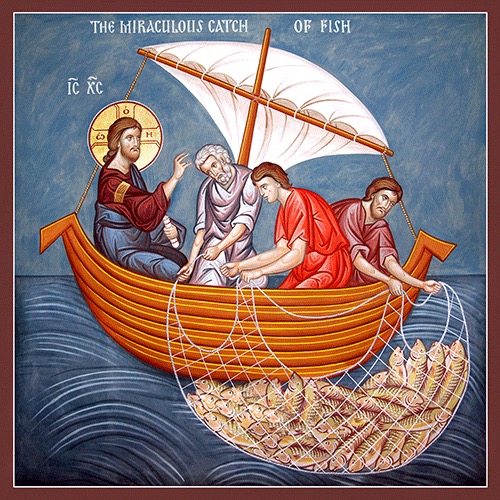
Our reading this morning is from Luke’s gospel, and we pick up early in the Story. Jesus has set out on his own in the region of Galilee. He has been teaching, healing, and casting out evil spirits. He’s already begun raising the ire of his fellow Jews. The people in his hometown of Nazareth have already tried to throw him off a cliff for his Messianic assertions. We finally arrive in the Story when Jesus begins calling specific followers to be his disciples. As you listen, focus on the three basic qualities of discipleship demonstrated by Peter. These qualities are obeying, confessing, and following. They enable us to see and respond to God’s presence. Listen to the Word of the Lord!

Luke 5:1-11

5.1 Once while Jesuswas standing beside the lake of Gennesaret, and the crowd was pressing in on him to hear the word of God, he saw two boats there at the shore of the lake; the fishermen had gone out of them and were washing their nets. He got into one of the boats, the one belonging to Simon, and asked him to put out a little way from the shore. Then he sat down and taught the crowds from the boat. When he had finished speaking, he said to Simon, “Put out into the deep water and let down your nets for a catch.” Simon answered, “Master, we have worked all night long but have caught nothing. Yet if you say so, I will let down the nets.” When they had done this, they caught so many fish that their nets were beginning to break. So they signaled their partners in the other boat to come and help them. And they came and filled both boats, so that they began to sink. But when Simon Peter saw it, he fell down at Jesus’ knees, saying, “Go away from me, Lord, for I am a sinful man!” For he and all who were with him were amazed at the catch of fish that they had taken; 10 and so also were James and John, sons of Zebedee, who were partners with Simon. Then Jesus said to Simon, “Do not be afraid; from now on you will be catching people.” 11 When they had brought their boats to shore, they left everything and followed him.[1]

Today marks the fifth Sunday in the season of Epiphany. The Christian calendar begins with the season of Advent, then Christmas, and then Epiphany. We intentionally move from preparing for the coming of God. We shift to welcoming the presence of God in the Christ child. Now, people are beginning to see and experience Jesus as the promised one of God. Epiphany is the time when people begin seeing Jesus as the manifestation of God among them.

Epiphanies are deeply personal experiences. They are moments when God’s presence is revealed to us that demand a response. We often recognize epiphanies after the fact. God provides the moment and movement of the Spirit but we have to be spiritually alert to perceive it. Epiphanies are not forced on us — they are gifts left in plain sight for us waiting to be discovered.    

This morning, we find Jesus teaching from a boat. He asks Peter to put out into deep water and drop the nets even though Peter and the others have been up all night fishing without catching a thing. Jesus is setting the stage for an epiphany. It’s now up to Peter. What will he do with Jesus’ request? It’s here we observe how Peter begins demonstrating three essential qualities of discipleship — obedience, confession, and following.

Peter, James, and John decide to humor this itinerant Preacher and obey his request. Going out a ways, Jesus says, “Drop the nets here.” I can see the guys rolling their eyes at this carpenter’s request but out the nets go. As soon as the nets went overboard, they began filling up. The overflowing catch pulled the boat deeper down into the water. The fisherman could’ve just written this all off as good luck or coincidence.  

But Peter saw it as something different; he saw a glimpse of the miraculous among the mundane. Peter sees something in Jesus he has not seen before — the Presence of God in his midst. He literally falls down upon Jesus’ knees in the tiny boat.  We are not sure if the other fisherman, James and John Zebedee, got it or not. All we know is that Peter experienced and claimed an epiphany. Jesus set the stage; Peter had to put all the pieces together and decide what to do with it.

Peter obeyed what was asked of him. He trusted Jesus’ instructions even when it did not make any sense. It was a crazy suggestion, but he went along with it when suddenly, God showed up and Peter saw it. Despite exhaustion and doubt, Peter obeys. Because he did, God shows up in an extraordinary way.

This is where the second quality of discipleship gets introduced as Peter confesses what he experienced. When we obey God’s call, we open ourselves up to witnessing epiphanies. Then we often wonder, “Who will believe me? What will they say if I tell them?”

Our Story says that Peter saw the boats getting swamped with the huge haul of fish. He saw Jesus sitting there watching. Jesus was most likely sporting a little grin on his face. Peter acknowledges what the epiphany is for him. It’s none other than the presence of God in his midst. When he declares, “Lord, please go away from me as I am a sinful man,” he embraces the revelation. This is Peter’s confession; he realizes he is in the presence of the Holy.

It’s one thing to experience a powerful moment. It becomes an epiphany when we name it for what it is — a revelation of God’s presence. Peter obeyed. Peter confessed. Now, Peter follows Jesus.

Beloved, this is often the most difficult aspect of discipleship. We are asked to leave everything behind like our fishermen. We obey Jesus. We confess Jesus. Yet, it’s this following Jesus that’s hard to do. You see, if we are given an epiphany, we are expected to do something with it. What good would the catching of all those fish be if Peter decided to simply stay on the boat? Peter was given a glimpse of the presence of God. He also experienced God’s gracious provision. Now he’s responsible for doing something with that. So Peter goes into action. He recognizes that an epiphany is not simply a moment of inspiration — it’s a call for transformation!

Our Story says Peter and his business colleagues got back to shore. They followed Jesus to become fishers of people. Peter and the other two were given the epiphany for a reason; Jesus asks them to do something with it.

So, what about you? Has God ever created the perfect conditions for an epiphany in your life? Did you recognize it for what it was? Remember, epiphanies are not just for our personal inspiration, they are for our personal and communal transformation! They call us to take action. We are encouraged to take steps forward. We should act out in faith, even when it does not make any sense to do so. Let’s keep our eyes open for God’s presence — and when God calls, may we have the courage to follow. Pray with me.  

Lord, help us to pay attention to the ways you are revealing yourself to us. Through your Holy Spirit, help us to obey when you call. Assist us to name and confess what we have seen. Guide us to follow wherever Jesus leads us. Amen.

© 2025. Patrick H. Wrisley, Pastor, First Presbyterian Church, 8 West Notre Dame Street, Glens Falls, New York 12801.  Sermon manuscripts are available for the edification of members and friends of First Presbyterian Church, Glens Falls, New York and shall not be altered, re-purposed, published or preached without permission. All rights reserved.


[1] New Revised Standard Version (NRSV). New Revised Standard Version Bible, copyright © 1989 the Division of Christian Education of the National Council of the Churches of Christ in the United States of America. Used by permission. All rights reserved.

Posted in Sermon | Tagged , , , , , , , , , | Leave a comment

Showing Others Who God Is, 1 Corinthians 12:1-11

A Sermon delivered on January 19, 2025 by Rev. Dr. Patrick H. Wrisley.

1 Corinthians 12:1-11

12.1 Now concerning spiritual gifts, brothers and sisters, I do not want you to be uninformed. 2You know that when you were pagans, you were enticed and led astray to idols that could not speak. 3Therefore I want you to understand that no one speaking by the Spirit of God ever says “Let Jesus be cursed!” and no one can say “Jesus is Lord” except by the Holy Spirit. 4Now there are varieties of gifts, but the same Spirit;5and there are varieties of services, but the same Lord; 6and there are varieties of activities, but it is the same God who activates all of them in everyone. 7To each is given the manifestation of the Spirit for the common good. 8To one is given through the Spirit the utterance of wisdom, and to another the utterance of knowledge according to the same Spirit, 9to another faith by the same Spirit, to another gifts of healing by the one Spirit, 10to another the working of miracles, to another prophecy, to another the discernment of spirits, to another various kinds of tongues, to another the interpretation of tongues. 11All these are activated by one and the same Spirit, who allots to each one individually just as the Spirit chooses.[1]

This morning, we are going to be visiting one of Paul’s churches located on an isthmus and served as a crossroads for both sea and land traffic. Paul spent roughly eighteen months in the city of Corinth working as a tent maker with a couple named Priscilla and Aquila in the city’s marketplace. It was a bustling town of culture, wealth, and full of traders from all over the ancient world. Paul went to Corinth because he knew this city was a crossroads and would be the perfect place to reach a wide variety and number of people. Paul did his market research and knew Corinth would be a great place to get the gospel message out.

As a city of trade and commerce, Corinth was home to wealthy business owners and travelers as well as poor working-class stiffs that kept the wheels of commerce moving. As a melting pot, it was full of all types of pagan religions influenced by beliefs from all over the ancient world. Can you imagine trying to start a new church plant in that type of environment?

Starting a new church is tricky business. When I started a new church development in Disney’s town of Celebration, I got a taste of what Paul experienced in Corinth. Everyone in the world knows about Disney and when they decided to build a new town on the edge of the parks, it attracted worldwide attention and appeal. Over 5,000 people bid to buy one of the first 350 homes in the town when it first opened in November 1996. My family and I arrived and at once was overwhelmed by the rich diversity of people from struggling cast members renting apartments to wealthy business owners who could afford multi-million dollar mansions. There were people from all over the world. Business execs from Germany, England and India. A retired NYC firefighter and his family. Young aspiring schoolteachers from Alabama and Tennessee. Actors relocating to central Florida. There were Catholics, staunch Southern Baptists, American Baptists, Lutherans, pre-churched folk, non-denominational folks, and a handful of Presbyterians. The people moving to Celebration saw an opportunity to build a town and community from scratch and each had their own ideas on how to do it.

The Presbytery of Central Florida had the foresight to buy the land set aside by Disney for a church location. Originally, Disney wanted to build a white-clapboard church in the center of town that had Baptists meet at 9:00, Methodists at 10:30, Presbyterians at noon, Catholics for afternoon mass, and Jewish folks Friday night or Saturday morning. The problem was none of the religious bodies wanted to play nice together and complained about their off-hour worship times. So, Disney threw up their hands and sold the property to the people who really wanted to be there. We Presbyterians were the only ones who bid on it. Already that was causing problems among the new residents.

I arrived in mid-November of 1996 and began worshiping two weeks later in the AMC theater. I held the town’s first Christmas Eve service with a pageant in the golf club’s bar and restaurant just weeks later. It would have all been idyllic except for the fact there were members in the community who didn’t want the Presbyterians to be building a church because it should not be a Presbyterian Church but the community’s church representing everyone in the town (as if it wasn’t!).  That first Christmas Eve, I had to be a scab and literally walk through protesters standing outside the golf club complaining it was a Presbyterian service.

Building a church from scratch attracts all types of people. There are those who simply want to have a faith community to take part in. There are those who are upset with their former churches and see a new church as a way to make the church comply to the way they think it should be. Then there are those who see a way to exercise their ego and power for leadership of the new church because they want to be in charge. Everyone had an opinion on how to start and build a church and it took everything I had as a Presbyterian pastor to navigate these opinions of the spiritual know-it-alls and still plant a church “decently and in order.”  I fully understood what Paul went through in Corinth: The church was not even formally founded, and factions were developing on what type of worship we should have, what type of theology should be espoused, and who should serve as the church leadership. I had retired UCC, Lutheran, and Baptist pastors telling me how I should do things and whose wives were most vocal in expressing their opinions and stirring up gossip in the fellowship and community. All these behaviors showed themselves within the first 6 months of my moving there!  Everyone was out to build their Disney church in the image they saw fitting their wants and needs.

Somehow, people were forgetting the church is to be built in God’s image and designs, not theirs. People began to think this is MY church which in fact, it is not; it’s God’s church. As we sit here this morning, this isn’t your church nor is it mine: It’s God’s and when we forget that basic fact and start complaining about this or that, what you like or don’t like, what type of worship or instruments are best, we then move subtlety onto the fast-track of demise because God has left the picture. As soon as God and God’s ministry is removed from the equation, the devil begins meddling in the details and wins. 

This is what was happening in Corinth. The ones with the money felt they had the power and could call the shots. Those with certain spiritual gifts, particularly those who could “speak in tongues” thought themselves spiritually superior to others. The one place in a stratified community and culture where there should be equanimity there were divisions and cliques. This is why Paul spends three whole chapters in 1 Corinthians addressing these divisions: the people and their superior spiritual gifts took precedence over the reconciling work of Jesus as Lord. A not-so-subtle shift occurred from being a third person “We” to a community built on a bunch of segregated “Me’s.” This is why verse 7 is the key to our text today.

Paul writes, “To each is given the manifestation of the Spirit for the common good.” The ancient word used for ‘the common good’ is symphero, the Greek word we get our word symphony[2]. Paul is saying the Spirit gifts each person in the faith community with a spiritual gift to bring the community together, to carry a burden together, to use one’s gift to help the benefit of all. Just as each instrument and the conductor of a symphony works together to create beautiful music, so members of a faith community weave their gifts together for the common ministry of Jesus Christ. It’s all about the ‘we’ and not about the ‘me.’

The late pastor/preacher/scholar Eugene Peterson translates verse 7 this way: Each person is given something to do that shows who God is: Everyone gets in on it, everyone benefits. Today’s scripture is not so much about what spiritual gifts are as it is about what their purpose is. The focus is not on my gift of preaching as it is showing who God is through my preaching. The focus is not about your gift of hospitality or being able to give liberally to the church’s ministries with money or investments as it is how that hospitality, how that financial giving is showing who God is.

Over the next two weeks, we will be unpacking Paul’s thoughts on spiritual gifts as we work through chapters 12 and 13. In the meantime, spend time reading those two chapters in 1 Corinthians and ponder on what spiritual gifts God has given you. Specifically, how does your spiritual gift show others who God is?

© 2025 Patrick H. Wrisley, Pastor, First Presbyterian Church of Glens Falls, NY 12801. Sermon manuscripts are available for the edification of members and friends of First Presbyterian Church of Glens Falls, New York and may not be altered, re-purposed, published or preached without permission. All rights reserved.


[1] New Revised Standard Version (NRSV). New Revised Standard Version Bible, copyright © 1989 the Division of Christian Education of the National Council of the Churches of Christ in the United States of America. Used by permission. All rights reserved.

[2] See symphérō, soom-fer’-o; from Strongs G4862 and Strongs G5342 (including its alternate); to bear together (contribute), i.e. (literally) to collect, or (figuratively) to conduce; especially (neuter participle as a noun) advantage:—be better for, bring together, be expedient (for), be good, (be) profit(-able for). See at https://www.blueletterbible.org/lexicon/g4851/kjv/tr/0-1/.

Posted in Sermon | Tagged , , , , , , , , , , , , , , , | Leave a comment

Growing Back into Christmas

A sermon delivered on December 24, 2024 by Patrick H. Wrisley, D.Min.

John 1:1-14

1.1 In the beginning was the Word, and the Word was with God, and the Word was God. 2He was in the beginning with God. 3All things came into being through him, and without him not one thing came into being. What has come into being 4in him was life, and the life was the light of all people. 5The light shines in the darkness, and the darkness did not overcome it.

6There was a man sent from God, whose name was John. 7He came as a witness to testify to the light, so that all might believe through him. 8He himself was not the light, but he came to testify to the light. 9The true light, which enlightens everyone, was coming into the world. 

10He was in the world, and the world came into being through him; yet the world did not know him. 11He came to what was his own, and his own people did not accept him. 12But to all who received him, who believed in his name, he gave power to become children of God, 13who were born, not of blood or of the will of the flesh or of the will of man, but of God. 14And the Word became flesh and lived among us, and we have seen his glory, the glory as of a father’s only son, full of grace and truth.

For 64 years the power and profundity of this night has amazed me so. As a child peering over the back of the sofa staring at the Atlanta winter night, my eyes would scan the sky searching the twinkling starlight above. Back then I was full of awe and wonder and believed in the magic of Christmas. As I became older, the awe and wonder never really left but their sense of presence seemed to fade somewhat. In their place settled a spirit of busy-ness and rush. The nights of awe and wonder melted into fulfilling obligations in the giving of gifts or showing up someplace during the frenetic season. The magic of Christmas had very subtlety moved from the power of the newborn Christ the King to consumerism, a trajectory from the manger to the marketplace. 

I’m grateful that I have grown up so much since then.  They say that the older you become the more you regress back into childhood, and I proudly say this has happened to me, especially at Christmastime. I find that the older I become, the more I realize how much I dislike hunting for deals on Black Friday, Small Town Saturday, Cyber Monday or Prime Days; rather, Christmastime has once again become a time for me to go hunting for the gift of the manger while intensely listening for the little baby coo as he wiggles for the warmth of his mother. I suppose one could say that with each passing year, I am growing back into Christmas.

The Welsh have a word which describes how many people feel this time of year. The word is hiraeth (here-eyeth). It’s a noun and it describes a feeling a person has who possesses a longing and yearning for home and the past for the way we imagine things used to be; it’s a type of homesickness found deep in your soul, and it’s tinged with a little touch of grief over the times and experiences lost to the past and with those who have departed. As writer Gretchen Peters notes, “Hiraeth is a kind of nostalgic homesickness for a home you can’t return to, or quite possibly one that never existed. It’s a deep yearning for a rootedness that’s irrevocably lost.”[1] Yes, the older we become, Christmas births within in each of us a deep sense of hiraeth.

We long for the Christmases of yesterday, either the ones we had or ones we wish we had. It’s a longing for home and a life that is simpler and more grounded. Yet, Christmas also evokes a spiritual hiraeth within us, which in all honesty, is what Christmas is all about in the first place. We listen to the Christmas stories, watch the kids enact the birth of baby Jesus, smile at the children dressed as angels. We sing familiar carols and are taken by the hand of the Spirit and are led back to what Christmas is truly all about. We suspend our callous, stubborn hearts and once again open our spirit to the possibility, to the reality, that unto us this day, in the City of David, Christ is born. 

Beloved, we live in a swirly, mixed-up, muddled-up world in the words of Sir Raymond Douglas Davies.  But tonight, this holy night, we practice hiraeth. 

Tonight, we go back home again, longing and looking for those reminders that God is still in control and that God has not left his beloved forsaken. 

Tonight, we remember God and how Gods loves us enough to put skin on and join us in this journey of life.  

Tonight, we remind ourselves that God placed his trust in a young girl’s weary and feeble arms to hold, love, and care for his only begotten Son. Ultimately, the birth of Jesus is God’s active expression of God’s faith in you and me. God allows you and me to care for this child who has no place to rest his head except in your arms and mine. 

Friends, John reminds us that if we only receive the baby Jesus, literally, pick him up, we then become children of God. As we lean over the manger, he cries to be picked up in your arms. Tonight, let’s grow back into Christmas and receive the baby being placed carefully, lovingly, in our arms this night. Let us revel in the presence, joy, and hope the birth of Jesus provides. Feel him in your arms. Feel him in your heart. Feel his soft hair and breathe in that lovely baby smell. He was born for you, beloved; yay, he was born for you. Amen.

© December 24, 2024, Patrick H. Wrisley, Pastor, First Presbyterian Church, 8 West Notre Dame Street, Glens Falls, NY 12801.  Sermon manuscripts are available for the edification of members and friends of First Presbyterian Church, Glens Falls, New York and shall not be altered, re-purposed, published or preached without permission. All rights reserved.


[1] Gretchen Peters, Hiraeth. How to find our way back, The Oxford American, Issue 119, Winter 2022. Accessed at https://oxfordamerican.org/magazine/issue-119-winter-2022/hiraeth

Posted in Sermon | Tagged , , , , , , , , , | 1 Comment

Fed on the Bread of Tears, Psalm 80:1-7

A Sermon delivered on Sunday, December 22, 2024 by Rev. Dr. Patrick H. Wrisley.

Food is a big deal this time of year; the holidays always seem to bring out the wonderful culinary and baking skills lying dormant during the rest of the year. There are delicious poppy seed loaves, which was a favorite of mine that my wife Kelly made each year to give away to folks. Christmas cookies with red and green frosting on them. There is homemade fudge and hot chocolate and the Venti half-calf Caramel latte with whole milk at your favorite coffee shop. Then there are the apple, pumpkin, and pecan pies to add the dollop of goodness after our overstuffed holiday meals of ham, turkey, or roast beast. WebMD indicates that folks will gain up to two pounds over the course of holiday binging which is much less than I was expecting.[1] It is safe to say that between Thanksgiving and New Year’s, people wallow in a carbo-loaded sugary bliss. 

You have blessed me the last few weeks as I have been doing rounds with this bronchial pneumonia with delicious food to get me back in preaching shape. From chicken noodle soups, homemade bread, cookies, and a yellow jar of something I was not sure what it was. I looked at a note attached, and it says, “Lemon curd – a good decongestant.” 

“Lemon curd?” I thought to myself. “What’s that?” So, I stick in a spoon and pull out this bright yellow congealed scoop and took a bite. I died and went to heaven as Lemon curd is nothing but lemon meringue pie without the crust! Bliss indeed! Jill Emblidge, they will rise up and call you blessed for that one! So, it is in the context of all this gastrointestinal goodness that today’s scripture jumped out at me.

Turn in your Bible to Psalm 80. The psalms comprised the Hebrew peoples’ hymn book and in the psalms are different types of songs to sing. Some were songs of triumph. Some were songs sung while traveling to religious festivals in Jerusalem. Other psalms were used as songs of praise and thanksgiving for all God has done, is doing, and will do in the future. And then, there were some songs that were complaints and laments. These are songs sung to God demanding to know where the heck God was in the midst of trouble. They are songs implicating God as being a silent partner in a marriage or indicting the Lord for being asleep while the people of Israel flounder. Well, that is the type of psalm we have for this morning. It’s a psalm of lament and complaint expressed to God. Listen to the Word of the Lord.

Psalm 80

1Give ear, O Shepherd of Israel, you who lead Joseph like a flock! You who are enthroned upon the cherubim, shine forth 2before Ephraim and Benjamin and Manasseh. Stir up your might, and come to save us! 3Restore us, O God; let your face shine, that we may be saved. 4O Lord God of hosts, how long will you be angry with your people’s prayers? 5You have fed them with the bread of tears and have given them tears to drink in full measure. 6You make us the scorn of our neighbors; our enemies laugh among themselves. 7Restore us, O God of hosts; let your face shine, that we may be saved. (NRSV)

“You have fed your people with the bread of tears.” Isn’t that an incredible image? The lectionary Bible study group meets on Wednesdays. They gather to look at our preaching passages and had a field day with this one. This text seemed out of place compared to the stories of angels appearing and announcing good news of impending births and the promise of a coming deliverer of the people. Psalm 80 comes roaring forth as a giant Debbie-downer in this season of festive holiday preparations. Who wants to talk about eating the bread of tears when you have Jill’s lemon curd to scarf down?

The American Psychological Association reports that nine in ten adults experience various stresses and fears over the holidays. These include financial worries. They also miss loved ones who have died or are far away. Some people do not look forward to seeing certain family members, like crazy Uncle Eddy, at the Christmas table due to fear of family arguments. The same study points out that 43% of the people says that the stress they experience over the holidays interferes with their ability to really enjoy them and that 36% felt all the gift giving had become competitive.[2] Daniel Gillison, writing for the National Alliance of Mental Health says 3 in 5 Americans feel their mental health is negatively affected by the holidays.[3] We wrestled with the text for a few minutes in the Wednesday Bible study. Finally, we admitted that Psalm 80 merits being looked at in worship.

Who doesn’t love the holidays? They are festive and fattening. Hopefully places of worship can help people keep the center of Christmas focused on the child coming and cooing in the manger, and believe me, it is getting harder every year. But the holidays can be difficult for some and because Church deals with hard truths and reality, we need to acknowledge that some of those sitting next to us in the pews or who can’t even get themselves motivated to come to worship are having a difficult time emotionally, spiritually, socially, familially, or professionally. 

Mixed in with our own dysfunction, is the circus playing out in Washington, conflicts in Eastern Europe, volatility in the Middle East, famine in Sudan, threats of tariffs, deportations, climate change and war.

I have always said Church is a microcosm of the larger world. It is the place, it is the community, Jesus chose to reveal and live out the Kingdom of God to the world. If we in the Church cannot take care of each other, there’s little chance the world can or will. Psalm 80 is our reminder that there are those times when God seems silent at best or aloof at worst. It reminds us there are those recurrent tides ebbing in and out where people will feel happiness and will feel dread. And it is in this community called Church, we become the living reminders to each other God has not forgotten them, that God has not abandoned them, that God is listening to their cries through us.

The late priest, professor, and contemplative, Henri Nouwen speaks of these Psalm 80 moments in our lives. He writes the mystery of the Christian life, “is not that God came to take our burden away or to take our cross away or to take our agony away. No. God came to invite us to connect our burden with God’s burden, to connect our suffering with God’s suffering, to connect our pain to God’s pain.”[4]

Beloved, look around you. Think about the people you run into every single day – your neighbors, teachers, bank clerks, or even family – who are the people that you can be the one who gently, lovingly, helps connect their suffering to God’s presence and suffering for them? You see, this is the beauty of Christmas. This is the beauty of Mary’s Magnificat, that God lives, moves, breathes, and heals the ones whose hearts are tired or broken.

© December 22, 2024, by Patrick H. Wrisley. Sermon manuscripts are available for the edification of members and friends of First Presbyterian Church of Glens Falls, 8 West Notre Dame Street, Glens Falls, NY. They shall not be altered, re-purposed, published, or preached without permission. All rights reserved.


[1] See https://www.webmd.com/diet/features/holiday-weight-gain-big-fat-lie. Accessed on December 22, 2024.

[2] See American Psychological Association, Created November 30, 2023, Even a joyous holiday season can cause stress for most Americans. Accessed on December 20, 2024 from https://www.apa.org/news/press/releases/2023/11/holiday-season-stress.

[3] Daniel H. Gillison, The Most Difficult Time of Year: Mental  Health During the Holidays, December 20, 2021. National Alliance of Mental Health, https://www.nami.org/from-the-ceo/the-most-difficult-time-of-the-year-mental-health-during-the-holidays/.

[4] Henry J. M.  Nouwen, Following Jesus. Finding our way home in an age of anxiety, Gabrielle Earnshaw, ed. (New York: image books, 2024), p 80.

Posted in Sermon | Tagged , , , , , , , , | Leave a comment