A Sermon Delivered on February 15, 2026 by the Rev. Dr. Patrick H. Wrisley.
Today marks the close of the liturgical year’s Second Act. The First Act, Advent and Christmas, introduced us to God’s remarkable interest in and personal investment with our world. God cared so much for the world God made that, as Eugene Peterson paraphrases it in The Message, “He moved into the neighborhood.”
The Second Act of this Divine Drama began on January 6th, when we read about three wise men from East Asia paying homage to the infant Jesus. The Season of Epiphany started when these magi came searching for the newborn King of the Jews and recognized who they had found when they arrived at the holy family in Bethlehem.
These past weeks have taken us through biblical texts revealing who this person Jesus is and what matters most to him. We’ve listened to his preaching with the Sermon on the Mount, watched him heal and teach, seen him challenge religious authorities. And now we arrive at the last Sunday in Epiphany when scripture not only illuminates Jesus’ identity but floods it with light and we can unmistakably see exactly who we are dealing with in all these stories.
Friends, unless we fully grasp the point of Act Two, we will not be ready to understand Act Three, which begins this Wednesday. The Season of Lent calls us to a forty-day journey with Jesus to the Cross, focusing on what he came to do, but it also calls us to begin our own transformation. So, before we can understand what Jesus came to do, we must be clear about who he is.
Matthew begins to flesh this out in chapter 16 of his gospel, when Jesus pulls his disciples aside and asks if they have had an epiphany. In other words, have they had their own “a-ha!” and know who he is? They tell Jesus what they are hearing: “Some people say you’re John the Baptist come back to life. Others think you’re one of the Old Testament prophets like Elijah or Jeremiah.” Then, with intensity in his voice, Jesus pushes the point: “But who do you say that I am?” In a flash of Holy Spirit-inspired brilliance, Peter blurts out, “You are the Messiah, the Son of the living God!”
Finally! Someone in Jesus’ inner circle gets it! Jesus, beaming, is so pleased he gives Peter a new nickname: The Rock. And it is right here in the closing verses of Matthew 16 where Jesus speaks plainly about what lies ahead: They are going to Jerusalem; he will be roughed up, arrested, prosecuted, killed; and on the third day he will rise again.
Peter loses it. He pulls Jesus aside and rebukes him for saying such an outlandish thing. The Rock becomes the stumbling block. Jesus, turning sharply, snaps at him: “Get behind me, Satan! You are blocking my way, Peter!” Jesus then tells all of them that anyone who follows him must deny themselves, pick up their cross, and follow him. The cost of following Jesus is clear, and the path is not what they expect. All of this brings us to today’s text which is the final scene of Act Two. Listen to the Word of the Lord from Matthew 17:1-9.
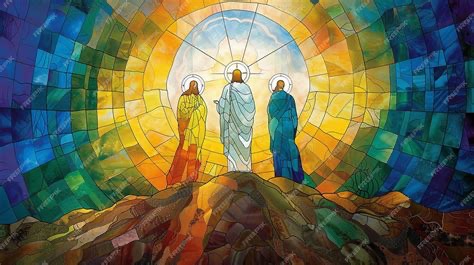
Six days later, Jesus took with him Peter and James and his brother John and led them up a high mountain, by themselves. And he was transfigured before them, and his face shone like the sun, and his clothes became dazzling white. Suddenly there appeared to them Moses and Elijah, talking with him. Then Peter said to Jesus, Lord, it is good for us to be here; if you wish, I will make three dwellings here, one for you, one for Moses, and one for Elijah. While he was still speaking, suddenly a bright cloud overshadowed them, and from the cloud a voice said, This is my Son, the Beloved; with him I am well pleased; listen to him! When the disciples heard this, they fell to the ground and were overcome by fear. But Jesus came and touched them, saying, Get up and do not be afraid. And when they looked up, they saw no one except Jesus himself alone. As they were coming down the mountain, Jesus ordered them, Tell no one about the vision until after the Son of Man has been raised from the dead. (NRSV)
Matthew writes to a primarily Jewish audience and weaves several Jewish elements throughout our text that his first readers would have at once recognized. The six days echo the cloud covering Mount Sinai before God spoke to Moses. The mountain itself recalls where God met with the prophets and leaders of Israel. The cloud signals the very presence of God.
If we are not careful, we, like Peter, will get all wrapped up in the minutiae and totally miss the point of the culmination of Act 2. You see, our first inclination is to focus on the mechanics of what took place. Scripture says Jesus underwent a metamorphosis; he changed appearance before their very eyes. Our analytical minds want to figure out the how. We might envision something like the transporter beam on the Starship Enterprise with matter rearranging itself, light bending, reality shifting. But asking “How could this really happen?” entirely misses the point. The better question to ask is: Why did this happen?
Matthew wrote his gospel for a fledgling community of Christ-followers late in the first century. The early Church did not have what we call the Bible; all they had to work with were the Hebrew scriptures, our Old Testament. Throughout those scriptures, God demanded the Hebrews to worship the one true God and no other. They were to be obedient and listen to what the Lord God said through the prophets like Moses, Elijah, Isaiah, Jeremiah, and Ezekiel. All the prophets were very clear: The Lord your God is One. Obey him.
So, imagine you are a pious first or second-century Jew, trying to live faithfully according to the traditions handed down to you. Now you are being asked to worship this man Jesus. What do you do? Well, it means you need to have your own metamorphosis concerning your understanding of God. You shall undergo your own transfiguration, i.e., that dramatic change from who you are to become whomever God is creating you to be now.
I’m curious, did you notice it was only Jesus whose appearance appearance. The epiphany is not that Moses and Elijah showed up; the revelation is that Moses and Elijah stayed the same while Jesus was transformed before them. Matthew is shouting to the young, fledgling Church: Jesus is not just another great teacher, rabbi, or prophet. Jesus stands as the very living Presence of the great I Am; he is the God Moses met in the burning bush.
This is one of the scandals of Christian faith. Transfiguration Sunday reminds us that Jesus is in an entirely different league than other religious leaders or teachers like Buddha, Muhammad, or Moses. Our Christian faith proclaims that yes, Jesus was fully human, but he is the Lord Almighty himself who dared to become a man. Matthew drives this home through the ringing voice that declared, “This is my beloved Son. Listen to him!”
One scholar writes, “What is significant in this account is not its special effects, but what it affirms about the early church’s foundational belief about Jesus: namely, that he was not just another exceptional human being, prophet, or great teacher and example for all, but the decisive representation of the Divine, the source and judge of life.”[1]
This last epiphany of the season reminds us exactly who Jesus is and what he taught. In Jesus, God becomes the prophet himself, and this is what knocked the three disciples off their feet that day. This is what filled them with holy fear and awe. And frankly, this is what should still move and stir us today.
And lest we miss it, amid their anxious, befuddled fear, the transfigured Christ of God gently touches the three disciples and says, “Get up. Don’t be afraid.” Filled with confidence, Jesus led them down the mountain in their own transformed way. As their understanding of who Jesus was at his core shifted, so their personal spiritual integration of who they were as men of God began to shift as well. The change that occurred in Jesus demanded an equal shift in them. They came down the mountain entirely different people than when they went up.
As we leave worship today, let us go filled with hope and confidence that as we begin our Lenten journey, walking down the mountain to whatever tomorrow has waiting for us, we descend as changed people. Our assumptions of God have been challenged and enlarged. Our shared experience with Jesus on the mountain has caused us to become more aware to the nuances of God’s presence in our lives. And let’s remember that we walk with Jesus toward Jerusalem and the Cross, we too will hear Jesus say, “Do not be afraid.” We journey the following forty days with God’s beloved Son, Emmanuel, God-with-us. So, dear friends, what are you going to discuss with Jesus coming down the mountain? In the Name of the Father, the Son, and the Holy Spirit. Amen.
© 2026 Patrick H. Wrisley, Pastor, First Presbyterian Church of Glens Falls, 8 West Notre Dame Street, Glens Falls, NY 12801. Sermon manuscripts are available for the edification of members and friends of First Presbyterian Church of Glens Falls, New York, and shall not be altered, re-purposed, published, or preached without permission. All rights reserved.
[1] Bruner, Dale, Matthew: A Commentary, Volume 2 (New York: Eerdmans Publishing Co., 2007).


 patrick h wrisley