
A Sermon Delivered on February 8, 2026 by the Rev. Dr. Patrick H. Wrisley.
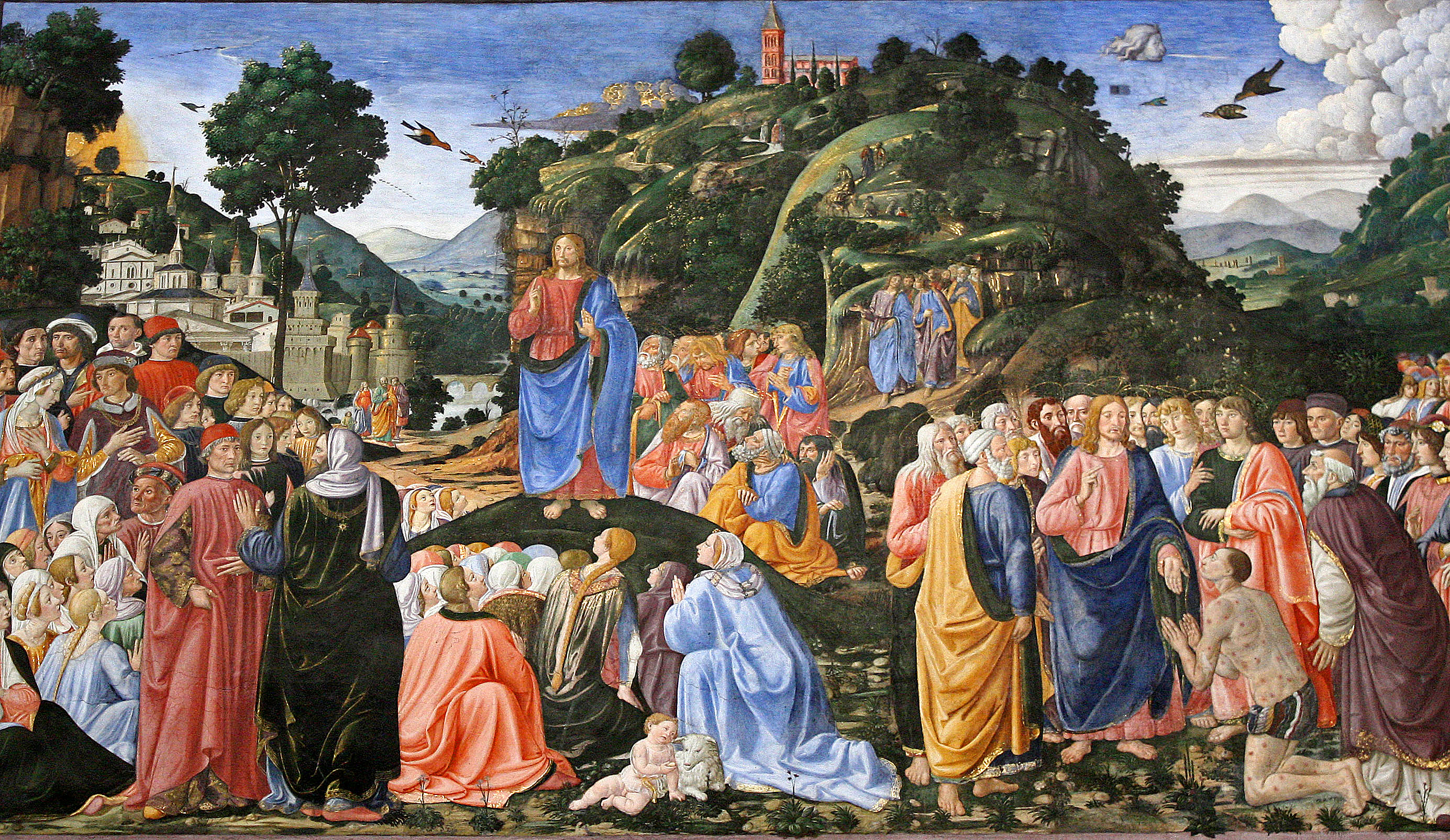
Matthew tells us that Jesus goes up the mountain in chapter five and then comes back down again in chapter eight. Between those two movements lies what we call the Sermon on the Mount. These chapters hold the heart of Jesus’ teaching in Matthew’s Gospel.
At first glance, it seems clear who Jesus is teaching: his disciples. And yet, Matthew also tells us that large crowds follow him up the hillside. It is here something subtle happens in the text. Matthew shifts his voice and suddenly speaks in the second person plural, i.e., he goes from writing “you” and begins writing to, “All y’all!” With that subtle shift of Matthew’s, we are no longer just observers of the story; no, as readers, we are now directly invited into it.
So here we are, climbing the hillside just north of Capernaum. And as we arrive, we get to choose where we sit. We can squeeze in close with the disciples, i.e., those who want to hear every word, who have already said yes to following Jesus. Or we can choose to hang back with the crowds on the periphery simply watching from a non-committed distance wondering and waiting to see what happens next. We are curious, but we are not yet attached to Jesus’ committed group.
So, Church, where do we choose to sit? You see, where you and I choose to sit decides what we hear with respect to what comes next.
Today’s text picks up right after the well-known Beatitudes and you know them as the “blessed ares.” But now Jesus turns to what scholar Dale Bruner calls the “your ares.”[1] Hear the Word of the Lord.
Matthew 5:13-20
You are the salt of the earth; but if salt has lost its taste, how can its saltiness be restored? It is no longer good for anything but is thrown out and trampled underfoot.
You are the light of the world. A city built on a hill cannot be hid. No one after lighting a lamp puts it under the bushel basket, but on the lampstand, and it gives light to all in the house. In the same way, let your light shine before others, so that they may see your good works and give glory to your Father in heaven.
Do not think that I have come to abolish the law or the prophets; I have come not to abolish but to fulfill. For truly I tell you, until heaven and earth pass away, not one letter, not one stroke of a letter, will pass from the law until all is accomplished. Therefore, whoever breaks one of the least of these commandments, and teaches others to do the same, will be called least in the kingdom of heaven; but whoever does them and teaches them will be called great in the kingdom of heaven. For I tell you, unless your righteousness exceeds that of the scribes and Pharisees, you will never enter the kingdom of heaven.[2]
These words are spoken directly to those disciples who have made the conscious choice to sit up close to where Jesus is speaking. Jesus is talking to people who intend to follow him or at least think and believe they do.
The very first thing Jesus makes clear is this: disciples are commissioned. He declares:
You are the salt of the earth.
You are the light of the world.
These “you ares” are emphatic; they are not a friendly proposition. Notice what Jesus does not say. He does not say you should be salt and light. He does not say you might become salt and light someday if you work hard enough. He says, “You are.” This is not a suggestion. It is a declaration.[3]
Before the Great Commission sends the disciples out into the world, it is here in this moment Jesus commissions them to understand who they already are. Being salt and light is not extra credit Christianity; being salt and light is the literal job description. It is what we signed up for when we decided to follow Jesus.
And that means discipleship is never meant to stay on the mountaintop. Jesus does not gather people so they can stay comfortable, inspired, and entertained. He gathers people so they can be sent.
Second, Jesus tells us that disciples must live into who they are. Salt had many uses in the ancient world like preserving food, sealing covenants, and purifying sacrifices.[4] But at its most basic level, salt does one thing well: it brings out flavor. As one scholar notes, “Salt brightens and sharpens other flavors already present.”[5]
Salt does not overpower healthy food. It enhances what is already there. I once got invited to dinner by a friend who happens to be a chef. Dessert was homemade chocolate chip cookies. They were extraordinary and the reason was simple. He added just enough salt to make the sweetness pop. The salt made you want another bite. And then another.
Friends, that is what good salting does. But too much salt? Well, that ruins everything. And Jesus knows that too. Disciples are meant to enhance the lives of others, not overwhelm them. Our presence in the world should make faith more compelling, more beautiful, more life-giving. Sadly, sometimes we Christians over-salt our walk with God. We confuse being faithful with being harsh. We judge, condemn, or wrap our faith in political or cultural power. When that happens, Jesus becomes difficult to swallow for others.
If people are drifting away from the church, it is often for one of two reasons. On one hand, people stay away because they have tasted too much salt and the church leaves a bad taste in their mouth. On the other hand, sometimes people come to church, and they are met with a bland and boring fellowship that fails to keep step with the times they are living in; to the outsider or pre-Christian, the fellowship is tasteless.
The same is true when it comes to the Church being light.
Jesus says we are the light of the world. We are not called to be competing spotlights, but rather we are beckoned to collectively share one singular light reflecting God’s grace. Light exists to help people see, to help them find their way.
But like salt, too much of a good thing can be problematic: too much light can blind other people’s ability to see. When people shield their eyes around Christians, it is usually because we are shining our own light instead of Christ’s. The goal is never to draw attention to ourselves. The goal is to help others see Jesus more clearly.
Finally, Jesus talks about righteousness. Righteousness is one of the fifty-cent theological words we misunderstand. We are to remember that righteousness is not moral perfection. It is not religious performance. Righteousness is simply living our every day, run-of-the-mill lives in a way that makes Jesus visible.
A righteous life is salty in the best visible way bringing out goodness and hope in others. A righteous life shines light that helps people navigate darkness. A righteous life looks different from the surrounding culture because it is a life shaped by grace. We often think of our own righteousness being solely about ourselves and our relationship with God; it is so much larger than just one’s personal piety. Righteousness has a communal aspect, too! Our righteousness is to be so winsome that it points others to the God we have chosen to serve.
Church, Jesus is not asking us to become something new today. He is calling us to live more fully into who we already are.
Salt that makes the world hunger for God. Light that helps people find their way home. Righteousness makes our life in Christ look attractive.
Beloved, let us choose the disciple’s seat up close to Jesus. Let our lives show others whom we love and what we confess. And may the quality of our lives our lives always point to the life-giving love of God in Jesus Christ. In the name of the Father, and of the Son, and of the Holy Spirit. Amen.
© 2026 by Patrick H. Wrisley, Pastor, First Presbyterian Church of Glens Falls, 8 West Notre Dame Street, Glens Falls, NY 12801. Sermon manuscripts are available for the edification of members and friends of First Presbyterian Church of Glens Falls, New York and shall not be altered, re-purposed, published, or preached without permission. All rights reserved.
[1] Frederick Dale Bruner, Matthew 1-12. A Commentary. The Christbook (Grand Rapids: William B. Eerdmans Publishing Company, 1987), 151.
[2] New Revised Standard Version (NRSV). New Revised Standard Version Bible, copyright © 1989 the Division of Christian Education of the National Council of the Churches of Christ in the United States of America. Used by permission. All rights reserved.
[3] Bruner, 186-189.
[4] See Feasting on the Gospels–Matthew, Volume 1 (p. 239). Presbyterian Publishing Corporation. Kindle Edition. “Jesus’ followers are defined as salt. Salt was widely used for various purposes in the ancient world, such as preserving, seasoning for food (Job 6:6), fertilizing soil (Luke 14:34–35), sacrificing (Lev. 2:13; Ezra 6:9; Ezek. 43:24), covenanting (Num. 18:19; 2 Chr. 13:5), purifying (Exod. 30:35; 2 Kgs. 2:19–21), cleansing (Ezek. 16:4), and signifying loyalty (Ezra 4:14).”
[5] Matthew M. Boulton, Feasting on the Gospels–Matthew, Volume 1 (p. 237). Presbyterian Publishing Corporation. Kindle Edition.


 patrick h wrisley