A Sermon Delivered May 11, 2025 by the Rev. Dr. Patrick H. Wrisley.
Once upon a time, there was a fierce and brilliant Greek military commander named Alexander—the one we now call Alexander the Great. He conquered a vast empire stretching from Greece, down into Egypt, and east through Palestine and Mesopotamia, all the way to India. But Alexander died young—only 32 years old—about 300 years before Jesus was born. After his death, his empire was divided among his four leading generals. They split the territories into four regions: Greece, Egypt, what we now call the Middle East, and India.
One of those generals, Seleucus, took control of the region that included Palestine, Syria, Iraq, and Iran. This became known as the Seleucid Empire. Fast forward some 130 years: a ruthless king named Antiochus Epiphanes rose to power in that empire. He did something that sent shockwaves through the Jewish world—he erected a statue of the Greek god Zeus inside the Jewish Temple in Jerusalem.
It was an act of desecration that sparked a full-blown revolt. A Jewish family known as the Maccabees led the charge. They fought back, and in 164 BCE, they reclaimed the city of Jerusalem. One of the first acts the Jewish people did was to go into the Temple and tear down that statue. They began to purify the Temple, stone by stone, removing anything defiled and replacing it with freshly hewn stone.
Then, they celebrated. For eight nights in a row, they held a dedication ceremony for the renewed Temple. That celebration became what we now know as the Festival of Dedication—or as we call it—Hanukkah. Finally, some 140 years before Jesus’ birth, the Jews had fully liberated their land and—for the first time in centuries—were operating as an independent nation. That lasted for about 80 years, until they invited Roman mercenaries in to help settle growing unrest from neighboring countries…and, well, we know how that turned out.
So, why do I mention all this?
Because it gives us the deeper context for today’s Gospel passage. You see, stories in Scripture aren’t told in a vacuum. Every word matters. Every detail carries weight. And John, the Gospel writer, is no exception.
At this point in John’s Gospel, Jesus has just healed a man born blind—on theSabbath. That miracle has stirred up tension with the religious leaders. They’re not just annoyed; they’re alarmed. And in the middle of this controversy, Jesus begins talking about himself as “the Good Shepherd”—the one who knows his sheep, whose sheep know his voice.
And if you were a Jewish leader standing there, you’d hear more than just a pastoral metaphor. You’d hear echoes of Ezekiel 34—a fiery condemnation of Israel’s false shepherds: the corrupt priests and leaders who fed themselves while neglecting the flock.
Now, here’s where things get sticky. Jesus has healed on the Sabbath. He just insulted the religious leaders. Now we pick up the story in John 10, verse 22:
John 10:22-30
10.22 At that time the festival of the Dedication took place in Jerusalem. It was winter, 23and Jesus was walking in the temple, in the portico of Solomon. 24So the Jews gathered around him and said to him, ‘How long will you keep us in suspense? If you are the Messiah, tell us plainly.’ 25Jesus answered, ‘I have told you, and you do not believe. The works that I do in my Father’s name testify to me; 26but you do not believe, because you do not belong to my sheep. 27My sheep hear my voice. I know them, and they follow me. 28I give them eternal life, and they will never perish. No one will snatch them out of my hand. 29What my Father has given me is greater than all else, and no one can snatch it out of the Father’s hand. 30The Father and I are one.’
Let’s pause a moment.
It’s winter. The Jews are celebrating Hanukkah—a festival of liberation, a celebration of God’s faithfulness in delivering them from oppression. It’s their Fourth of July. And where is Jesus? He’s walking in Solomon’s Portico—a part of the Temple complex associated with royal authority. This is the place where kings like Solomon once sat in judgment.
John is not just providing the reader a setting for his Story —John is making a statement. You see, Jesus is standing where kings used to stand and make judgements for the people, during a festival that remembers and celebrates God’s deliverance—and he’s being peppered with questions about whether or not he is the Messiah, the Davidic King. The people crowd around him and say, “How long will you keep us in suspense? If you are the Messiah, tell us plainly.”
And Jesus responds, “I have told you—and you do not believe.”
The people are looking for another liberator, like Judas Maccabeus—someone to rally the multitudes and lead them in kicking out their Roman occupiers. But this is not what Jesus has to offer; he is not offering political freedom from an oppressive regime. He is providing spiritual liberation and a new way of living in the world.
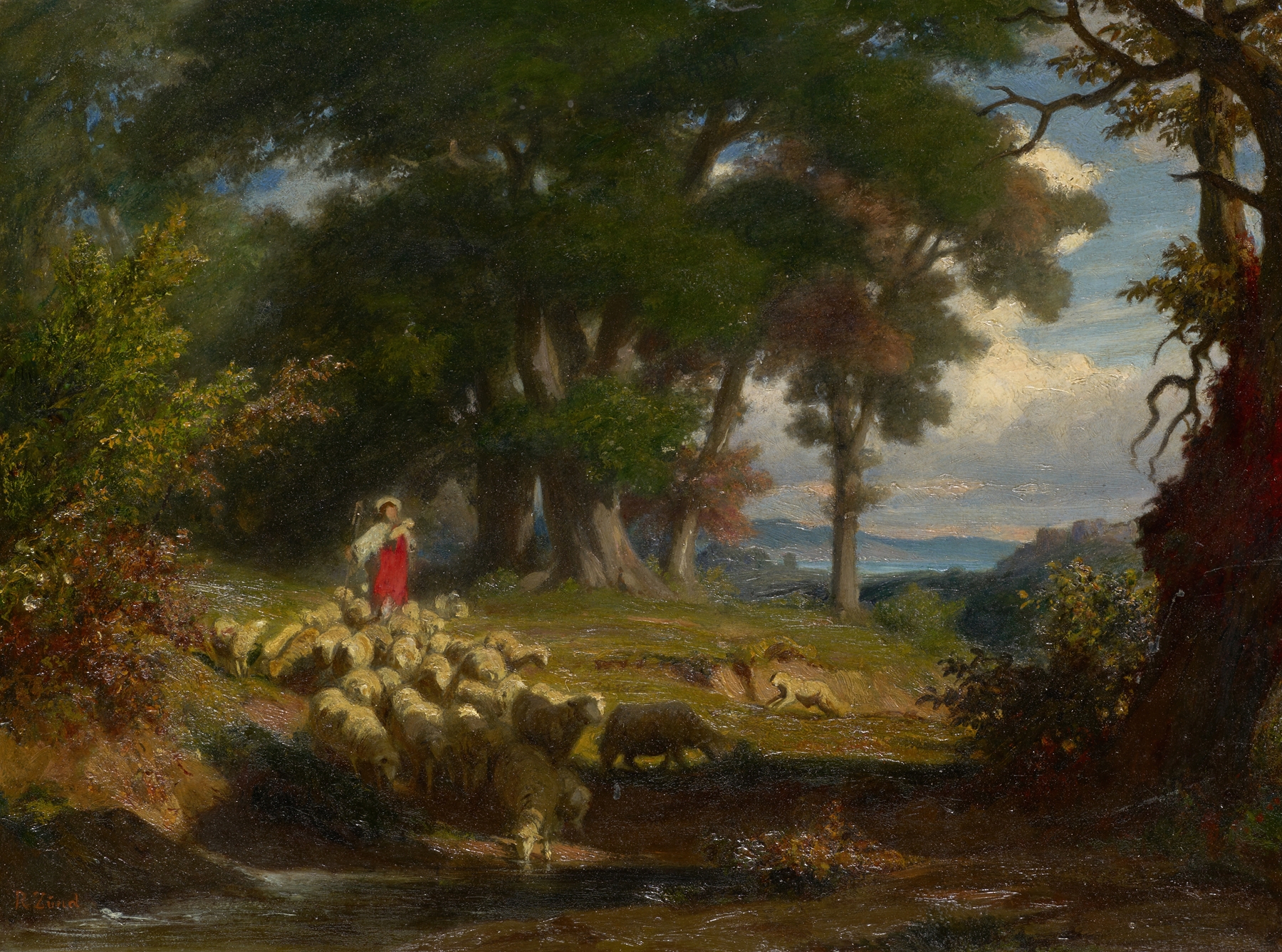
The people want a warrior-king; Jesus gives them, well, a shepherd.
A shepherd who knows his sheep.
A shepherd who feeds the sheep.
A shepherd who waters the sheep.
A shepherd whose sheep recognize his voice.
A shepherd who leads, protects, and never abandons them.
Jesus says:
My sheep hear my voice. I know them, and they follow me. I give them eternal life, and they will never perish. No one will snatch them out of my hand.
This past Friday, I hopped into the car and took a ride over to Manchester and Northshire Bookstore. If you remember, Friday was pouring down rain and we were under a flash flood advisory. Creeks and rivers were overflowing; fields were mud bogs. Between Granville and Pawlet along the Mettawee River there is a sheep farm with hundreds of sheep standing around in the mud. What hit me is that they were not standing up on the green high ground; they were wandering around near the overflowing river just begging to be swept away on a log sluice you see at 6 Flags! And then I remembered something.
Sheep are not the sharpest tacks in the box.
They’re not the brightest creatures.
They have poor eyesight.
They tend to blindly follow others in the herd, even into danger.
They’re messy.
They’re smelly.
But—they have excellent hearing.
They learn the voice of their shepherd.
They respond to the tone, the cadence, the rhythm of his or her voice. They trust that voice. And they follow that voice—because that voice leads them to green pastures, still waters, and safety away from the overflowing river.
Friends, that is the kind of shepherd Jesus is.
He does not lead with an iron rod, but with a gentle nudge and a push.
He does not demand loyalty—he invites trust.
He does not lead from behind beating the sheep with a stick – he leads from the front calling them by name.
And once you and I are in his care, nothing—no one—can separate the Shepherd from his lambs.
Beloved, let me invite you to still yourself today and I want you to listen to the Shepherd’s voice today. What are the places in your life where fear has frozen you, where doubt has hampered you, where addiction muddles you, or where doubt is robbing you of your dreams? Are you looking for quick-fix solutions when what you really need is a spiritual reboot?
Because here’s the Good News: The Good Shepherd is calling.
He says, “I know you. I see you. I hold you in my hand. And nothing—not death, not fear, not failure—can take you away from me.” Friends, remember the words of Isaiah 43:
Do not fear, for I have redeemed you;
I have summoned you by name; you are mine.
2 When you pass through the waters,
I will be with you;
and when you pass through the rivers,
they will not sweep over you.
When you walk through the fire,
you will not be burned;
the flames will not set you ablaze.
3 For I am the Lord your God,
the Holy One of Israel, your Savior.
Beloved, that is the voice of liberation. That is the voice of Easter. That is the voice of the Good Shepherd who intimately knows you by name. In the Name of the One who is, was, and is yet to come. Amen.
© 2025 Patrick H. Wrisley, Pastor, First Presbyterian Church of Glens Falls, 8 West Notre Dame Street, Glens Falls, NY 12801. Sermon manuscripts are available for the edification of members and friends of First Presbyterian Church of Glens Falls, New York, and shall not be altered, re-purposed, published, or preached without permission. All rights reserved.


 patrick h wrisley