
A sermon delivered Sunday, March 2, 2025by the Rev. Dr. Patrick H. Wrisley
Turn in your Bibles to Luke 9:28-36. The very first line of our text says, “Now about eight days after these sayings, Jesus took…” As careful readers, our first task is to go back and understand which sayings Luke is referring to.
Just about a week earlier in story time, Jesus miraculously fed 5,000 people with only a few loaves of bread and some fish; indeed, they gathered up twelve baskets of leftovers to boot! Following this, Jesus withdrew to a lonely place for a time of prayer and reflection with his disciples. In this quiet moment, he asked them, “Who do people say that I am?” The disciples answered, “Some say Elijah, others one of the great prophets of old.” Then Jesus pressed further and asked them the one question all of us must respond to: But who do YOU say that I am? Peter, ever eager to be the one who gets the right answer, boldly declared, “You are the Christ, the Messiah of God!” We are excited for Peter because he finally got something right but Jesus sternly tells them not to share this fact.
It makes us wonder, “Why the secrecy?” If Jesus had wanted to remain hidden, he had not done a very good job—his miracles and teachings had already drawn massive crowds. It’s not that Jesus wanted to remain hidden but rather his identity wasn’t to be fully revealed quit yet. Why? First, the disciples’ understanding of the Messiah was incomplete. They expected a conqueror who would overthrow Israel’s oppressors and Jesus’ mission was radically different from that. Second, Jesus likely wanted to avoid stirring up the crowds with their incorrect understanding of what Messiah meant. If the masses heard the word Messiah, they would attempt to force Jesus into a role he was not meant to fulfill. Jesus’ identity and mission were determined by God and were totally different from human expectations.
Eight days before our passage today, Jesus also shared difficult news: following him would not be a path of power and glory, but one of sacrifice and suffering. “Whoever wants to follow me must deny themselves, take up their cross daily, and follow me” (Luke 9:23). The Messiah they expected was not the Messiah they were given. The true Christ would lay down his life, and his followers were called to do the same. This is the backdrop for today’s text—the Transfiguration.
Luke 9:28-36
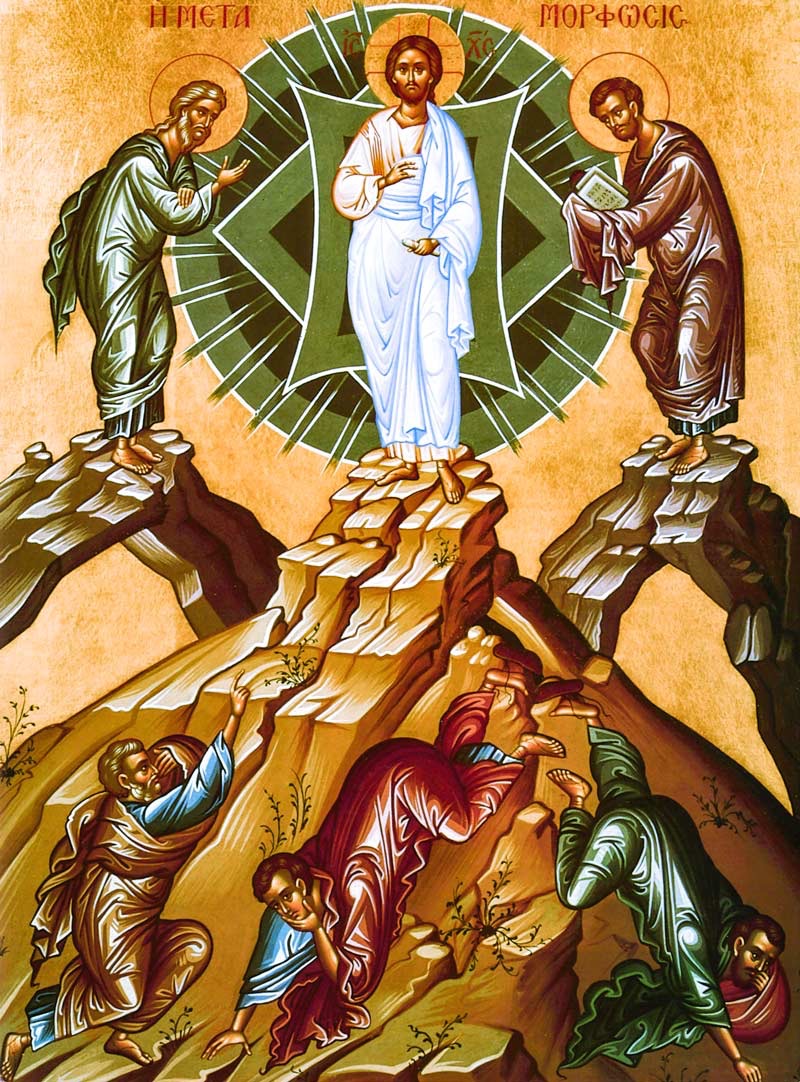
28Now about eight days after these sayings Jesus took with him Peter and John and James, and went up on the mountain to pray. 29And while he was praying, the appearance of his face changed, and his clothes became dazzling white. 30Suddenly they saw two men, Moses and Elijah, talking to him. 31They appeared in glory and were speaking of his departure, which he was about to accomplish at Jerusalem. 32Now Peter and his companions were weighed down with sleep; but since they had stayed awake, they saw his glory and the two men who stood with him. 33Just as they were leaving him, Peter said to Jesus, “Master, it is good for us to be here; let us make three dwellings, one for you, one for Moses, and one for Elijah” —not knowing what he said. 34While he was saying this, a cloud came and overshadowed them; and they were terrified as they entered the cloud. 35Then from the cloud came a voice that said, “This is my Son, my Chosen; listen to him!” 36When the voice had spoken, Jesus was found alone. And they kept silent and in those days told no one any of the things they had seen.
Today, we commemorate Transfiguration Sunday. This is the moment in the gospel narrative when God unmistakably reveals Jesus’ true identity—not just to Jesus, as at his baptism, but now to the disciples. In Luke 3:22, at Jesus’ baptism, God declared privately to him, “You are my beloved Son; with you, I am well pleased.” But here, on the mountaintop, God’s voice is heard by all present, marking a turning point: from this moment on, Jesus sets his face toward Jerusalem and his impending sacrifice. It literally goes all down hill from this point forward.
Our scene this morning is meant to conjure up echoes and flashbacks of key Old Testament moments. Moses met God on Mount Sinai in the burning bush. Elijah encountered God while hiding in a cave on top of Mount Horeb. Now, once again, the Almighty is revealed on the mountain top but not through a bush or a whirlwind but in Jesus. We read, “they appeared in glory” which is to say the radiance and purity of God’s character was on full display.
It’s tempting to follow in Peter’s steps and get caught up in this amazing spectacle. We can easily get wrapped up in the event and totally miss what the event is pointing to. The transfiguration is not just revealing Jesus’ true identity for revelation’s sake. Jesus’ Transfiguration is all about a declaration of a new world order. Did you notice what the three were talking about? They were talking about Jesus’ departure, or as it says in the original language, his exodus. And what happened during the Hebrew Exodus in our Old Testament? The people were liberated and moved from bondage to freedom! And this is exactly what Jesus was about to do on a cosmic scale!
Peter, though well-meaning, totally misunderstands. He sees Jesus on par with Moses and Elijah—great leaders of Israel’s past. But God corrects him: This is my Son, my Chosen; listen to him! Jesus is not just another prophet; he is the fulfillment of the Law and the Prophets. His mission is not to establish just another earthly kingdom but is leading humanity to a new life and freedom through his exodus!
Peter and the disciples are witnessing more than just Jesus’ transfiguration—they are being called to undergo their own. Their understanding of Messiah must be transformed. No longer are they to cling to the idea of a warrior king who will conquer Rome. Instead, they must embrace a Messiah who conquers sin, suffering, and injustice—not with a sword, but with grace, love, and self-sacrifice. Jesus’ earlier injunction that they must deny themselves, daily pick up their cross and follow him takes on greater import and meaning to them.
This transformation is neither quick nor easy. Franz Kafka’s novel The Metamorphosis provides an interesting parallel. The main character, Gregor Samsa, upon undergoing his shocking transformation, laments, “I cannot make you understand. I cannot make anyone understand what is happening inside me. I cannot even explain it to myself.” Change—true transformation—is difficult and often painful. For Peter and the disciples, understanding the Cross took time. They struggled, stumbled, and at times failed. But over time, they were transfigured from fearful, uncertain followers into bold witnesses who turned the world upside down for Christ leading others to freedom.
Jesus lived into his transfiguration. So did the disciples. And on this Transfiguration Sunday we are asked to do the same.
As we prepare to enter the season of Lent, we are invited into our own transformation to reflect God’s glory in our ordinary lives. This Wednesday, we will gather for Ash Wednesday, marking a time of confession, reflection, and renewal. This is the beginning of our forty-day journey—a journey of surrender, of allowing our old, limited understandings of Jesus, the Church, and discipleship to be burned away so that we might embrace the fullness of God’s calling.
The Transfiguration is not just about Jesus’ change—it is about ours. Just as Jesus’ identity was fully revealed, we are invited to discover our new identity as we follow in Jesus’ steps. We are invited to discover who we truly are in him. We are invited to ponder how we each reflect God’s glory where we live, work, and play. Just as the disciples were challenged to expand their understanding of what it means to live in God’s kingdom, we are called to let go of old assumptions and embrace the radical, transformative love of Christ.
Beloved, as we get ready to journey with Jesus to the Cross, may we step forward in faith with him. May we listen to Jesus on the way. And may we allow ourselves to be transfigured into the image of our Savior. What spiritual metamorphosis do you wish to see in yourself? Let’s think about these things. Amen.
© 2025 Patrick H. Wrisley, Pastor, First Presbyterian Church of Glens Falls, NY 12801. Sermon manuscripts are available for the edification of members and friends of First Presbyterian Church of Glens Falls, New York and shall not be altered, re-purposed, published or preached without permission. All rights reserved.


 patrick h wrisley