
A Sermon Delivered on August 11, 2024 by Patrick H. Wrisley, D.Min.
Today’s Story with the biblical giant Elijah is one all of us can relate with in our own lives. Let us review what is going on in Elijah’s life in the before chapter, 1 Kings 18, so we can better find with him.
In 1 Kings 18, God has dazzled the king and queen of the northern Kingdom of Israel Ahab and Jezebel with dramatic displays of divine power. Elijah has showed that their 450 prophets of Baal are charlatans, and he then kills those prophets by the sword. Queen Jezebel is none too pleased about this and places a fatwah of sorts on Elijah’s head. She has killed the Lord God’s prophets before, and she promises to take Elijah’s life as well. What is Elijah’s response?
Elijah turns tale and runs. He runs some 100 miles to the remote southern part of Judah and then he flees another 100 miles southwest towards Egypt! He is putting as much space between him and Jezebel as he can, and he ultimately winds up where God first began to define his relationship with the people of Israel. This is where we pick up in the Story.
1 Kings 19.1-14
19.1Ahab told Jezebel all that Elijah had done, and how he had killed all the prophets with the sword. 2Then Jezebel sent a messenger to Elijah, saying, “So may the gods do to me, and more also, if I do not make your life like the life of one of them by this time tomorrow.” 3Then he was afraid; he got up and fled for his life, and came to Beer-sheba, which belongs to Judah; he left his servant there. 4But he himself went a day’s journey into the wilderness and came and sat down under a solitary broom tree. He asked that he might die: “It is enough; now, O Lord, take away my life, for I am no better than my ancestors.” 5Then he lay down under the broom tree and fell asleep. Suddenly an angel touched him and said to him, “Get up and eat.” 6He looked, and there at his head was a cake baked on hot stones, and a jar of water. He ate and drank, and lay down again. 7The angel of the Lord came a second time, touched him, and said, “Get up and eat, otherwise the journey will be too much for you.” 8He got up, and ate and drank; then he went in the strength of that food forty days and forty nights to Horeb the mount of God.
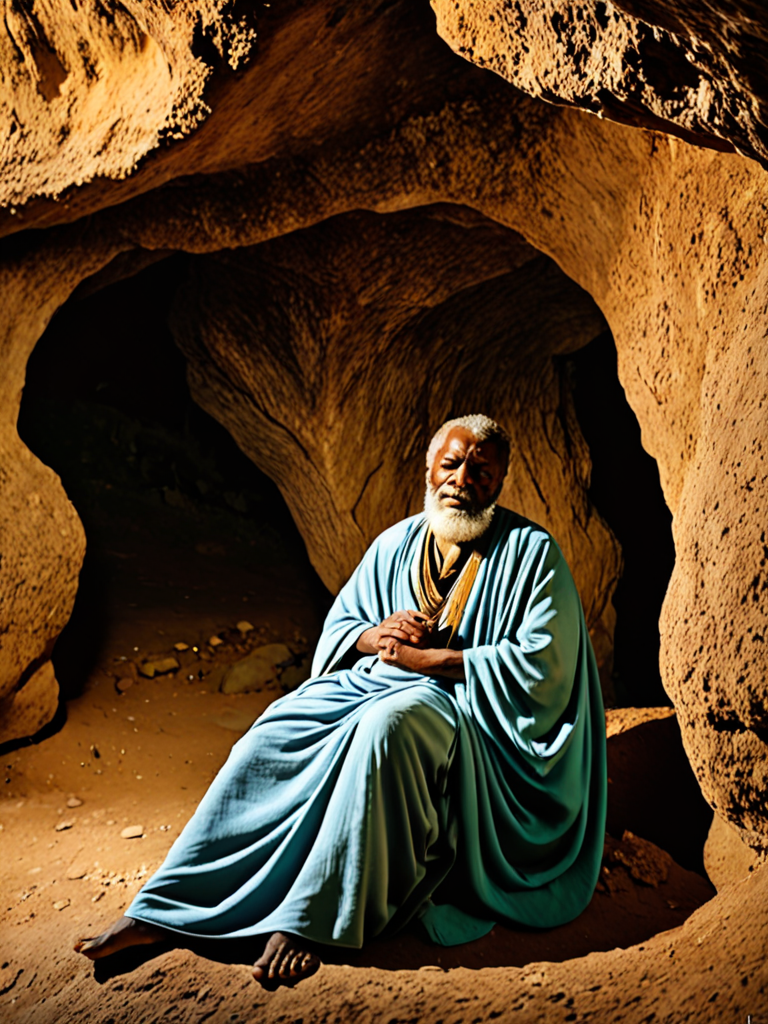
9At that place he came to a cave, and spent the night there. Then the word of the Lord came to him, saying, “What are you doing here, Elijah?”10He answered, “I have been very zealous for the Lord, the God of hosts; for the Israelites have forsaken your covenant, thrown down your altars, and killed your prophets with the sword. I alone am left, and they are seeking my life, to take it away.” 11He said, “Go out and stand on the mountain before the Lord, for the Lord is about to pass by.” Now there was a great wind, so strong that it was splitting mountains and breaking rocks in pieces before the Lord, but the Lord was not in the wind; and after the wind an earthquake, but the Lord was not in the earthquake;12and after the earthquake a fire, but the Lord was not in the fire; and after the fire a sound of sheer silence. 13When Elijah heard it, he wrapped his face in his mantle and went out and stood at the entrance of the cave. Then there came a voice to him that said, “What are you doing here, Elijah?” 14He answered, “I have been very zealous for the Lord, the God of hosts; for the Israelites have forsaken your covenant, thrown down your altars, and killed your prophets with the sword. I alone am left, and they are seeking my life, to take it away.” [i]
What strikes me about this Story is that the Prophet Elijah, who is usually spot-on with next God’s lead and direction, has totally gone off script. The one time when he should be inquiring of God as what to do next in his life, he instead charts his own path, and zig zags his way to a place where he can be alone.
Elijah is overwhelmed with all the events of his life. He is filled with both fear and amnesia. Fear in that life events are too big for him and are out of control; his world seems as though it was crumbling down all around him. His all-encompassing fear and fatigue causes Elijah to act in ways he normally would not have acted. His fear bred within him a sense of amnesia.
His fear made him forget to stop and first listen to God for direction.
His fear made him forget that not once has God let him down.
His fear made him to forget that God has performed dramatic events of divine power and has listened to Elijah’s prayers.
His fear made him forget that he, in fact, was not the last prophet of the Lord God left; he knew there were hundreds of others.
His fear turned his once normally indefatigable lion-hearted spirit into a shattered shell of a man who became enveloped in hopelessness.
Has that ever happened to you? Have life events so swallowed you up that their waves come one after the other beating on you and in their battering, you forget that you know how to swim? This is where Elijah is.
Look with me at verse 9 in our text. We read, “At that place he came to a cave, and spent the night there.” Another rendering of this verse is, “At that place, he entered into a depression and spent the night there.” Considering all that is going on in Elijah’s life, considering how a bounty has been placed on his head, considering his spiritual amnesia, there is a wonderful play on words in our Story. Elijah was literally in a depression.
Friends, we live in swirly time. Many of us know or personally suffer from some sort of depression or feeling overwhelmed by life. Did you know that 32% of young people between the ages of 13 and 18 in our country suffer from sort of anxiety disorder?[2] The National Institute of Mental Health notes, “An estimated 22.1 percent of Americans ages 18 and older—about 1 in 5 adults—suffer from a diagnosable mental disorder in a given year.”[3] Over 52% of those who suffer from depression do not get medical help for their illness.[4]
When a person is in a depression, they easily fall into a state of amnesia; in other words, they forget the way a normal life feels and really is.
When a person is in a depression, overwhelmed with life, they forget to pause and listen for God’s direction and solace.
When a person is in a depression, they forget that in honest hindsight, God has never let them down before so why would God forget them at this point?
When a person is in a depression, they tragically feel this sense of being the only one who really understands the pain they are feeling; though they are surrounded by other people who care, their depression prevents them from seeing those who are ready and willing to help.
So, what exactly does God do with Elijah as he is stuck in his depression? God does three things. The first thing we note is God goes and meets Elijah where he is. Even into depression’s deep recesses, God can speak with clarity. God can penetrate the cave’s depths with God’s very Word. I love what the great philosopher, Soren Kierkegaard wrote where he says, “When human knowledge can’t see a hands-breadth before it in the dark night of suffering, then faith can see God, for faith sees best in the dark.”[5]
The second thing that we note is how God patiently meets Elijah in the depression itself. Does God lay into Elijah for not praying for direction or help during his plight? Does God tell him, “You don’t have it that bad; there are people worse off than you!”? Does God tell him, “Suck it up and pull yourself up by the bootstraps”? Absolutely not. God simply asks, “Elijah, what are you doing here? Go stand outside the depression as I will come by you.”
What follows are all these dramatic displays of divine power from greats winds, earthquakes, and fire. No amount of divine fireworks would pull Elijah out from his depression. But then, God becomes silent – or as one person described, “grindingly silent.” This piercing silence calls out to Elijah, and I wonder what he is thinking.
“Is God gone?”
“Why isn’t God trying to get my attention?”
“Has God abandoned me?”
These are common feelings for those who are overwhelmed with the pressures of life. I wonder what drew Elijah out of the depression. Was he at all curious to know if God was still there? We just do not know.
This leads us to the third thing God did and that was to give Elijah something to do. God did not give up on him even though Elijah had given up on himself. God knew that Elijah’s gifts and graces were not being put to work while he was stuck the depression, that cave, that he was huddling inside. Elijah seems quite content to stay in the depression he was in, but God needed to lure him out.
This is a common behavior for those who feel overwhelmed with all that life is throwing at them. They want to hunker down into the cave even further away from anyone or anything. You see, people overwhelmed by life or in a depression really do not have the energy or want to do anything; it is simply too hard to muster the energy. The Lord God wants Elijah to do the very thing Elijah is afraid of and that is re-engaging life. God is asking him to do the counterintuitive response to crawl outside the cave and get back into life with all its winds, earthquakes, and fires. God is calling Elijah back out into life and purpose. Once again, God simply asks Elijah, “Elijah, what are you doing here?” Once again, Elijah goes through his list of woes, but God knows the path back to fullness and life for Elijah is to get out of the cave and back down the mountain. God tells him, “Elijah, I hear you. Trust me. But you see, there is life to be lived and the only way you are going to overcome the overwhelming events you are feeling is to honestly acknowledge them and lean into them. I am with you. I need you to You have to get back to work; it will be good for you, I promise. Now, backtrack your route and be the Prophet you are wired up to be. Go and anoint Hazael as King over Aram.” God knew that to break out of that depression, Elijah needed to be about something useful.
So, what has this to do with you and me? It affirms that even those loved, called, and cared for by God will at times become overwhelmed with the pressures of life and that sometimes those pressures will drive us into a depression of immobility.
It affirms that when we meet those who are in those depressions in life, we, like God, are to refrain from offering helpful advice and comments like, “You don’t have it so bad.” “There are a lot of people worse off than you.” “Suck it up and pull up your bootstraps.” No, that type of advice simply drives people further into the cave, the depression.
Instead, it affirms that when we meet people overwhelmed by life because of illness, broken relationships, rut-like jobs, or mental illness – we are most caring when we, like God, are silent with them. We are to be a quiet, loving presence that patiently waits lets others come out of the cave when they feel safe to do so.
Finally, like God, when people do come out of their cave and depression, we are to meet them with a simple question and not overload them with advice. God asked Elijah, “Eli, what are you doing here?” We are simply to ask, “Sister, brother, how are you doing? Remember, you are not alone.”
It is a great comfort to know that a spiritual giant like Elijah felt overwhelmed by life just like we do at times. It is also a blessing to remember that God followed him there and never let him alone.
© August 11, 2024 Patrick H. Wrisley. Sermon manuscripts are available for the edification of members and friends of First Presbyterian Church, DeLand, Florida and not be altered, re-purposed, published or preached without permission. All rights reserved.
[1] New Revised Standard Version (NRSV). New Revised Standard Version Bible, copyright © 1989 the Division of Christian Education of the National Council of the Churches of Christ in the United States of America. Used by permission. All rights reserved.
[2] See https://adaa.org/understanding-anxiety/facts-statistics. Accessed August 8, 2024.
[3] The National Alliance on Mental Health at https://www.nami.org/About-Mental-Illness/Mental-Health-By-the-Numbers/. Accessed on August 6, 2024.
[4] Ibid.
[5] As quoted in Estelle Frankel’s, The Wisdom of Not Knowing. Discovering a Life of Wonder by Embracing Uncertainty (Boulder: Shambhala, 2017), 55.


 patrick h wrisley