
A sermon delivered on March 17, 2024, the Fifth Sunday of Lent, Year B
We have transported ahead in John’s Story to chapter 12. Jesus has come to the Passover festival and the Pharisees, the local religious leaders, see Jesus as a threat and are grousing, “Look, the world has gone after him.” This is right where we pick up in the Story. Listen to the Word of the Lord.
John 12:20-33
20Now among those who went up to worship at the festival were some Greeks. 21They came to Philip, who was from Bethsaida in Galilee, and said to him, “Sir, we wish to see Jesus.” 22Philip went and told Andrew; then Andrew and Philip went and told Jesus. 23Jesus answered them, “The hour has come for the Son of Man to be glorified. 24Very truly, I tell you, unless a grain of wheat falls into the earth and dies, it remains just a single grain; but if it dies, it bears much fruit. 25Those who love their life lose it, and those who hate their life in this world will keep it for eternal life. 26Whoever serves me must follow me, and where I am, there will my servant be also. Whoever serves me, the Father will honor.
27“Now my soul is troubled. And what should I say—‘Father, save me from this hour’? No, it is for this reason that I have come to this hour. 28Father, glorify your name.” Then a voice came from heaven, “I have glorified it, and I will glorify it again.” 29The crowd standing there heard it and said that it was thunder. Others said, “An angel has spoken to him.” 30Jesus answered, “This voice has come for your sake, not for mine. 31Now is the judgment of this world; now the ruler of this world will be driven out. 32And I, when I am lifted up from the earth, will draw all people to myself.” 33He said this to indicate the kind of death he was to die.[1]
So, where do we place ourselves in today’s Story? We are the Greeks. The Greeks represent everyone who is not a Jew but are still looking for the Messiah as well. Their request was a simple one; they told Philip, “Sir, we wish to see Jesus.” Why they wanted to see Jesus is never really discovered nor is it revealed if they even got to see him. You see, John uses the characters of the Greeks in his Story to push us deeper into the narrative; John uses them as literary foils.
Jesus, it seems, as with most people of notoriety, was surrounded by an entourage of sorts. This group develops layers around the special person and in their minds, they are protecting the VIP from unnecessary badgering from people they do not know. You know, the hoi polloi like you and me This is the vibe I am feeling from reading the Story. Philip is out on the outer edges and gets stopped by the Greeks. He then goes a little bit deeper into the circle of influence gets Andrew and discusses the Greeks’ request. Then, both of them go and find Jesus and share the Greeks’ request. The text never says whether the Greeks saw Jesus or not, but it does go on to outline Jesus’ response to them.
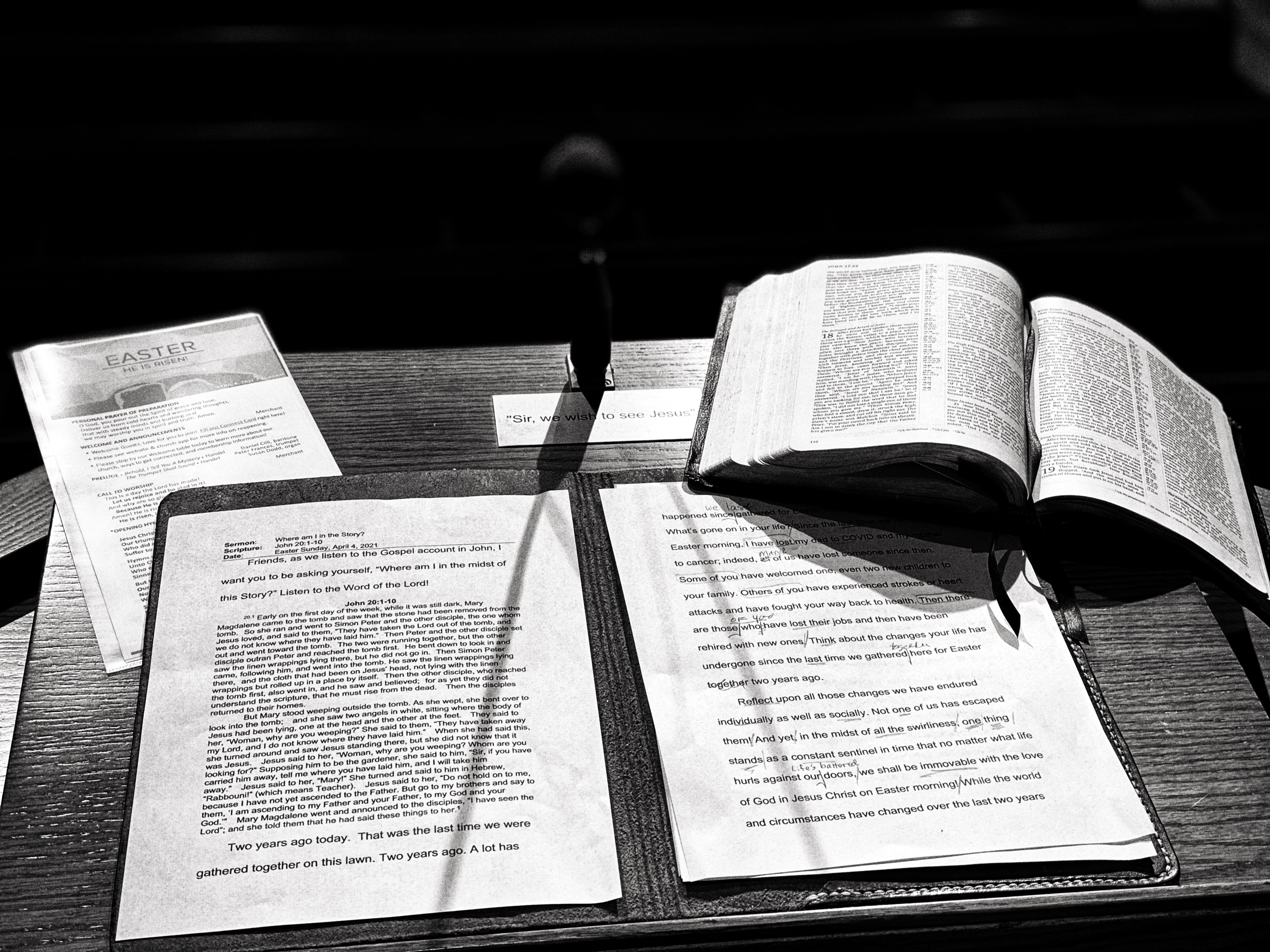
I’ve always been puzzled by this text. As a preacher who has been in a lot of pulpits over the years, it is not uncommon to be sitting in the preacher’s chair behind the pulpit and see a little plaque stuck on the back of the pulpit that says, “Sir, we wish to see Jesus.” I’ve always wondered why that was there. Why is that a message directed to me, the preacher? For so long I thought, “Well duh, I’m supposed to tell them about Jesus!” but I never made the connection between the Greeks’ question and Jesus’ reply.
“Patrick, we wish to see Jesus.” Well of course you would, who wouldn’t! And after all those years is puzzling over this apparent non-sequitur, it finally hit me what this text is all about. These words are written on the backside of pulpits to remind us, Preachers, that it’s easy to tell people about Jesus; it’s entirely something different to help people understand and count the cost of what it takes to do so. As I have said, we never learn if Jesus saw the Greeks or not; all we know is the response Jesus gave to the disciples articulated what is required of the Greeks, or anyone else for that matter, to see him.
Sir, we wish to see Jesus. The Lord answers, “I tell you, unless a grain of wheat falls into the earth and dies, it remains a single grain; but if it dies, it bears much fruit.”
Sir, we wish to see Jesus. The Lord answers, “Those who love their life lose it, and those who hate their life in this world will keep it for eternal life.”
Sir, we wish to see Jesus. The Lord answers, “Whoever serves me must follow me, and where I am, there will my servant be also. Whoever serves me, the Father will honor.”
This morning, our biblical Story is outlining the cost of what it means to follow Jesus and call ourselves “a disciple.” Jesus is giving us a lesson on the price we are to pay to call ourselves, “Christian.” Jesus is telling Andrew and Philip that the price of admission to seeing and experiencing Jesus is that we will need to die to ourselves and to the world’s expectations and values. When we come and see Jesus, we are called to empty ourselves to be filled with God. In other words, beloved, the way down is the way up.
Priest/author/mystic Richard Rohr writes, “The soul has many secrets. They are only revealed to those who want them and are never completely forced upon us. One of the best-kept secrets, and yet hidden in plain sight, is that the way up is the way down. Or, if you prefer, the way down is the way up.”[2] The way down is where we join Jesus in the pains of this world. The way down is where we see how broken our value system is. The way down is when we finally realize we are making a pluperfect mess of God’s creation. The way down is when we recognize how we politically and economically justify injustice to the least of these in our world. Friends, it is only when we realize how bereft we are on the way down that we can be lifted back up to fully see and experience Jesus in his Easter radiance. But it takes sacrifice.
We must die to ourselves to sprout new life.
We must give up our life and identity to find a new identity in the family of God.
We must serve, not ourselves, but Jesus, and follow him wherever he goes. In other words, my beloved…
We have to go through the pain of Good Friday before we can rise up in Easter life and joy!
We have to hit rock bottom with our use of drink and drugs before we can climb back out to healthy sobriety.
We have to go down on our knees to clean the latrines before we can rise up and lead a regiment.
We have to be stripped of pride before we can put on true honor.
A cook has to make a lot of glop before they can become a Master Chef.
The caterpillar has to die in order to come back to life as a butterfly!
The bread has to be broken before it can be given and shared with others.
So, you and I want to see Jesus? Have we calculated all that it takes to do so? Next week is Palm Sunday, beloved. Passion Week is following on its heels and it’s an invitation for us to go down and embrace the pain and sacrifice Jesus embraced. We still have a lot to pray and think about before Easter comes; namely, are we able to do it? In the Name of the One who is, was, and is yet to come. Amen.
© 2024 Patrick H. Wrisley. Sermon manuscripts are available for the edification of members and friends of the First Presbyterian Church of Glens Falls, 8 West Notre Dame Street, Glens Falls, New York 12801 and may not be altered, re-purposed, published, or preached without permission. All rights reserved.
[1] The New Revised Standard Version, 1989, from the World Council of Churches.
[2] Richard Rohr, Falling Upward. A Spirituality for the Two Halves of Life (San Francisco: Jossey-Bass, 2011), xviii.


 patrick h wrisley